
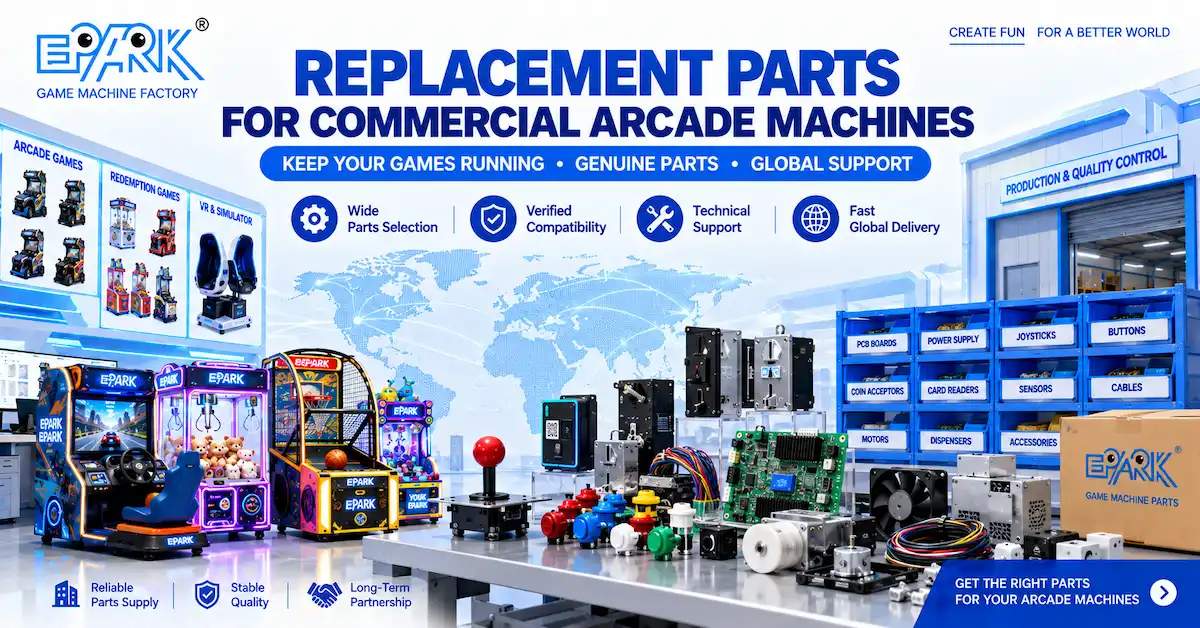
Start with the Installed Machine, Not a Product Photo
When ordering replacement parts for commercial arcade machines, identify the machine model, serial number or order reference, installed part number, and reported fault before comparing prices. Then request confirmation of the approved replacement, any configuration requirements, and current availability. EPARK’s installation and after-sales process includes online video assistance and spare-parts supply, making technical identification a practical starting point for an EPARK equipment inquiry. For machines purchased elsewhere, request a compatibility review rather than assuming that similar-looking components are interchangeable. The purchasing goal is a verified replacement for a known machine—not simply a component with a matching appearance.
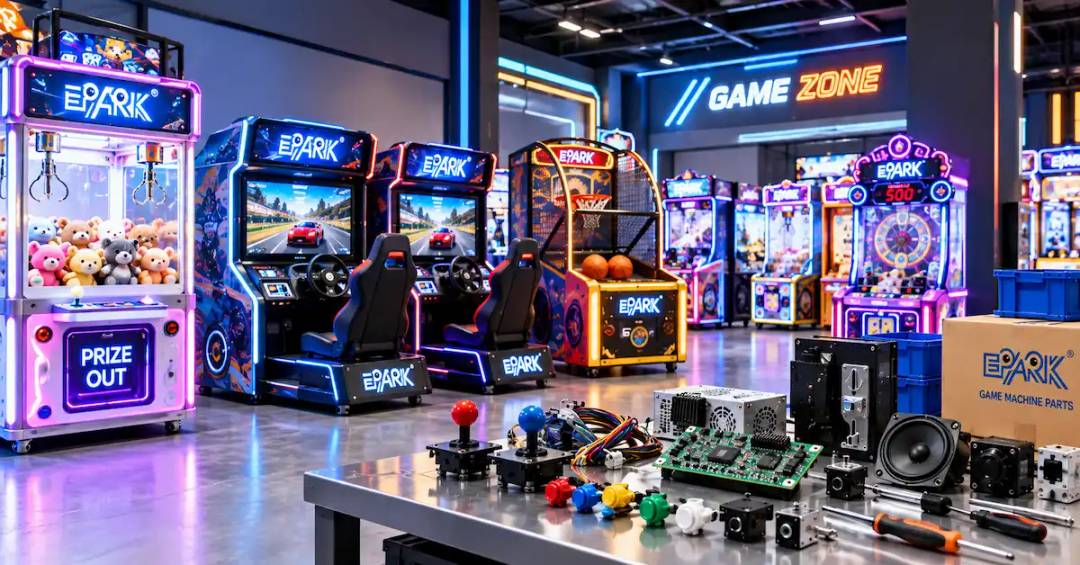
Separate an Urgent Repair from a Spare-Stock Purchase
An urgent repair and a preventive stock order need different decisions. For one machine already out of service, prioritize fault identification, part matching, and the complete route to restoration. For a new family entertainment center, build a spare-parts schedule around the approved equipment list and available technicians. For distributors, connect every stocked component to the customer machines it supports. Arcade chains should record compatibility across locations before pooling inventory. A hotel game room or small mall arcade without technical staff should also confirm who will install and test the replacement. This guide focuses on commercial equipment procurement, not unrestricted modification or repairs that bypass the manufacturer’s service instructions.
Match Spare-Part Categories to Your Equipment Mix
Claw Machines, Payment Devices, and General Controls
EPARK’s spare-parts planning guide identifies buttons, joysticks, coin acceptors, readers, sensors, motors, power supplies, control boards, wiring, and other service components as categories to review. Treat these as discussion points rather than a universal shopping list. For a claw-machine order, request the exact references for the fitted controls, payment hardware, and any serviceable grab or movement assemblies. Keep mechanical parts, electronic modules, and consumables separately identified. A replacement request should specify whether you need an individual component, an assembled mechanism, or a complete service kit with the associated mounting hardware.
Ticket Redemption Machines
For paper-ticket equipment, review the dispenser, its connections, mounting arrangement, and ticket-detection setup together. EPARK’s ticket redemption equipment guide recommends confirming whether the dispenser can be replaced separately and how ticket output is detected. For your machine, request a matching replacement reference and the approved checks after installation. Digital-point equipment requires a different discussion: identify the reader, interface, and account system rather than ordering a paper-ticket component. In either case, include payment, gameplay, scoring, and reward delivery in the acceptance check instead of confirming only that the replacement powers on.
Racing, Shooting, Sports, and Simulator Equipment
For racing equipment, EPARK discusses steering wheels, pedals, mainboards, power supplies, displays, wiring, buttons, and lighting within its racing arcade procurement guide. Build the service list for the actual configuration: a standard cabinet and a machine with motion or feedback features should not automatically receive the same spare kit. Apply the same model-specific approach to shooting controls, basketball scoring components, and simulator accessories. Ask whether the supplier recommends replacing a small component or its complete assembly, and confirm any calibration, software setup, or specialist service required afterward.
Describe the Fault Before Choosing the Replacement
Avoid turning a symptom into an unverified parts order. Instead of requesting “a new board because tickets are not coming out,” describe whether the game starts, whether scoring works, what appears on the display, and when the problem occurs. EPARK’s after-sales support guide recommends supplying the model, order reference, component photographs, fault video, error codes where available, and recent settings or wiring changes. Add the result of any checks already authorized by the support team. Keep one service record for the issue so that purchasing staff, local technicians, and the supplier are working from the same information. Confirm the suspected component before approving a replacement order.
Specifications to Confirm for Replacement Parts for Commercial Arcade Machines
Use the following worksheet to request a component-specific confirmation. It is a purchasing checklist, not an EPARK catalog of verified part numbers or electrical ratings; those values must come from the installed equipment records and the proposed replacement documentation.
| Verification Item | Information to Obtain | What the Supplier Should Confirm |
|---|---|---|
| Machine identity | Model, serial number, order reference, and configuration | The replacement applies to this machine |
| Original component | Manufacturer label, part number, revision, and clear photographs | Exact replacement or documented successor |
| Mechanical fit | Dimensions, fixing positions, shaft or actuator details, and access requirements | Installation without unapproved modifications |
| Electrical requirements | Component supply type, voltage, current requirements, and applicable ratings | Compatibility with the machine’s relevant circuit |
| Connections | Connector reference, pin assignments, cable arrangement, and polarity where applicable | Correct connection—not merely a similar plug shape |
| Software and settings | Board revision, firmware, configuration, and required setup | What must be supplied, transferred, or configured |
| Payment or reward interface | System provider, reader or dispenser model, and interface details | Compatibility with the complete operating system |
| Materials and construction | Applicable material, panel thickness, mounting hardware, or mechanical specification | Suitability of the proposed construction |
| Documentation | Installation instructions, applicable technical records, and test requirements | How the replacement will be installed and accepted |
| Commercial status | Condition, quantity, availability, warranty, and return terms | Exactly what the quotation covers |
Keep Machine Ratings and Component Ratings Separate
Record the complete machine’s electrical information separately from the requirements of the component being replaced. For a power supply, request both its input and output specifications; for a control board, request the revision and configuration; for a reader, identify the payment platform and interface. These are different approval questions. As a hypothetical example, two board photographs may appear identical while their labels show different revisions. The appropriate purchasing action is to obtain written compatibility confirmation, including any setup changes—not to decide from the photograph alone.
Compare Replacement Options After Compatibility Is Established
When comparing replacement parts for commercial arcade machines, distinguish an exact replacement from a successor part, an approved alternative, and a repaired or exchange unit. The table below compares purchasing routes rather than unverified models or prices. Obtain an order-specific quotation and approval for whichever route is proposed.
| Replacement Route | Evidence to Request | When to Consider It | Additional Costs or Conditions to Check |
|---|---|---|---|
| Same part number and revision | Confirmation against the installed machine and configuration | A direct replacement is available | Configuration, included accessories, and installation support |
| Documented successor part | Written mapping from the old reference to the new one | The original part has been replaced by a newer version | Adapters, firmware changes, setup, and revised instructions |
| Approved third-party equivalent | Documented mechanical, electrical, functional, and software review | An alternative has been technically approved | Validation, integration work, and warranty responsibility |
| Refurbished or exchange assembly | Declared condition, repair scope, test results, and warranty | A supported repair or exchange program is available | Return shipping, core-return requirements, deposits, and exclusions |
An “OEM” description should not replace machine-level verification. Equally, do not reject or accept an alternative solely because it comes from another manufacturer. Ask the responsible technical team to approve the exact item and document any differences. For safety-related or motion-system components, leave substitution decisions to appropriately qualified personnel.
Check Materials, Workmanship, and Functional Acceptance
Define inspection requirements around the part’s function. For a wiring assembly, request the correct connector references, cable identification, and assembly documentation. For a mechanical module, confirm dimensions, mounting hardware, and the required movement or alignment checks. For a replacement panel, specify the approved material, thickness, fixing arrangement, and edge treatment rather than accepting a cosmetic match. EPARK’s manufacturing process describes wiring, PCB installation, control integration, and complete-machine functional testing; ask which inspections apply specifically to your replacement order. Do not assume that a spare component receives every test described for a complete machine. Where relevant, request applicable component documentation and technical approval of the replacement configuration.
Build Spare Stock Around Service Impact, Not Equal Quantities
Plan replacement parts for commercial arcade machines according to your installed equipment, recorded usage, replenishment time, and local repair capability. Start by distinguishing parts whose absence prevents operation from cosmetic items that can be scheduled separately. Then identify which approved components are genuinely shared across several machines. Avoid purchasing one of everything simply because it appears on a parts list. As an illustrative planning example—not EPARK consumption or delivery data—assume a venue uses two identical approved switches per month, allows one month for replenishment, and chooses a buffer of two switches. A starting reorder trigger would be four units: two for expected demand plus two buffer units. Monitor usable stock plus confirmed incoming stock minus quantities already allocated to repairs. Revise the trigger when actual consumption or lead times change, and obtain storage instructions for the components purchased.
Ask About Dispatch Readiness and Discontinued Parts
For replacement parts, clarify whether the quoted item is available, requires assembly or programming, or needs further compatibility approval. Ask for the expected dispatch date separately from carrier transit and destination processing. EPARK lists emergency parts supply within its technical service offering, but that general service description does not establish live stock or a delivery commitment for a particular component. For older equipment, request the current replacement reference, any documented successor, and the support route when the original is unavailable. For repeat orders, agree how component changes will be communicated and recorded. Do not treat complete-machine production lead times as replacement-part dispatch times.
Compare the Total Repair Cost and Written Warranty Terms
A quotation for replacement parts for commercial arcade machines should identify more than the unit price. Review freight, configuration work, local installation, testing, any return shipment, and charges associated with an exchange arrangement. Compare an individual component with a complete assembly where both are approved options, taking account of the work your technician can perform. For a warranty claim, confirm coverage, required evidence, authorization, shipping responsibility, and whether the failed item must be returned. EPARK’s warranty guidance also recommends clarifying consumables, customized components, and local labor. Keep a purchase request separate from a warranty claim until the supplier confirms how the case will be handled; spare-parts availability does not automatically mean a free replacement.
Keep OEM and Private-Label Parts Traceable
For customized machines, retain both your internal product code and the supplier’s machine and component references. Request a revision-controlled component list for service-critical items, then record approved substitutions and the machines affected. For branded panels or decorative assemblies, preserve the approved artwork version alongside the physical specifications. EPARK’s custom game-machine design guidance highlights service access, component availability, and replaceable modules as design considerations. Use the same priorities when placing repeat orders. A familiar cabinet graphic should not be your only identifier when requesting parts for a private-label machine; provide the order and configuration records that connect it to the equipment actually supplied.
Agree on Installation and Return-to-Service Checks
Before the replacement arrives, identify who is qualified to install it and what instructions are required. Follow the manufacturer’s isolation and stored-energy precautions, and do not bypass guards or protective functions to keep a game operating. Confirm whether the replacement requires settings, calibration, payment-system activation, or other technical assistance. EPARK’s technical support FAQ describes remote guidance, setup manuals, and operation guides; establish the assistance appropriate to the specific repair. After installation, record the replacement reference and test the affected functions together with the normal game sequence. For payment or redemption work, include credit recognition and reward delivery where applicable. Reopen the machine only after the responsible technician completes the required checks.
Send EPARK a Model-Matched Parts Inquiry
For an inquiry about replacement parts for commercial arcade machines, provide the machine model, serial number or order reference, original part label, photographs, fault description, quantity, destination, and required timing. State whether the request concerns an immediate repair, a planned spare kit, distributor inventory, or a possible warranty claim. For a larger inventory request, include the installed machine quantities and existing stock rather than only a general list of part categories. Request a response identifying the proposed replacement, compatible machines, condition, included accessories, setup requirements, dispatch availability, and commercial terms. Use the EPARK contact page to submit these details and request confirmation before issuing the purchase order.
Frequently Asked Questions
1. Where Should I Start When Buying Commercial Arcade Replacement Parts?
Start with the original equipment supplier and the installed machine’s records. Request identification and compatibility confirmation before comparing purchasing alternatives. For an EPARK machine, include its model and order reference so the inquiry can be reviewed against the relevant equipment.
2. What Can I Do When the Original Part Number Is Unreadable?
Provide the machine identity, a clear overall photograph, close-ups of the component, visible markings, and its location in the machine. Have a technician supply any additional measurements or connection details requested by the supplier. Do not invent a reference from appearance.
3. Can Two Machines with the Same Cabinet Use Different Parts?
Do not assume a shared cabinet design establishes compatibility. Compare the model, production or order reference, installed component, and configuration. Ask the supplier to identify the supported machine range for the proposed replacement before treating it as shared inventory.
4. Does a Replacement Control Board Arrive Ready to Install?
Confirm this before ordering. Ask whether the board includes the required firmware and machine configuration, whether settings must be transferred, and whether calibration is necessary. Include any required software authorization or setup assistance in the quotation.
5. Can I Replace a Card Reader with Any Similar Reader?
Request compatibility approval from the machine supplier and the payment-system provider. Confirm the hardware interface, configuration, account requirements, and acceptance test. Include a complete payment-to-game transaction rather than checking only whether the reader displays a startup screen.
6. Are Replacement Parts Included in the Machine Warranty?
Obtain the written terms for the specific machine and component. Confirm whether the reported failure is covered, what evidence is required, and who pays for shipping and installation. Keep consumable purchases, accidental-damage repairs, and approved warranty replacements separately documented.
7. Should I Order Spare Parts with New Arcade Machines?
Request a recommended package based on the confirmed equipment list, local technical resources, and stocking priorities. Identify included and separately charged items, label each part, and confirm where it will be packed. Do not hold up an urgent repair merely to combine shipments.
8. How Many Spare Parts Should an FEC Keep?
There is no single quantity suitable for every FEC. Use the number of compatible machines, maintenance records, replenishment time, service impact, and storage requirements. Review stock after actual operating experience rather than keeping the initial package unchanged indefinitely.
9. How Quickly Can Replacement Parts Be Delivered?
Request an item-specific dispatch estimate and a separate transport estimate. Confirm whether identification, programming, testing, payment, or return authorization must be completed first. A general statement about technical support is not a confirmed delivery date.
10. What Happens When a Part Is Discontinued?
Ask for a documented successor, an approved alternative, or a supported repair or exchange option. Confirm any effect on configuration, installation, warranty, and service documentation. Do not assume an older machine can accept a current component without technical review.
Conclusion
The right replacement parts for commercial arcade machines connect a verified component to a known machine, a clear installation process, and practical long-term support. For FEC operators and distributors, purchasing decisions should address compatibility, stock priorities, dispatch readiness, and total repair cost together. Keep model and revision records, document approved substitutions, and build inventory around the equipment you actually operate. Contact EPARK with your machine and component details to discuss replacement identification, spare-stock requirements, and the technical support needed for your order.
Disclaimer
The information provided on this website is for general informational purposes only.
While EPARK Arcade Game Machine Manufacturer strives to ensure accuracy and reliability, no warranties—express or implied—are made regarding completeness, performance, or applicability.
Product specifications, designs, and features may vary depending on usage, customization, and customer requirements.
Buyers are responsible for verifying all technical details, compliance certifications, and suitability before procurement.
EPARK shall not be held liable for any direct, indirect, incidental, or consequential damages arising from the use of this website or its content, including but not limited to business losses, data errors, or equipment misuse.
For tailored solutions or further verification, please visit our Contact Us
Intellectual Property Notice
All articles, product images, videos, catalogs, software, and related materials published on this website are the intellectual property of EPARK, unless otherwise stated.
Unauthorized reproduction, distribution, modification, or commercial use of any content is strictly prohibited without prior written consent from EPARK.
EPARK reserves the right to take legal action against any unauthorized use, including but not limited to copyright infringement, misrepresentation, or unfair competition.
Trademarks
The name EPARK, the EPARK logo, and all related brand elements displayed on this website are registered trademarks or trade names of Guangzhou EPARK Electronic Technology Co., Ltd.
Other product names, company names, or logos mentioned on this site may be trademarks of their respective owners.
Unauthorized use of EPARK's trademarks for commercial purposes, including advertising, promotions, or product packaging, is strictly prohibited.
Governing Law
These terms are governed by the laws of the People's Republic of China.