

What Should an Arcade Machine Export Documentation Supplier Actually Do?
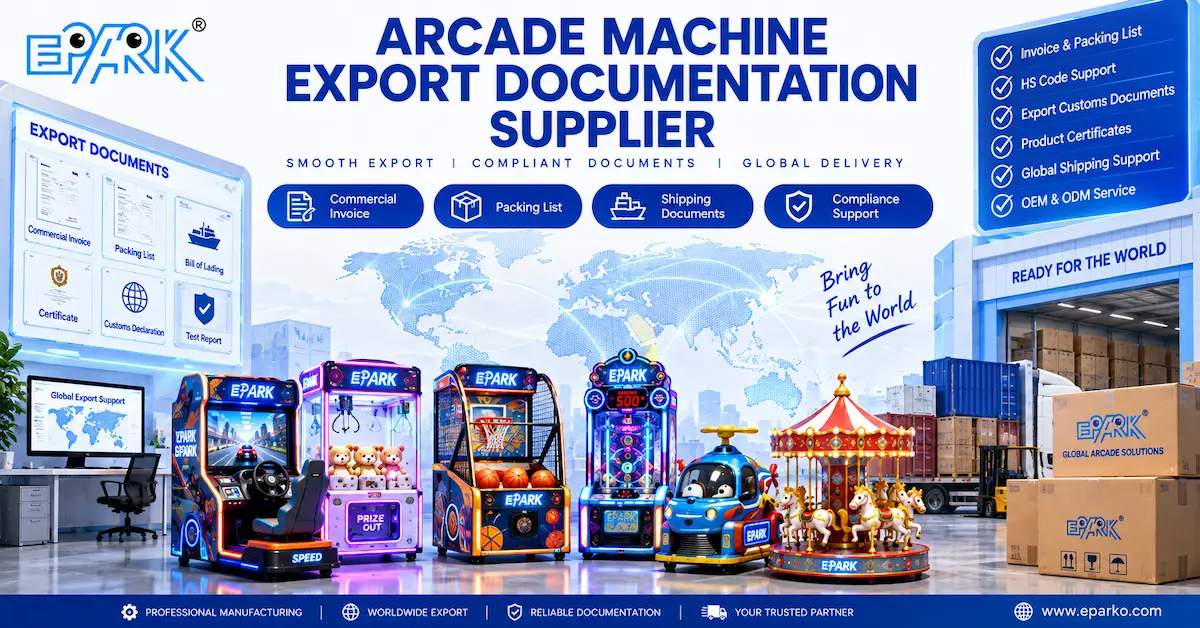
An arcade machine export documentation supplier should connect the commercial order, manufactured equipment, packing information, and shipment records into one consistent document package. Overseas buyers should not evaluate document support only by asking whether the supplier can provide a commercial invoice or packing list. The more important question is whether the model names, quantities, package counts, weights, values, buyer and consignee information, customization details, and shipment references remain consistent from purchase confirmation through customs clearance and destination receiving. EPARK provides commercial arcade equipment for international projects and combines equipment supply with project and logistics support through its arcade machine service system. For each shipment, however, buyers should confirm the exact documents EPARK will prepare, the records supplied by the freight forwarder or carrier, and the documents that remain the responsibility of the importer or customs broker.

Who Needs a Structured Export Documentation Process?
Distributors importing several arcade machine categories, FEC investors purchasing a complete venue package, arcade chains buying for multiple locations, entertainment-equipment importers, and private-label brands all need stronger document control than a buyer purchasing one simple domestic shipment. A distributor may need individual models and carton references to match customer orders after arrival; a new FEC may receive racing machines, claw machines, basketball games, redemption equipment, and VR products in the same container; a private-label buyer may need commercial documents to use one product code while technical records retain the manufacturer's underlying model reference. Buyers can review EPARK's commercial arcade equipment range first, then create the document requirement around the final equipment list. This process is less useful when the buyer has not yet confirmed the destination, purchasing entity, consignee, machine models, quantities, or shipping arrangement, because those unresolved details directly affect the final documentation.
Build an Export Document Matrix Before Production Is Completed
A professional arcade machine export documentation supplier should encourage the buyer to define the required document package before the goods are ready for shipment. The exact documents depend on the destination country, cargo, contractual terms, carrier, payment arrangement, local customs requirements, and whether specialized product documentation is requested. The table below is therefore a procurement-control framework rather than a statement that every EPARK shipment automatically includes every document listed.
| Document / Record | Typical Purpose | Information to Verify | Responsibility to Confirm |
|---|---|---|---|
| Commercial invoice | Commercial value and shipment description | Seller, buyer, goods, quantity, currency,values and agreed trade information | Usually seller/exporter prepares; buyer should approve critical details |
| Packing list | Describes physical packages | Model, quantity, packages, dimensions, net/gross weight and marks | Supplier should base it on final packing |
| Sales contract / order confirmation | Commercial reference | Models, configuration, quantity, price and responsibilities | Buyer and supplier |
| Shipping marks | Package identification | Order, model, package number,destination or consignee reference | Supplier according to agreed format |
| Loading record | Evidence of container loading | Container reference, package allocation, loading photos and seal information where applicable | Supplier / loading party / forwarder as agreed |
| Transport document | Carrier's record of carriage | Shipper, consignee, ports,cargo description and package data | Carrier or freight forwarder normally issues |
| Origin-related document | May be needed for customs or trade purposes | Exporter/product information and applicable origin data | Confirm issuer and destination requirements |
| Product documentation | Supports installation, technical review or market requirements | Exact model/version and scope | Manufacturer/supplier as applicable |
| Inspection / test record | Supports pre-shipment acceptance | Machine identity,tested functions and result | Supplier or agreed inspection party |
| Insurance evidence | Demonstrates cargo insurance if arranged | Insured party, cargo, value, route and coverage | Confirm according to shipping arrangement |
The most important control is consistency. If the commercial invoice lists 25 machines, the packing list describes 27 units, and the loading record refers to different model names, the buyer may face avoidable questions during receiving or customs processing. Create one approved equipment schedule and use it as the reference for all later documents.
Make the Commercial Invoice Match the Approved Arcade Machine Order
The commercial invoice should describe what was actually sold rather than repeat a broad marketing phrase such as “game machines.” For a mixed FEC shipment, identify product descriptions clearly enough for the buyer, supplier, freight forwarder, and customs broker to understand which goods are being shipped.Keep model references consistent with the order documents and avoid changing terminology between quotation, invoice, packing list, and receiving records without explanation. The invoice should also reflect the agreed quantity, currency, commercial value, buyer and seller information, and other transaction information required for the shipment.
Overseas buyers should review the draft before final issuance. A spelling error in the consignee name, an obsolete delivery address, or a quantity copied from an early quotation can create unnecessary correction work later. When customization is involved, decide whether the commercial document should show the buyer's internal product description, the supplier's model, or both. Keep the relationship between those references documented internally so future repeat orders and spare-parts requests can still identify the actual machine configuration.
The Packing List Must Describe the Physical Shipment, Not the Sales Catalog
A packing list becomes useful when it reflects the machines after export packing has been completed. The finished shipping package can differ considerably from the operating machine: racing seats may be packed separately, basketball structures may ship in approved sections, accessories may have separate cartons, and customized signs or spare parts may be packed with specific machines.For this reason, an arcade machine export documentation supplier should prepare or finalize packing information from actual packed goods rather than simply copying dimensions from a product page.
EPARK's design and production process includes packing and shipment preparation after manufacturing and testing. Buyers should request order-specific packed dimensions, gross weights, package quantities, and marks after the final shipping configuration is known. A useful packing list allows the receiving team to answer four questions immediately: What package is this? Which machine does it belong to? What should be inside it? Where should it go after unloading?
Create a Package Identification System for Mixed FEC Orders
Mixed arcade shipments benefit from package numbering because one commercial machine does not always equal one shipping package. A racing simulator could have a cabinet and separately packed seat; another machine may contain accessories or assembly hardware inside a designated carton. Instead of marking every package only with “EPARK Arcade Machine,” use an agreed structure such as order reference, machine code, and package sequence.For example, a hypothetical identification such as FEC01-RACING03-1/2 tells the receiving team that the package belongs to racing machine 03 and is the first of two packages. This example is a document-control method, not an EPARK mandatory labeling system.
For multiple venue destinations, add an internal destination reference if required. This can help distributors avoid unloading all machines into one warehouse and then manually identifying equipment from photographs. The shipping mark on the package, the packing list, and the receiving checklist should use the same reference.
Confirm Packed Dimensions and Weights Before Freight Documentation Is Finalized
Machine dimensions used for layout design are not necessarily suitable for shipping documents. Overseas buyers should distinguish operating dimensions, packed dimensions, net weight, gross packed weight, and total package volume. These values affect freight planning, container utilization, unloading requirements, and document accuracy. Do not estimate gross weight by adding an arbitrary packaging percentage to the net machine weight when actual packed data can be obtained.
For container shipments, the final loading arrangement also needs to reflect actual packed units.Buyers planning mixed equipment can combine documentation preparation with EPARK's wider project and shipping support. Any change to machine quantity, packaging format, or separately supplied accessories after the packing list is created should trigger a document review before the shipment is released.
Treat Customs Classification as a Confirmation Item, Not a Copied Number
Overseas buyers often ask a supplier for an HS classification because it is needed for customs processing and landed-cost estimates. The supplier can provide the classification used for its export declaration or previous shipments, but the importing company and its customs broker should confirm the classification appropriate to the actual product and destination requirements. Arcade equipment includes multiple product types—such as video games, prize equipment, rides, simulators, and related components—so buyers should not assume that every EPARK product must use one identical classification.
Record the proposed classification early enough that the importer can review it before shipment. If the destination broker believes a different description or classification applies, resolve the issue before the commercial invoice and transport documentation are finalized.A code used for another model or another country should not automatically become the classification for the current shipment.
Separate Export Shipping Documents from Product Compliance Documents

One of the most important distinctions for overseas buyers is that shipping paperwork and product compliance documentation serve different purposes. A commercial invoice proves the commercial transaction; a packing list describes packages; transport documents describe carriage. None of those documents, by themselves, proves that a specific machine satisfies a technical or regulatory requirement in the destination market.
If the buyer, project consultant, distributor, or local authority requires conformity records, declarations, test reports, manuals, electrical information, or other product documents, request them against the exact ordered machine or applicable product family. Do not rely only on a logo displayed on a supplier website. EPARK explains its company, manufacturing, customization, and international project capabilities on its About Us page, but an overseas buyer should still verify which document applies to which machine and configuration before using it for import or project approval.
Use Pre-Shipment QC Records as Part of the Export File
Good export documentation starts before paperwork reaches the freight forwarder. It should include evidence that the goods being documented correspond to the goods approved by the buyer. EPARK's manufacturing and quality-control process describes machine assembly, testing, inspection, packaging, and shipment preparation. For an international order, buyers can create a pre-shipment file linking the machine model or order reference to photographs, functional checks, payment configuration, customization approval, accessories, and packing status.
A useful record sequence is approved order → production version → inspection result → packed package → loading position. This creates traceability when several similar cabinets are being shipped together. It also helps resolve a future question such as whether a missing reader, customized panel, key set, or accessory was included before shipment.
Document Container Loading for Easier Destination Receiving
For full-container arcade equipment orders, document support should continue after the packing list is completed. Record the container identification, packages loaded, significant loading-stage photographs, final package arrangement where practical, and seal information once confirmed by the responsible shipping parties. These records do not replace carrier documentation, but they can help the buyer understand what entered the container.
A professional arcade machine export documentation supplier should also help connect the package list with the loading plan. If the order spans more than one container, do not issue only one general packing list without identifying which packages were assigned to each container. A distributor receiving several customer orders needs this information before the doors open at the destination warehouse.
Clarify Which Party Issues Each Shipping Document
The arcade factory does not issue every document in an international shipment.Some documents are prepared by the seller or exporter, some come from the freight forwarder or carrier, and others may require an authorized institution, customs broker, inspection body, insurer, or other relevant organization. The buyer should therefore create a responsibility matrix before the shipping deadline.
| Documentation Function | Supplier / Exporter | Forwarder / Carrier | Buyer / Broker |
|---|---|---|---|
| Product and order information | Primary source | Uses supplied data | Reviews |
| Commercial invoice | Normally prepares | References where required | Reviews for import use |
| Packing list | Normally prepares from packing data | Uses for logistics | Uses for receiving/customs |
| Container loading information | May provide loading records | Coordinates transport equipment | Uses for receiving |
| Transport document | Provides shipment information | Normally issues/processes | Reviews consignee details |
| Import declaration | Supplies supporting commercial data | May support | Importer/broker normally manages |
| Customs classification | Can provide proposed/export-side reference | May review operationally | Importer/broker should confirm destination treatment |
| Insurance | Provides data if required | May arrange if contracted | Buyer confirms required coverage |
| Market compliance records | Supplies applicable product documents | Not usually technical approver | Buyer verifies destination requirements |
This division is intentionally general because the final responsibility depends on the agreed shipment and commercial terms. Put the actual responsibility into the order or logistics instructions rather than assuming it from industry habits.
Coordinate Documentation With the Agreed Shipping Terms
Commercial terms affect which party arranges freight, insurance, export processes, local transportation, and other logistics activities. The buyer should make sure that the quotation, contract, invoice, and logistics instructions describe the same agreed responsibilities. Avoid using a trade term simply because it appeared on a previous quotation if the team has not confirmed what it means for the current project.
Ask practical questions: Who books the freight? Who provides the container? Who arranges cargo insurance if required? Who receives the transport document? Who handles destination customs clearance? Who pays destination charges? Who organizes unloading? Written answers reduce the risk of finding an unexpected responsibility only after the cargo reaches port.
OEM and Private-Label Orders Need Stronger Document Version Control
For an OEM arcade project, the commercial product name may differ from EPARK's internal model reference. Artwork, logos, payment configuration, language, cabinet color, labels, or packaging may also change. Keep a version-controlled record connecting the customer's private-label product code to the manufacturing configuration.EPARK supports OEM/ODM and customized commercial arcade projects through its arcade machine manufacturing services, making this document relationship especially important for distributors planning repeated orders.
Before shipment, make sure the approved artwork, configuration sheet, packing list, invoice description, and physical machine all refer to the same product revision. A later replacement-parts request becomes much easier if the supplier can connect “Customer Model X5” back to the original EPARK production configuration.
Do Not Treat One Export Document Package as Permanent for Repeat Orders
Repeat orders create a different risk: teams often copy the previous shipment's documents without checking whether anything has changed. Machine revisions, quantities, package dimensions, prices, buyer addresses, consignee information, shipping routes, payment systems, or accessories may be different. An arcade machine export documentation supplier should use the previous file as a reference—not as an automatically approved template.
Before every repeat shipment, perform a change review covering model/version, quantity, configuration, packaging, commercial values, destination information, and product documents.If nothing has changed, record that confirmation. If a machine has been updated, ensure the new reference follows through the invoice, packing list, QC file, and future spare-parts records.
Evaluate Export Documentation Support Together With Supplier Capability
A supplier saying “we export worldwide” does not explain how accurately it controls international orders. Overseas buyers can use the following comparison framework when evaluating documentation capability.
| Evaluation Area | Basic Supplier Response | Better Export Support | Buyer Value |
|---|---|---|---|
| Order identification | Product name only | Model, version, quantity and configuration records | Lower risk of wrong shipment |
| Packing information | Estimated carton size | Final packed dimensions,weight and package count | Better freight and receiving planning |
| Shipping marks | Generic labels | Order-linked package identification | Easier destination reconciliation |
| Commercial documents | Invoice on request | Draft review before final issue | Fewer avoidable corrections |
| Loading records | Container photo | Package-to-container traceability | Better receiving visibility |
| Product documents | General certificate folder | Model/application-specific document review | Better compliance control |
| OEM documentation | Customer logo only | Buyer code mapped to supplier configuration | Easier repeat orders and maintenance |
| Change control | Copy old documents | Review shipment changes before issue | Better batch consistency |
| After-sales records | Machine photo required | Order and configuration traceability | Faster technical identification |
The best arcade machine export documentation supplier is therefore not simply the factory with the longest document list.It is the supplier whose records consistently describe the equipment being manufactured, packed, shipped, received, installed, and later serviced.
Build the Documentation Schedule Into the Delivery Timeline
Do not wait until the truck or container arrives at the factory to begin document preparation. Confirm buyer and consignee details during order processing, establish required product documents during technical review, collect final packed dimensions after packing, and reconcile the shipment before issuing final commercial paperwork. Carrier-related documents follow the booking and shipment process and should be reviewed as soon as drafts are available.
EPARK's FAQ provides information covering ordering, customization, international delivery, installation, and technical support. Buyers should use these general service capabilities as the starting point for an order-specific schedule. Production completion, document completion, vessel departure, international transit, customs clearance, delivery, and venue opening are separate milestones and should remain separate in the project plan.
What Should Overseas Buyers Send EPARK Before Document Preparation?
To prepare an international arcade order efficiently, provide the legal buyer name, billing information, consignee details, destination country, final delivery or port information where relevant, machine models, quantities, approved customization, payment-system requirements, and freight-forwarder contact if one has already been appointed. Also identify any documents required by your bank, customs broker, distributor, consultant, project owner, or local authority before shipment.
For a mixed FEC project, attach the approved equipment list so product names and quantities can be reconciled with the commercial documents. Buyers can review EPARK's products, service process, and common purchasing questions before submitting order details through Contact Us.Do not wait until dispatch to mention a destination-specific document requirement that could have affected product configuration, testing, labeling, or shipment preparation.
Frequently Asked Questions
1. What Documents Should I Ask an Arcade Machine Export Supplier to Prepare?
Start by confirming the commercial invoice, packing list, order or contract records, package identification, and relevant loading information. Depending on the shipment, destination, product, and commercial arrangement, additional origin, compliance, transport, insurance, inspection, or other documents may also be required. Obtain a destination-specific checklist from your customs or logistics professionals.
2. Does the Arcade Factory Issue the Bill of Lading?
Normally, the bill of lading or corresponding transport document is issued through the carrier or freight forwarder rather than created as a manufacturer technical document. The supplier provides cargo and shipment information, while the buyer should review important consignee, cargo, and routing details on the draft.
3. Should the Packing List Use Machine Dimensions or Packed Dimensions?
Use actual shipment information. The packing list should reflect the physical packages, including the packed dimensions, gross weights, package quantities, and identification relevant to the shipment rather than only the assembled dimensions shown in the product catalog.
4. Who Confirms the HS Code for Imported Arcade Machines?
The supplier can provide the classification information it uses for the export side or prior shipments, but the importer and its customs broker should confirm the treatment required by the destination market for the actual equipment. Do not assume all arcade equipment automatically uses one identical classification.
5. Are Compliance Certificates the Same as Export Shipping Documents?
No. Commercial invoices, packing lists, and transport documents support the commercial and logistics process, while conformity records, test reports, declarations, manuals, or other technical documents support different product or market requirements. Confirm both sets independently where needed.
6. What Should I Check on a Commercial Invoice Before Shipment?
Check seller and buyer information, product descriptions, models where used, quantities, currency, commercial values, shipment-related terms, and any information specifically required for the transaction or destination. Compare the draft with the approved purchase order rather than reviewing it in isolation.
7. What Documentation Is Useful for a Full Container of Mixed Arcade Machines?
In addition to the commercial and transport paperwork, use a detailed packing list, package identification, container allocation where multiple containers are used, loading records, and links between separate accessory packages and their machines. This makes destination unloading and receiving more manageable.
8. Can OEM Arcade Machines Use My Brand Name on Export Documents?
The commercial naming arrangement can be discussed as part of the project, but the buyer and supplier should retain a traceable relationship between the private-label code and the underlying manufacturing model/configuration.Do not allow branding to remove the records needed for service and future repeat orders.
9. When Should Export Documentation Be Reviewed?
Begin requirements review before production is complete, review commercial and consignee information before shipping, finalize packing-related information after the actual goods are packed, and review carrier drafts according to the booking schedule. Avoid leaving every document check until the day of loading.
10. How Can I Request Export Documentation Support From EPARK?
Provide EPARK with the final equipment list, buyer and consignee information, destination, customization requirements, freight arrangement, and any known documentation requirements. Use the EPARK contact page to discuss the specific document and shipping scope for your order rather than assuming every international destination requires the same package.
Conclusion
Choosing an arcade machine export documentation supplier is part of controlling the entire international procurement process. Distributors, FEC operators, importers, and private-label buyers should make sure the commercial invoice, packing list, package marks, loading records, transport information, product documents, and internal order references all describe the same approved equipment. The strongest document process also separates supplier responsibilities from those of the carrier, freight forwarder, customs broker, insurer, and importer, reducing confusion when the machines move from factory production to international shipment and destination receiving. EPARK combines commercial arcade equipment supply with customization, project planning, export preparation, and technical support; for an order-specific documentation plan, contact EPARK with your destination, equipment list, quantities, consignee details, shipping arrangement, and required documents before the shipment is finalized.
Disclaimer
The information provided on this website is for general informational purposes only.
While EPARK Arcade Game Machine Manufacturer strives to ensure accuracy and reliability, no warranties—express or implied—are made regarding completeness, performance, or applicability.
Product specifications, designs, and features may vary depending on usage, customization, and customer requirements.
Buyers are responsible for verifying all technical details, compliance certifications, and suitability before procurement.
EPARK shall not be held liable for any direct, indirect, incidental, or consequential damages arising from the use of this website or its content, including but not limited to business losses, data errors, or equipment misuse.
For tailored solutions or further verification, please visit our Contact Us
Intellectual Property Notice
All articles, product images, videos, catalogs, software, and related materials published on this website are the intellectual property of EPARK, unless otherwise stated.
Unauthorized reproduction, distribution, modification, or commercial use of any content is strictly prohibited without prior written consent from EPARK.
EPARK reserves the right to take legal action against any unauthorized use, including but not limited to copyright infringement, misrepresentation, or unfair competition.
Trademarks
The name EPARK, the EPARK logo, and all related brand elements displayed on this website are registered trademarks or trade names of Guangzhou EPARK Electronic Technology Co., Ltd.
Other product names, company names, or logos mentioned on this site may be trademarks of their respective owners.
Unauthorized use of EPARK's trademarks for commercial purposes, including advertising, promotions, or product packaging, is strictly prohibited.
Governing Law
These terms are governed by the laws of the People's Republic of China.