
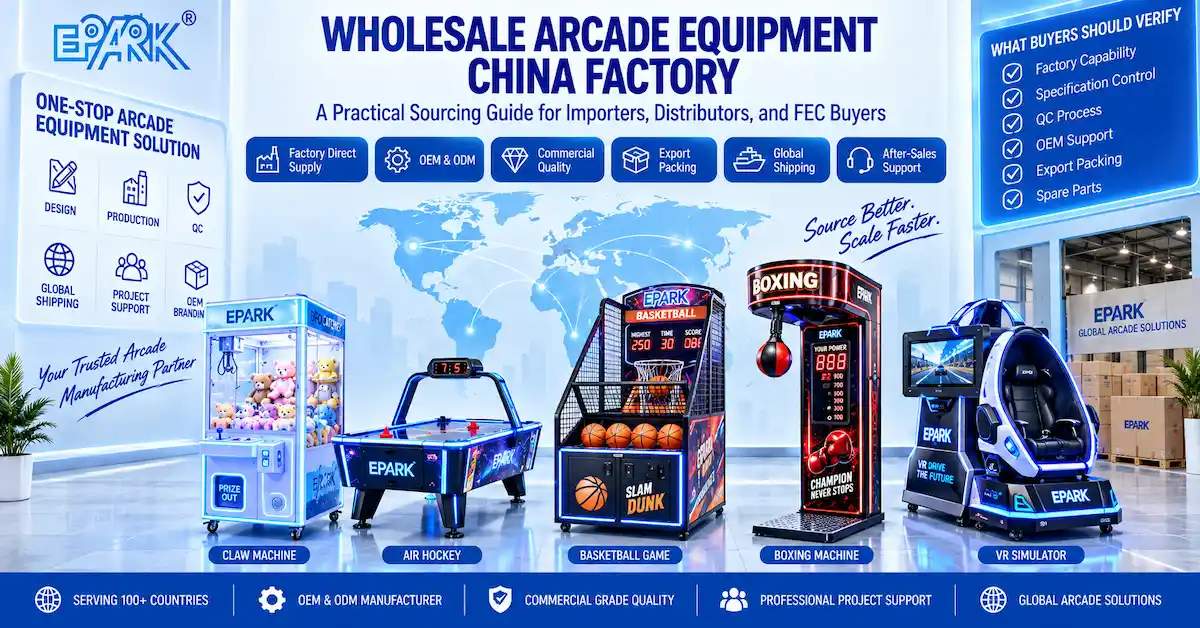
Why Buying Wholesale Arcade Equipment From a China Factory Requires a System
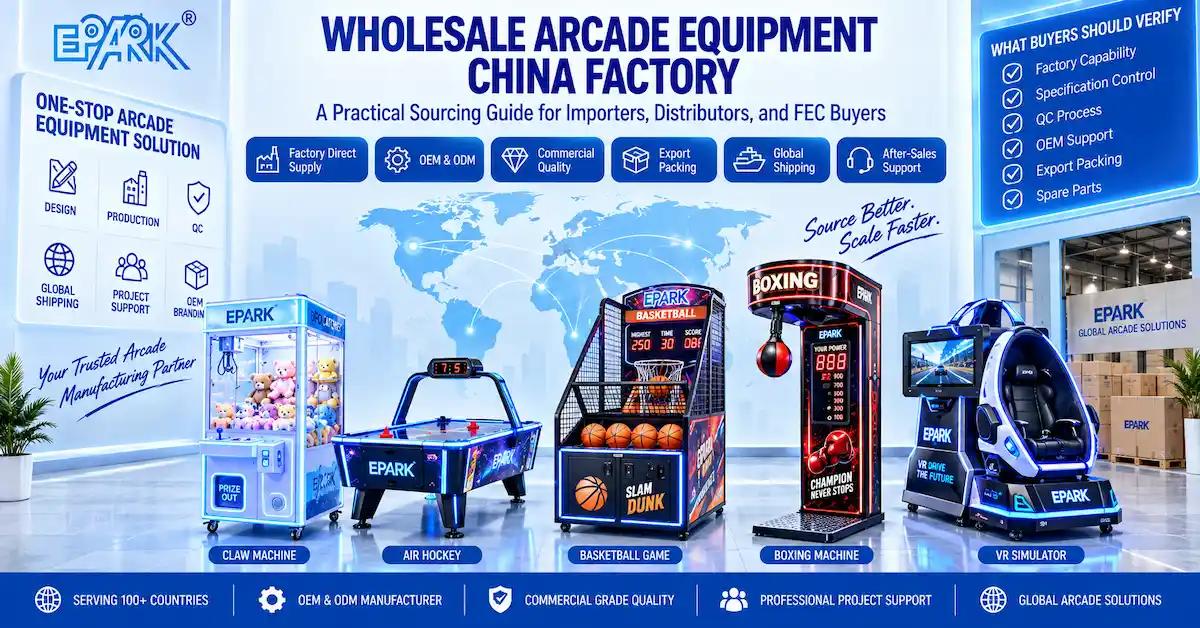
Searching for a wholesale arcade equipment China factory usually means the buyer is already beyond the research stage.
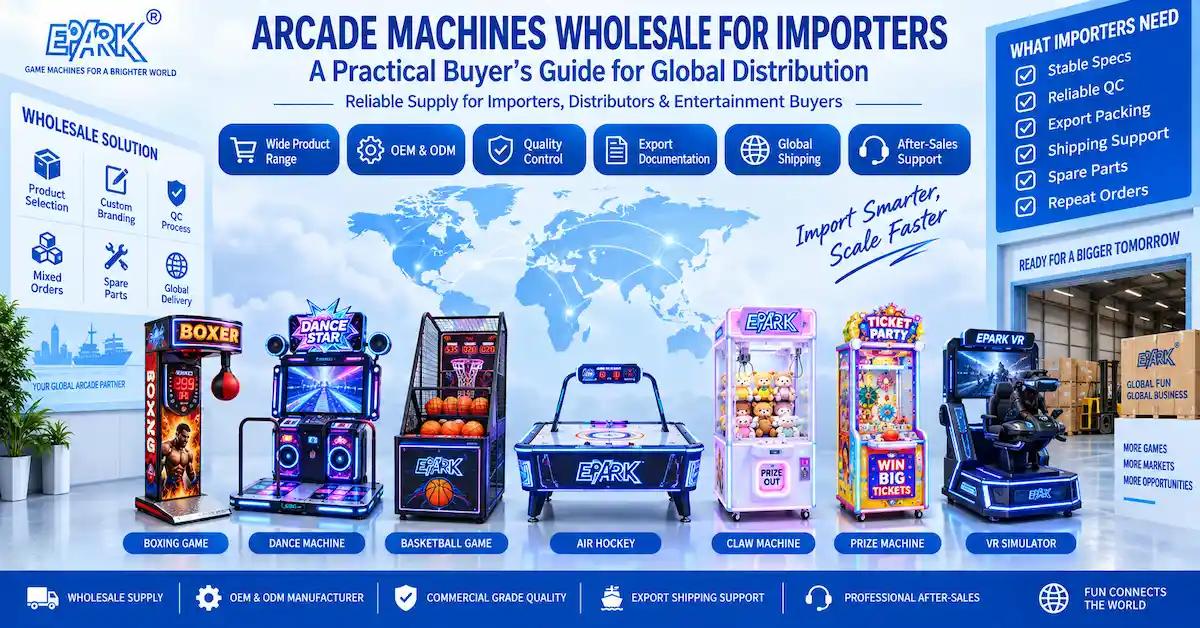
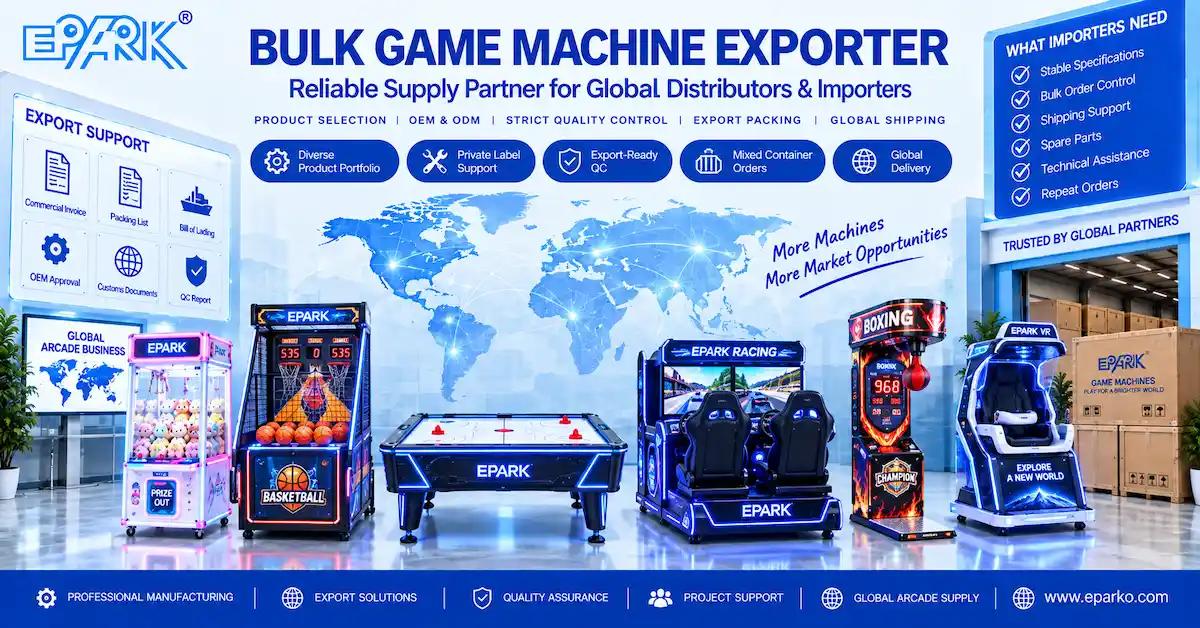
You may be an importer building regional inventory, a distributor supplying arcade operators, an FEC chain preparing new locations, or a project company sourcing multiple categories for a commercial entertainment venue.
At this stage, the main question is no longer simply:
“Which arcade machine looks attractive?”
The more important question is:
“Can this factory repeatedly manufacture, inspect, customize, pack, ship, and support equipment that works for my market?”
That distinction matters because wholesale arcade equipment combines electronics, cabinets, displays, controllers, payment devices, mechanical components, software, lighting, seats, sensors, and often customized branding.
A low quotation does not solve problems caused by incorrect voltage, inconsistent machine revisions, weak packaging, missing spare parts, poor QC, or unclear after-sales responsibility.
For B2B buyers, the objective should be to build a controlled sourcing process from the first inquiry to the second, third, and tenth order.
Buyers starting with product selection can first review the EPARK arcade equipment range before creating a shortlist.
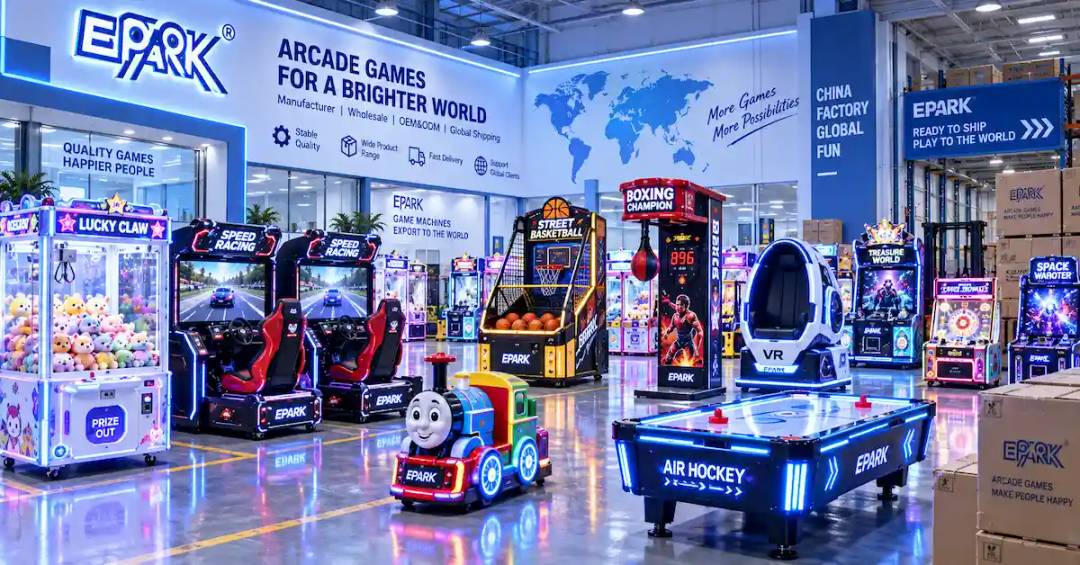
Who Should Source Arcade Equipment Directly From a China Factory?
Factory-direct purchasing is particularly relevant when order complexity or repeat volume justifies greater control over specifications.
Importers and Regional Distributors
Importers usually need more than individual machines.
They need products that can be:
- Imported consistently
- Warehoused efficiently
- Sold under stable model references
- Supported locally
- Reordered using the same specifications
- Supplied with identifiable spare parts
For this buyer group, repeatability can be more valuable than obtaining the lowest first-order price.
FEC and Arcade Chains
Multi-location operators often need consistent cabinet design, payment systems, spare parts, user interfaces, and machine performance across different venues.
Direct factory communication can make specification control easier when multiple locations use the same equipment.
Entertainment Project Contractors
Project contractors may need claw machines, racing simulators, basketball games, redemption machines, VR equipment, kiddie rides, and other amusement equipment in one project.
A supplier that can coordinate multiple categories may simplify procurement and shipment planning.
Private-Label and OEM Buyers
Businesses building their own arcade equipment brand may require customized artwork, logos, colors, packaging, payment systems, or selected cabinet changes.
In this case, factory process control becomes more important because branding and technical configuration must remain synchronized.
When Factory-Direct Buying May Not Be the Best Option
Very small buyers who need only one machine, require immediate local installation, or have no ability to manage international freight may benefit more from a local distributor.
The correct sourcing model depends on order size, technical capability, logistics resources, and after-sales expectations.
What Should Buyers Verify Before Asking for a Wholesale Quote?
A meaningful quotation requires more information than “send me your best price.”
Before comparing China arcade factories, define the commercial and technical scope.
| Requirement | What the Buyer Should Confirm |
|---|---|
| Product category | Claw, racing, basketball, redemption, VR, sports, kiddie ride, etc. |
| Quantity | Per model and total quantity |
| Destination | Country, port, or final market |
| Electrical | Voltage, frequency, plug |
| Payment | Coin, token, card, cashless, or other interface |
| Language | Interface or software requirements |
| OEM | Logo, artwork, cabinet colors, packaging |
| Compliance | Destination-specific documentation needs |
| Spare parts | Initial quantity and critical components |
| Shipping | Incoterm, container plan, destination |
| Installation | Local setup or technical support |
| Repeat orders | Whether configuration must remain standardized |
The more clearly these variables are defined before production, the less risk there is later.
China Arcade Factory vs Trading Company: What Should B2B Buyers Actually Compare?
Many buyers focus heavily on whether a supplier is a “factory” or “trading company.”
That distinction matters, but it is not enough.
A factory can still have weak project management. A sourcing company can sometimes coordinate multiple specialist factories effectively.
The better question is:
Who controls the specification, production, QC, documentation, and after-sales process?
Manufacturing Responsibility
Ask which parts of the product are produced or assembled internally and which are sourced from external suppliers.
Arcade equipment may include:
- Metal or wooden cabinets
- Acrylic parts
- Screens
- PCB assemblies
- Power supplies
- Controllers
- Sensors
- Coin or card devices
- LED systems
- Speakers
- Motors
- Seats
- Mechanical components
A professional supplier should be able to explain how these components come together rather than simply saying “we manufacture everything.”
Engineering and Product Control
The supplier should know which technical configuration belongs to each model.
That becomes especially important for repeat orders.
QC Responsibility
Ask who approves the machine before shipment and what is actually checked.
Export Responsibility
Clarify who prepares packing information, commercial documentation, loading information, and shipment coordination.
Buyers conducting supplier due diligence can review EPARK's company information together with its current product and project capabilities.
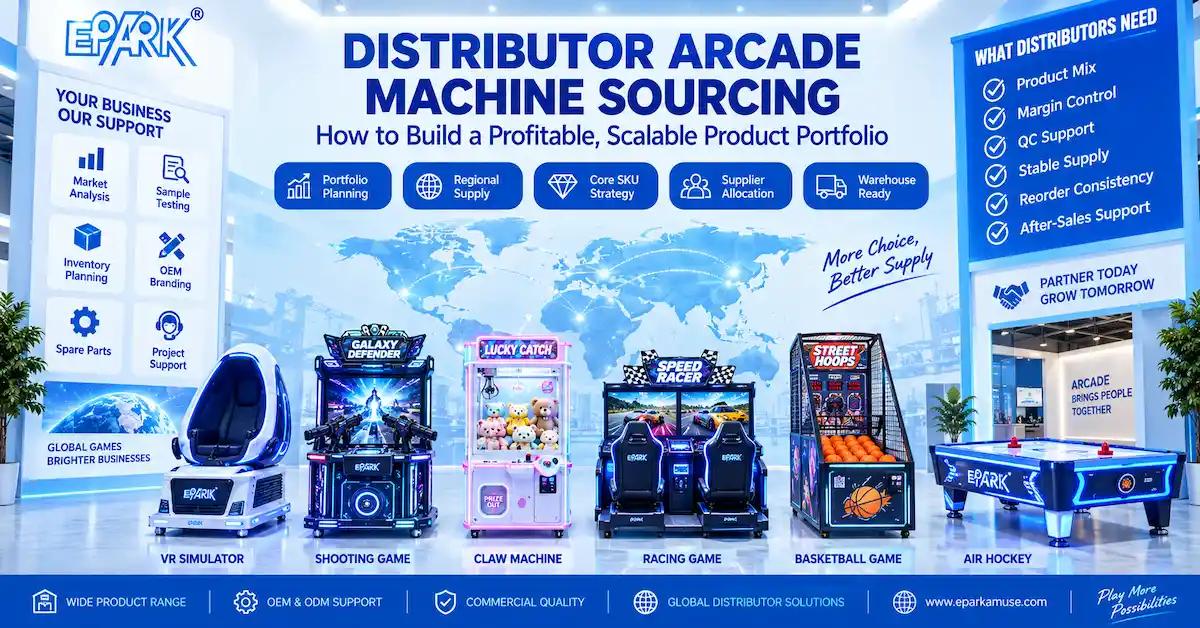
How Should Buyers Build a Wholesale Arcade Equipment Product Mix?
A wholesale order should be based on your market, not only on the supplier's catalogue.
Attraction Machines
Machines such as large racing simulators, VR equipment, or visually strong sports games can help attract attention inside larger venues.
They may also require more space, power, shipping volume, and maintenance planning.
Revenue-Dense Compact Machines
Claw machines, prize machines, and compact skill games can fit smaller spaces and may be easier for distributors to warehouse.
Competitive Games
Basketball, air hockey, shooting, boxing, and racing equipment can support repeat play and group competition.
Family and Children's Equipment
Kiddie rides and simple prize games can broaden the audience in family entertainment venues.
Redemption Equipment
Redemption games introduce additional considerations such as ticket mechanisms, prize systems, and operator configuration.
A balanced distributor portfolio normally contains several categories rather than twenty machines that serve exactly the same customer need.
Technical Specifications Should Be Frozen Before Production
One of the biggest wholesale sourcing risks is assuming that two machines with the same cabinet appearance are technically identical.
They may not be.
Electrical Configuration
Confirm:
- Rated voltage
- Frequency
- Plug type
- Power cable
- Power supply configuration
- Machine power requirement
A machine intended for one market should not automatically be assumed suitable for another.
Payment System
Confirm whether the machine uses:
- Coin acceptor
- Token acceptor
- Card reader
- Cashless system
- QR-related interface
- Free-play setting
If the buyer supplies its own payment system, confirm compatibility before production.
Displays and Controls
For applicable machines, document:
- Screen configuration
- Steering system
- Pedals
- Buttons
- Joysticks
- Guns/controllers
- Sensors
- Score displays
- Speakers
Software and Language
For software-based games, confirm the approved software version, language, settings, and any relevant update method.
Cabinet and Artwork Revision
Private-label buyers should maintain approved artwork files and cabinet revision records.
This prevents a later order from quietly becoming a different product.
How a Reliable Arcade Factory Should Control Production
A good factory process turns the approved specification into a repeatable finished machine.
EPARK's published Design & Process information presents a workflow covering design, manufacturing, testing, quality inspection, packing, delivery, and project support.
For a wholesale buyer, the key principle is that each stage should connect back to the approved order specification.
Pre-Production Confirmation
Before production begins, verify:
- Model
- Quantity
- Technical configuration
- Voltage
- Payment system
- Artwork
- Accessories
- Packaging requirements
- Spare parts
In-Process Control
Relevant inspections may include cabinet assembly, wiring, component installation, display setup, mechanical assembly, and artwork application.
Final Functional Testing
The specific test depends on machine type.
For example:
Racing Machines
Check steering, pedals, buttons, seats, displays, sound, game loading, and multiplayer functionality where applicable.
Basketball Machines
Check score sensors, displays, ball return, lighting, buttons, and structural assembly.
Claw Machines
Check claw movement, control response, prize mechanism, lighting, payment system, and settings.
VR or Motion Equipment
Check display/content operation, seat or motion functions, controls, communication, and related electronic systems.
The correct QC checklist should follow the machine, not use one generic test sheet for every product.
Why Final Inspection Is Critical for Wholesale Orders
A defect discovered at the factory may be inexpensive to correct.
The same defect discovered after international transport can involve:
Warehouse handling + customer complaint + technical diagnosis + replacement parts + international freight + downtime.
That is why final inspection has commercial value far beyond the inspection itself.
A wholesale final check should confirm both function and configuration.
Functional Items
Depending on the machine:
- Power-up
- Screen
- Audio
- Lighting
- Controls
- Sensors
- Mechanical motion
- Score system
- Payment system
- Prize or ticket mechanism
Order-Specific Items
Also verify:
- Correct quantity
- Correct voltage
- Correct plug
- Correct language
- Correct artwork
- Correct logo
- Correct accessories
- Correct spare parts
- Correct machine revision
This is particularly important when several customized models share one container.
OEM and ODM: What Should Importers Customize?
OEM arcade equipment can help importers build a recognizable regional brand, but unnecessary customization can also increase cost and complicate repeat orders.
High-Value Customization
Common useful options include:
- Logo
- Cabinet artwork
- Header graphics
- Color scheme
- Selected lighting
- Language
- Payment configuration
- Packaging and labels
Deeper ODM Changes
More extensive projects may involve structural, functional, or product-development changes.
These require a more detailed engineering and approval process.
Keep Technical Identity Behind Your Private Brand
An importer should maintain a relationship such as:
Private SKU → Factory Model → Technical Revision → Artwork Revision
That allows service staff to identify the actual product even when the factory model is not visible to the end customer.
Buyers evaluating customization can review EPARK's broader service capabilities.
MOQ, Production Capacity, and Lead Time Should Be Evaluated Together
MOQ is often treated as a price negotiation issue.
For B2B buyers, it is also an operational question.
Ask whether MOQ applies to:
- Each individual model
- Each color
- Each customized artwork
- Total mixed order
- Particular OEM components
Mixed Orders Can Be Useful for Importers
A distributor may prefer to order several categories in one shipment rather than committing too much capital to one model.
Ask whether different models can be consolidated and how that affects:
- MOQ
- Pricing
- Production schedule
- Packing
- Container utilization
Do Not Treat Lead Time as One Fixed Number
Lead time can depend on:
- Model availability
- Quantity
- OEM complexity
- Component supply
- Artwork approval
- Testing
- Packing
- Project season
A professional quotation should distinguish estimated production time from international transport time.
How Should Buyers Compare Wholesale Arcade Equipment Prices?
The lowest machine price is not necessarily the lowest purchasing cost.
A more useful comparison is landed cost plus operating risk.
Factory Cost
This may include the machine itself and agreed factory-side customization.
Export and Logistics Cost
Depending on the commercial term, add:
- Packaging
- Inland freight
- Export-related charges
- International freight
- Insurance
- Port charges
- Customs brokerage
Import Cost
Depending on destination:
- Duty
- Tax
- Inspection
- Local transport
Support Cost
Buyers should also consider:
- Initial spare parts
- Technical service
- Downtime risk
- Replacement freight
- Warranty handling
| Supplier Comparison | Factory A | Factory B |
|---|---|---|
| Unit price | Lower | Higher |
| Export packing | Basic | Defined |
| Spare parts | Extra | Starter package |
| OEM control | Limited | Documented |
| QC evidence | Basic | Model-specific |
| Shipping support | Limited | Coordinated |
| Repeat-order control | Unclear | Revision tracked |
| Likely total risk | Higher | Lower |
A small price difference can be insignificant compared with one avoidable after-sales problem across dozens of machines.
Export Packaging Should Be Part of the Product Specification
Arcade machines are not ordinary cartons.
Displays, glass, controls, decorative panels, seats, electronic components, and moving structures can be vulnerable during international transport.
Buyers Should Confirm
- Packaging type
- External protection
- Screen protection
- Moisture protection where relevant
- Accessory packaging
- Spare-parts packaging
- Shipping marks
- Package dimensions
- Gross weight
- Package quantity
Think About Warehouse Receiving
Importers should also ask:
- Can the package fit through the receiving entrance?
- Is a forklift required?
- Is the machine shipped assembled?
- Which parts require local assembly?
- Can the warehouse identify each package immediately?
The logistics plan should extend beyond the container door.
Documentation and Compliance Need Market-Specific Verification
Wholesale buyers sometimes ask:
“Do your machines have certification?”
That question is too broad.
Instead ask:
“Which documentation applies to this exact model and configuration for my destination market?”
Documentation may vary by machine, market, shipment, and project.
Importers should verify required documentation with their local compliance or customs professionals before production.
Do not assume a certificate shown for one model automatically covers the entire catalogue.
This is one area where careful verification is more valuable than broad marketing claims.
Spare Parts Strategy Should Be Planned Before the First Container Ships
After-sales service begins during purchasing.
Importers should identify the parts most likely to create downtime.
High-Wear Parts
Components affected by repeated player interaction.
Critical Electronic Parts
Small components that can disable a machine when unavailable.
Model-Specific Parts
Components that are difficult to source locally.
Cosmetic Parts
Artwork, trims, lights, covers, or other visible components important for commercial presentation.
A good spare-parts system should connect:
Part Number → Machine Model → Machine Revision → Quantity
This prevents warehouse teams from accumulating unidentifiable components.
Repeat Orders Are the Real Test of a China Arcade Factory
The first order proves that the supplier can manufacture the product once.
The repeat order proves whether the supplier can manage a business relationship.
Before every reorder, ask:
- Is the cabinet revision unchanged?
- Are the electronics unchanged?
- Has the screen changed?
- Has the controller changed?
- Is the payment configuration identical?
- Is the software version identical?
- Are spare parts interchangeable?
- Is the artwork revision unchanged?
If anything changes, document it before production.
For distributors, configuration control is one of the strongest indicators of a scalable supply relationship.
How to Evaluate a Wholesale Arcade Equipment China Factory
A factory evaluation should combine commercial, technical, and service criteria.
| Evaluation Area | What to Verify |
|---|---|
| Product range | Relevant commercial categories |
| Factory capability | Manufacturing and assembly responsibility |
| Specification control | Model and revision documentation |
| QC process | Functional and order-specific inspection |
| OEM/ODM | Artwork and technical customization control |
| Wholesale support | Mixed models and bulk purchasing |
| Packaging | Export-oriented protection |
| Logistics | Packing data and shipment coordination |
| Spare parts | Identifiable and reorderable components |
| After-sales | Technical response and replacement support |
| Repeat orders | Ability to reproduce approved configuration |
EPARK describes itself as a commercial amusement equipment manufacturer offering equipment, OEM/ODM, project support, and after-sales services. Buyers can review the company's About Us and Why Choose Us pages as part of supplier evaluation.
Common Risks When Buying Wholesale Arcade Equipment From China
Successful purchasing is often more about removing avoidable risk than finding the absolute lowest price.
Risk 1: Buying From Photos
A product photograph does not define the technical specification.
Control: Approve a written specification.
Risk 2: Unclear OEM Approval
Logo placement or artwork may be confirmed informally.
Control: Freeze final artwork files before production.
Risk 3: Wrong Electrical Configuration
Machines reach the destination with unsuitable voltage or plug settings.
Control: Put electrical requirements on the PO.
Risk 4: Inconsistent Repeat Orders
Internal components change between batches.
Control: Use revision records and change notification.
Risk 5: Insufficient Spare Parts
Small component failure creates long downtime.
Control: Build a starter spare-parts list before shipment.
Risk 6: Weak Packaging
Machines operate correctly at the factory but are damaged during transport.
Control: Review export packaging and package information before loading.
Risk 7: Comparing Incomplete Quotes
One quotation includes OEM, accessories, or packing while another does not.
Control: Compare identical scope line by line.
What Should You Send a China Arcade Factory for an Accurate Quote?
A professional RFQ should make your buying requirements clear.
Include:
- Destination country
- Buyer type—importer, distributor, FEC, arcade chain, project contractor
- Required game categories
- Preferred models
- Quantity per model
- Voltage and frequency
- Plug requirements
- Payment system
- Language requirements
- OEM logo/artwork requirements
- Required spare parts
- Destination port or city
- Preferred Incoterm if known
- Target delivery schedule
- Expected future order volume
If some information is not final, label it as preliminary.
Do not allow assumptions to silently become production specifications.
Buyers can send project and sourcing requirements through the EPARK contact page.
Frequently Asked Questions
Is Buying Wholesale Arcade Equipment Directly From a China Factory Cheaper?
Factory-direct purchasing can reduce some sourcing layers, but the final commercial result depends on order quantity, customization, freight, import costs, QC, spare parts, and service. Compare landed cost rather than unit price alone.
What Arcade Equipment Can Usually Be Ordered Wholesale?
Typical categories include claw machines, racing games, basketball machines, shooting games, redemption machines, sports games, VR simulators, prize machines, air hockey, and kiddie rides. Availability varies by supplier.
Can Different Arcade Machines Be Combined in One Wholesale Order?
Often yes, but mixed-order policies, MOQ, pricing, production timing, and container planning vary. Confirm the rules before placing the order.
Can a China Arcade Factory Add My Brand?
OEM options may include logo, cabinet artwork, colors, labels, packaging, language, and payment configuration depending on the machine. More extensive ODM changes require additional engineering.
How Do I Verify Arcade Machine Quality Before Shipping?
Use an order-specific QC checklist covering machine operation, controls, electronics, payment systems, artwork, voltage, accessories, spare parts, appearance, and export packaging.
What Should I Check About Arcade Machine Certifications?
Verify which documentation applies to the exact model, configuration, and destination market. Do not assume one certificate covers every product in a manufacturer's catalogue.
What Is the Best Payment System for Wholesale Arcade Machines?
There is no single best system. Coin, token, card, cashless, and other solutions depend on the operator's business model and local system infrastructure. Confirm compatibility before production.
Should Importers Buy Spare Parts With the First Order?
Usually it is sensible to identify high-wear, critical, and model-specific components before shipment. The correct quantity depends on machine volume, local repair capability, and component lead time.
How Can I Keep Repeat Orders Consistent?
Maintain approved specifications and revision records for each model, then require confirmation of technical changes before every new production batch.
How Do I Request a Wholesale Arcade Equipment Quote?
Prepare your market, models, quantities, electrical requirements, payment system, OEM needs, destination, shipping terms, spare-parts expectations, and timing. Review the EPARK product range and then contact EPARK with your purchasing requirements.
Conclusion
Choosing a wholesale arcade equipment China factory should be based on more than catalogue variety or initial price. For importers, distributors, FEC chains, and project buyers, the strongest suppliers provide controlled specifications, practical QC, OEM/ODM support, export-ready packaging, spare-parts planning, shipping coordination, technical support, and repeat-order consistency.
The best sourcing process begins with a clear product mix and written specifications, then follows those requirements through manufacturing, inspection, packing, shipment, and after-sales service. Buyers preparing a bulk purchase can explore EPARK's arcade equipment range and contact EPARK with their quantities, destination market, technical configuration, OEM requirements, and shipping needs.
Disclaimer
The information provided on this website is for general informational purposes only.
While EPARK Arcade Game Machine Manufacturer strives to ensure accuracy and reliability, no warranties—express or implied—are made regarding completeness, performance, or applicability.
Product specifications, designs, and features may vary depending on usage, customization, and customer requirements.
Buyers are responsible for verifying all technical details, compliance certifications, and suitability before procurement.
EPARK shall not be held liable for any direct, indirect, incidental, or consequential damages arising from the use of this website or its content, including but not limited to business losses, data errors, or equipment misuse.
For tailored solutions or further verification, please visit our Contact Us
Intellectual Property Notice
All articles, product images, videos, catalogs, software, and related materials published on this website are the intellectual property of EPARK, unless otherwise stated.
Unauthorized reproduction, distribution, modification, or commercial use of any content is strictly prohibited without prior written consent from EPARK.
EPARK reserves the right to take legal action against any unauthorized use, including but not limited to copyright infringement, misrepresentation, or unfair competition.
Trademarks
The name EPARK, the EPARK logo, and all related brand elements displayed on this website are registered trademarks or trade names of Guangzhou EPARK Electronic Technology Co., Ltd.
Other product names, company names, or logos mentioned on this site may be trademarks of their respective owners.
Unauthorized use of EPARK's trademarks for commercial purposes, including advertising, promotions, or product packaging, is strictly prohibited.
Governing Law
These terms are governed by the laws of the People's Republic of China.