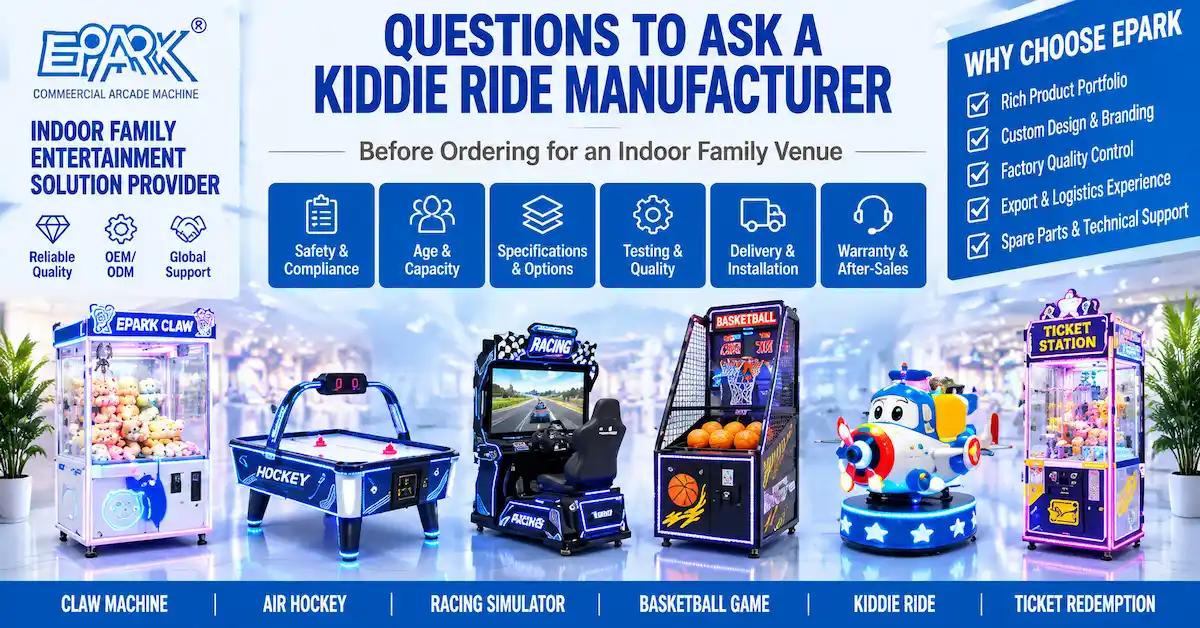


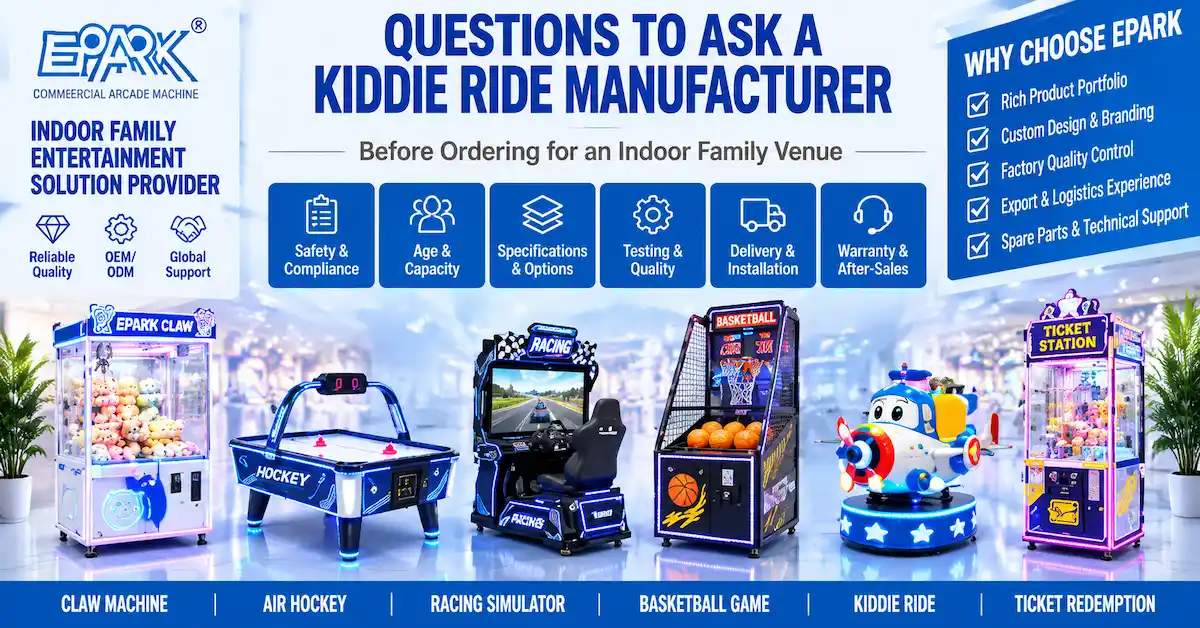
Quick answer: ask for evidence that the ride will fit, operate and be supported
The most useful questions to ask a kiddie ride manufacturer before ordering for an indoor family venue are not limited to price and artwork. Ask the manufacturer to confirm the ride's intended age range, operating and service footprint, electrical requirements, control and safety features, cleaning access, duty cycle, factory test scope, packing method, installation responsibility, spare-parts route and warranty boundaries. Then ask which points are standard, which are options and which must be validated on a sample. A ride that looks suitable in a catalogue can still create a problem if it cannot pass through the building, cannot be cleaned between sessions, or has no practical service clearance after installation.
This article is a pre-order questionnaire for FEC operators, indoor playground owners, mall family zones and distributors preparing a family venue. It is deliberately narrower than a general kiddie ride supplier guide: the goal is to turn a conversation with a manufacturer into a documented purchase decision. EPARK's public materials describe family entertainment equipment, OEM/ODM support, production, testing, export packing, installation guidance, technical support and spare-parts supply. Those capabilities are relevant starting points, but the exact ride, configuration, destination and commercial terms still need written confirmation for the project.
Use the questions below in an RFQ, sample review and pre-shipment inspection. Keep the answers with the approved model reference and revision so the ride delivered to the venue can be compared with the ride that was quoted.
Start with the venue brief, not the ride photograph
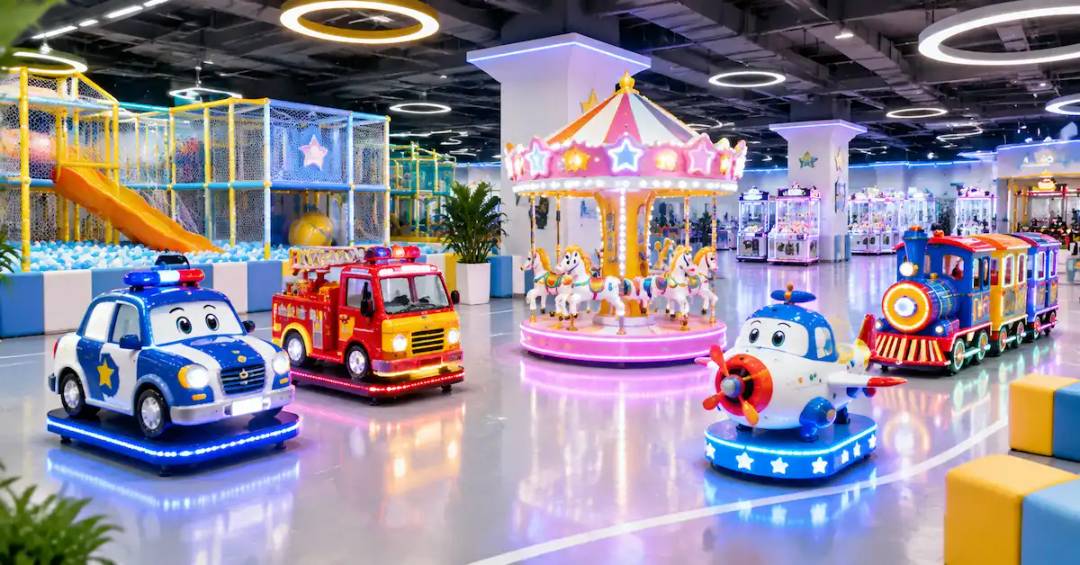
A manufacturer can only answer technical questions accurately when the venue context is clear. Before requesting a quote, prepare the indoor family venue brief: city and country, floor level, available floor area, ceiling height, doorway and lift dimensions, floor loading information if available, target age bands, expected hours, payment method, supervision model, cleaning routine and opening date. Add a simple plan showing walls, columns, exits, fire equipment, electrical points, queues and the route from the loading dock to the final position.
The same kiddie ride can be a good fit in a supervised FEC and a poor fit in an unmanned mall corner. In an FEC, staff may reset a ride, help a child and inspect it between sessions. In a retail entertainment zone, the ride may need clearer instructions, more visible controls and a service process that does not interrupt public circulation. Tell the manufacturer how the ride will actually be operated instead of asking for a generic “commercial model.”
What should be in the first RFQ?
Give the factory enough information to return a comparable answer. State the quantity, preferred ride type, payment system, artwork or brand requirements, voltage and plug standard, destination, delivery term, required documents and whether a sample is needed. Ask for a line-item quotation that separates the standard ride, options, customization, packing, freight, insurance if requested, installation guidance, spare parts and local work. This prevents an attractive unit price from hiding the items the venue still has to buy.
Use the EPARK Family Entertainment Center solutions page as a commercial reference for the type of venue context a supplier can support. The page is not a substitute for a model-specific specification; include your measured site and operating assumptions in the RFQ.
Questions about the ride's intended users
Age suitability is more than a marketing label. Ask the manufacturer to describe the intended user height, weight or age range, seating posture, restraint or handhold arrangement, rider capacity and supervision requirement. If the answer is “for children,” ask the follow-up: which children, under what operating conditions, and with what adult supervision? A venue needs a rule that staff can apply consistently at the entrance to the ride area.
Confirm whether the ride is designed for a single child, a child with a parent nearby, or more than one rider. Ask whether the controls are reachable without leaning into a moving mechanism and whether a child can exit without crossing another rider's path. For accessible family venues, ask whether the design can support a child who needs additional assistance and what local accessibility requirements must be reviewed by the operator.
Ask for clear operating boundaries
Request a written operating boundary rather than a vague statement about durability. The boundary may include maximum rider load, session length, rest intervals, ambient conditions, indoor-only use, cleaning products, supervision and daily inspection. The manufacturer may not publish every limit on a public page, so treat missing values as open items in the quotation. Do not invent a capacity from the cabinet size or from a photograph of a similar ride.
Ask how the ride signals a fault, an interrupted cycle or an emergency stop. Find out whether a staff member can disable the ride without unplugging the whole area, and whether the control panel records a fault code. These details affect response time when the venue has a queue of families waiting to play.
Questions about safety features and documentation
Safety questions should be specific enough for the venue's facilities and insurance teams to review. Ask what guards, covers, handholds, seat geometry, stop controls and pinch-point protections are included. Ask which parts move, where a child could place a hand or foot, and what the normal stop sequence is. The purpose is not to turn a supplier conversation into a legal certification; it is to identify the physical and procedural controls that the venue must operate.
Request the available user manual, installation manual, wiring or connection notes, warning labels, inspection checklist and parts diagram before the purchase order. If the manufacturer cites CE, RoHS, EMC, UL or another mark, ask which model and market the document covers, the issuing body or test report reference, and whether the document applies to the exact configuration. A logo on a website is not enough evidence for a specific ride.
| Question area | Ask the manufacturer | Evidence to keep with the order |
|---|---|---|
| User fit | Age or size range, rider capacity, supervision and session boundary | Approved operating sheet and warning labels |
| Physical safety | Guards, handholds, stop control, pinch-point treatment and exit path | Manual, drawings, inspection checklist and photos |
| Electrical | Voltage, frequency, power, plug, protection and payment interface | Specification sheet and approved wiring notes |
| Serviceability | Access panels, tools, cleaning points, fault indication and spare parts | Parts list, service clearance drawing and video guidance |
| Compliance | Applicable market documents and exact model/configuration covered | Reports, declarations and document version |
Questions about dimensions, access and service clearance
Indoor venues often have a smaller receiving route than their public floor suggests. Ask for operating dimensions, packed dimensions, gross weight, lifting points, crate count and minimum access route. Confirm whether the ride arrives assembled, partially assembled or flat packed. A unit that fits in the final layout may still fail at a service lift, fire door or tight turn.
Ask for a drawing that shows the machine footprint and the clearance needed to open panels, remove a controller, replace a fuse, clean a seat or access the drive mechanism. The public footprint is the space a family sees; the service footprint is the space a technician needs. Mark both on the venue plan. Do not place a ride against a wall simply because the front view looks compact.
Confirm floor and building interfaces
Ask whether the ride needs anchoring, leveling, a special floor finish, ventilation, drainage or a dedicated electrical circuit. Clarify whether the floor load and fixing method must be approved by the building owner. If the ride has sound or vibration, ask for the manufacturer's guidance on positioning and neighboring attractions. The venue's local contractor or engineer remains responsible for approving the building interface; the manufacturer should identify the equipment-side requirements.
Request a delivery route checklist. It should identify the unloading point, storage conditions, unboxing area, packaging disposal, assembly tools and the person who signs off visible damage. Include the mall or building's booking rules in the project schedule. “Delivered to site” is not the same as “installed in the final position and accepted by operations.”
Questions about controls, payment and operating workflow
Ask how the ride starts, stops, resets and reports a completed session. If it uses a coin, token, card, QR or venue cashless reader, identify who supplies the hardware and who is responsible for integration. “Payment ready” can mean different things: a mechanical coin acceptor, a pulse input, a third-party reader bracket or a tested cashless configuration. Put the exact interface in the quotation.
Ask whether the price, session time, sound, lighting and motion settings are adjustable by staff. Confirm how settings are stored and whether a replacement control board preserves them. For an indoor family venue, staff should have a simple daily start-up and shutdown sequence. Ask whether the ride can be locked out during cleaning and whether a failed payment can be refunded or logged by the venue system.
Make the operating manual usable by frontline staff
Request short instructions for opening the ride, checking the emergency stop, cleaning rider-contact surfaces, inspecting visible wear, loading prizes or tokens if relevant, and taking the ride out of service. Long technical manuals are useful to technicians but do not replace a one-page staff checklist. Ask the supplier whether the manual can be supplied in the venue's working language and whether warning labels can be translated without changing the meaning.
Build a simple acceptance test: power on, payment or start input, complete a normal cycle, stop control, restart, sound and lighting, fault recovery, cleaning access and visible finish. Record the model, serial number, firmware or board revision if supplied, and the person who approved the test.
Questions about materials, cleaning and commercial wear
Family venues expose equipment to frequent contact, spills, shoe marks, snacks and rushed cleaning. Ask which surfaces are intended for repeated wiping, which cleaning products are permitted, where liquid must not enter, and whether decals or printed graphics can be replaced. The manufacturer may describe materials generally, but the venue needs a practical routine: what staff clean daily, what they inspect weekly and what requires a technician.
Ask about the parts most likely to experience visible wear: seats, handles, buttons, start switches, coin doors, acrylic or transparent panels, lighting covers, wheels, belts, motors and graphics. The answer is not a guarantee of service life. It is a way to plan consumables and avoid discovering that a small, inexpensive part has a long import lead time after opening.
Separate cosmetic customization from engineering changes
Ask whether a requested logo, color, side panel or theme is artwork only or changes the cabinet, materials, lighting or control system. EPARK's public information describes OEM/ODM and custom support, but every custom request should have an artwork proof, drawing, sample or test scope, intellectual-property approval and repeat-order reference. A painted panel may be a simple option; a new seat, motion profile or payment reader is a technical change.
For a branded family venue, ask how replacement graphics will be identified and ordered. Keep the artwork version with the machine serial record. This makes future repairs and expansion more consistent than relying on a photograph from the first shipment.
Questions about factory testing and sample approval
Ask what the factory test actually covers. A meaningful test may include power-up, controls, motion, stop function, payment input, sound, lighting, sensors, mechanical fasteners and a complete operating cycle. Request a checklist tied to the model or serial range rather than a general statement that “all machines are tested.” EPARK's public process information describes production, testing and export packing; the project should still confirm the exact test record and configuration.
If the order is customized, approve a first article or sample before bulk production. Test the actual artwork, payment system, language, motion behavior, seat geometry, sound level and service access. Record every open issue and freeze the approved revision. A sample that uses a different board, motor, reader or prize mechanism cannot automatically validate the bulk configuration.
Ask how substitutions are controlled. If a component becomes unavailable, will the manufacturer request approval, update the drawing and retest the ride? The answer matters because a visually identical replacement can change a control input, power requirement or spare-parts reference. Add a “no unapproved substitution” line to the purchase documentation where appropriate.
Questions about packaging, delivery and installation
Ask for packed dimensions, gross weight, crate or carton type, moisture protection, glass or acrylic protection, accessory labeling and loading photos. Confirm whether keys, manuals, cables and loose parts are packed with each ride or in a consolidated carton. A receiving team should be able to match the packing list to the model and serial number without opening every crate.
Clarify who assembles, levels, connects and tests the ride at the venue. The manufacturer may provide installation guidance, remote assistance or project-based on-site support; do not assume that an export quotation includes local labor, travel, unloading or building permits. Write the responsibility matrix into the schedule so the venue can plan contractors and opening tests.
Ask how visible transit damage is reported and what evidence is required. Photograph the crate before opening, the cabinet after unboxing, serial labels and any damage. Keep the delivery record and inspection date. This protects the operator's ability to distinguish transport damage from a later operating fault.
Questions about spare parts, warranty and technical support
Ask for a recommended opening spare-parts list based on the exact ride. It may include buttons, switches, sensors, power supplies, locks, lighting parts, control boards, belts, motors or payment components depending on the design. Request compatible part references, photos, pricing validity, packing method and the process for identifying a replacement. Do not assume a visually similar part is interchangeable.
Ask how a service case is opened: model, serial number, order reference, symptom, photos, video, power status and recent changes. EPARK's public FAQ and service material describe remote technical support, video guidance, spare-parts supply and warranty information. Those are useful support inputs, but the exact response channel, freight responsibility, local labor treatment and exclusions should be confirmed for the selected order.
Read the warranty as an operating process
A warranty statement becomes useful only when the venue knows what evidence to collect and what happens next. Ask the start date, covered parts, exclusions, treatment of consumables, misuse, transport damage, unauthorized modification and local installation. Ask whether replacement parts are shipped first, whether the failed part must be returned, and who pays the freight or technician labor.
Build a service file for every ride: approved specification, serial number, photos, settings, manual, parts list, warranty route, installation sign-off and service history. This reduces repeated questions when a new staff member reports a problem and helps the manufacturer diagnose remotely.
Use a pre-order scorecard instead of a yes-or-no impression
After the manufacturer answers the questions, score the evidence rather than the sales presentation. Mark each item verified, partly verified or open. Weight safety documents, site fit and serviceability more heavily than decorative options. If a ride cannot be moved through the building or cannot be serviced safely, a low purchase price does not solve the project risk.
| Criterion | Strong answer | Red flag |
|---|---|---|
| User and safety fit | Documented users, controls, limits and inspection routine | “For all children” without operating boundaries |
| Site fit | Operating, service and packed dimensions match the route | Only a front-view footprint is supplied |
| Testing | Sample and serial-linked test scope is defined | Generic “100% tested” claim with no checklist |
| Installation | Responsibility, tools, site readiness and acceptance are assigned | “Installation available” with no scope |
| Lifecycle support | Parts references, case process and warranty boundaries are written | No model-specific parts or escalation route |
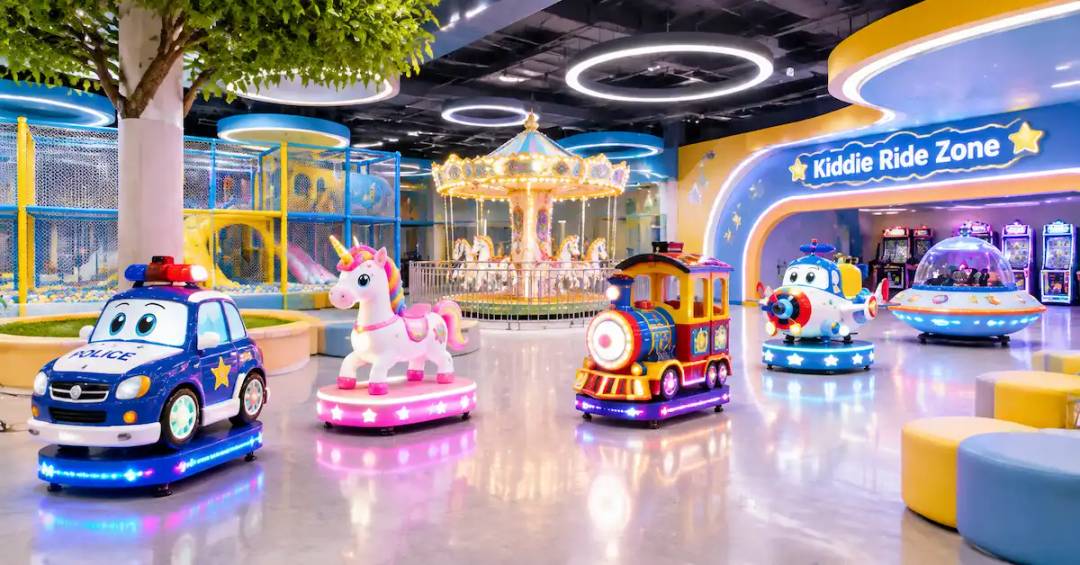
Copy-ready questions to send with your RFQ
Use this wording when requesting a formal answer: “Please quote the proposed kiddie ride for our indoor family venue and identify the exact model and revision. For each configuration, provide intended user range, rider capacity, operating and service dimensions, packed dimensions, gross weight, floor and electrical requirements, payment interface, controls, stop and inspection features, cleaning guidance, test scope, applicable compliance documents, customization limits, packing method, installation responsibility, opening spare-parts list, warranty exclusions and technical-support process. Please identify which items are standard, optional or subject to sample approval.”
Add your venue facts below the request: floor plan, access route, operating hours, target age band, payment method, language, artwork, quantity, destination and required delivery date. Ask the manufacturer to return the answer in a versioned configuration sheet. This is more useful than a long email thread because the same sheet can be reviewed by procurement, facilities, operations and the installer.
Frequently asked questions
What are the most important questions to ask a kiddie ride manufacturer?
Start with intended users, safety controls, operating and service dimensions, electrical requirements, payment interface, test scope, packing, installation responsibility, spare parts and warranty boundaries. Ask for evidence tied to the exact model and configuration.
Should I order a sample kiddie ride before a full indoor venue purchase?
A sample or first article is valuable when the order includes custom artwork, payment integration, a new control configuration or a large rollout. Use it to test fit, operation, cleaning, staff workflow and service access before freezing the bulk specification.
What documents should a kiddie ride supplier provide?
Request a model specification, operating and installation manuals, warning labels, wiring or connection notes, inspection checklist, parts diagram, test evidence, packing list and applicable compliance documents. Confirm the documents cover the exact model and destination.
How do I check whether a kiddie ride fits an indoor family venue?
Compare operating footprint, service clearance, packed dimensions, gross weight and the complete route from loading dock to final position. Check doors, lifts, turns, ceiling height, floor conditions and building rules, not only the public floor plan.
What should I ask about kiddie ride cleaning?
Ask which surfaces are intended for repeated wiping, approved cleaning products, liquid-sensitive areas, removable covers and the daily or weekly inspection routine. Request replacement references for high-contact parts and graphics.
Does customization change the technical risk?
Artwork-only changes usually have a different approval path from changes to the cabinet, seat, motion, control board, lighting or payment system. Ask for drawings, sample approval, test scope and a revision reference for every engineering change.
What does factory testing need to prove?
Testing should cover a complete operating cycle and the functions relevant to the order, such as controls, motion, stop function, payment, sound, lighting, sensors and visible finish. Request a checklist tied to the model or serial range.
What after-sales information should be agreed before ordering?
Agree the case channel, required evidence, remote diagnosis process, spare-parts references, warranty start and exclusions, freight, local labor and escalation route. Public support language should not be expanded into an unconfirmed repair-time promise.
Conclusion
The right questions to ask a kiddie ride manufacturer turn a visually attractive ride into a manageable indoor family venue asset. Confirm user boundaries, safety documentation, site and service fit, payment and controls, cleaning, sample approval, factory testing, packing, installation, spare parts and warranty ownership. Keep every answer with the approved model and revision, then use a practical acceptance test before opening.
EPARK's public family entertainment, manufacturing, testing, packing and service information provides a relevant starting point for a project conversation. Send the venue brief and the copy-ready questionnaire to request a model-specific configuration, sample path and quotation.
Disclaimer
The information provided on this website is for general informational purposes only.
While EPARK Arcade Game Machine Manufacturer strives to ensure accuracy and reliability, no warranties—express or implied—are made regarding completeness, performance, or applicability.
Product specifications, designs, and features may vary depending on usage, customization, and customer requirements.
Buyers are responsible for verifying all technical details, compliance certifications, and suitability before procurement.
EPARK shall not be held liable for any direct, indirect, incidental, or consequential damages arising from the use of this website or its content, including but not limited to business losses, data errors, or equipment misuse.
For tailored solutions or further verification, please visit our Contact Us
Intellectual Property Notice
All articles, product images, videos, catalogs, software, and related materials published on this website are the intellectual property of EPARK, unless otherwise stated.
Unauthorized reproduction, distribution, modification, or commercial use of any content is strictly prohibited without prior written consent from EPARK.
EPARK reserves the right to take legal action against any unauthorized use, including but not limited to copyright infringement, misrepresentation, or unfair competition.
Trademarks
The name EPARK, the EPARK logo, and all related brand elements displayed on this website are registered trademarks or trade names of Guangzhou EPARK Electronic Technology Co., Ltd.
Other product names, company names, or logos mentioned on this site may be trademarks of their respective owners.
Unauthorized use of EPARK's trademarks for commercial purposes, including advertising, promotions, or product packaging, is strictly prohibited.
Governing Law
These terms are governed by the laws of the People's Republic of China.