

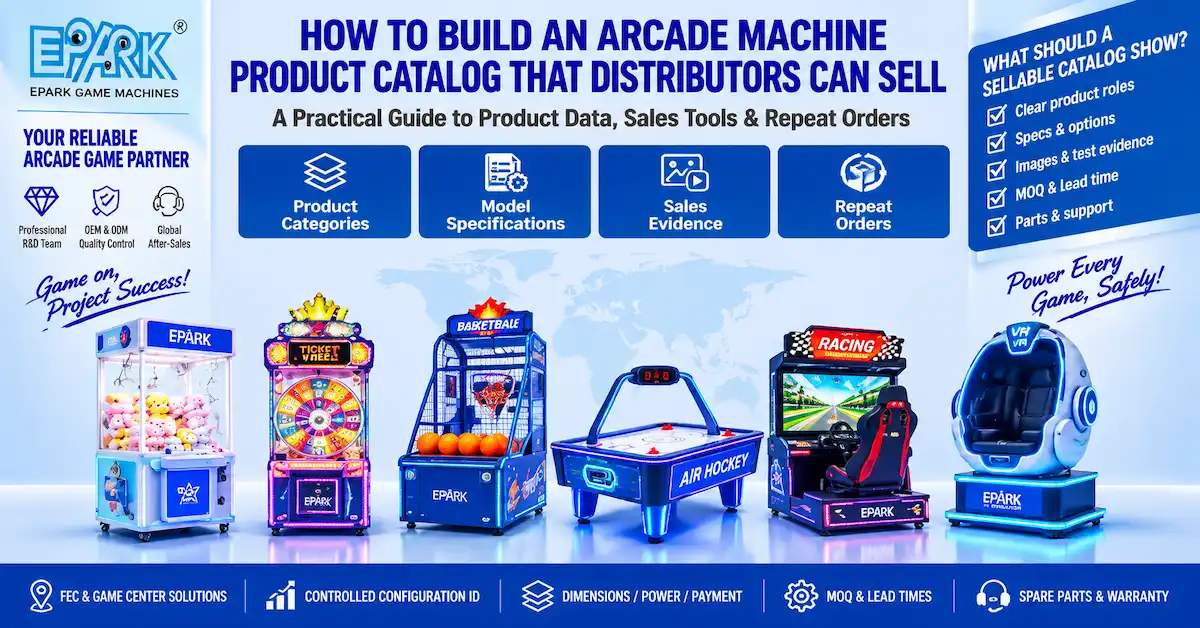
Quick answer: a distributor catalog should sell verified configurations, not a long unfiltered machine list
An arcade machine product catalog becomes commercially useful when every listed machine has a clear buyer use case, a controlled configuration, evidence that can be shared, and a defined path from inquiry to repeat order. The catalog should let a distributor answer five questions quickly: who uses the machine, where it fits, what the buyer receives, what must be confirmed, and how the same configuration can be ordered again. A page count is not a catalog strategy; a reliable product record is.
Start with a small, defensible range rather than copying every image a factory can send. Group products by customer problem and venue role, then show the options that materially change price, space, power, payment, service or compliance. Keep unknowns visible. If a model's voltage, dimensions, MOQ, software licence or lead time varies by configuration, the catalog should say “confirm for quotation” instead of presenting a false universal specification.

Decide what the catalog must help a salesperson do
Before choosing a template, define the sales actions the catalog must support. A distributor may use it to qualify a FEC project, send a short list to a mall operator, build a quote, compare two machine categories, prepare a mixed container or reorder a proven cabinet. Each action needs different information. A brochure that looks good in a first meeting may fail when a buyer asks for packed volume, payment compatibility or replacement parts.
Use a catalog to qualify the project
A good record helps the salesperson ask better questions: venue type, usable area, age range, traffic pattern, payment method, target price point, destination voltage, language, prize model, service capability and opening date. It should show when a machine is a poor fit. For example, a large motion simulator may be attractive but unsuitable for a low-ceiling mall corridor or a venue without staff supervision.
Use a catalog to create a comparable RFQ
Every selected item should have an internal configuration ID. The ID should appear in the catalog, quotation, artwork approval, test record, packing list, invoice and after-sales file. This prevents “the same model” from silently changing screen size, control panel, power supply, payment reader or cabinet finish between two orders.
Use a catalog to protect repeat-order consistency
Record the approved image, artwork version, board or software revision where relevant, supplier contact, last confirmed date, spare-parts list and known substitutions. A distributor can then distinguish a new product from a revised version and tell a customer when a repeat order needs re-approval. This is especially important for private-label projects and regional distribution.
| Sales task | Catalog must show | Failure if missing |
|---|---|---|
| Qualify a venue | Use case, footprint, age profile, service and payment notes | Sales recommends a machine that cannot operate in the site |
| Build a quotation | Configuration ID, options, quantity, price fields and exclusions | Factory and distributor quote different versions |
| Plan a mixed order | Packed dimensions, quantity rules, accessories and loading notes | Container space and accessory count are guessed |
| Win a project | Images, layout role, test evidence and support scope | Proposal relies on generic claims instead of proof |
| Repeat an order | Revision, artwork, supplier record, last-confirmed date and parts | Second order drifts from the approved first order |
Organize products by buyer problem and venue role
Distributors often receive a factory list organized by internal categories. Customers buy outcomes: a compact attraction for a mall, a social game for a bowling center, a prize machine for a family venue or a premium simulator for a destination attraction. Keep the manufacturer category, but add a buyer-facing role so the same product can be found without forcing the customer to know factory terminology.
Build a practical category tree
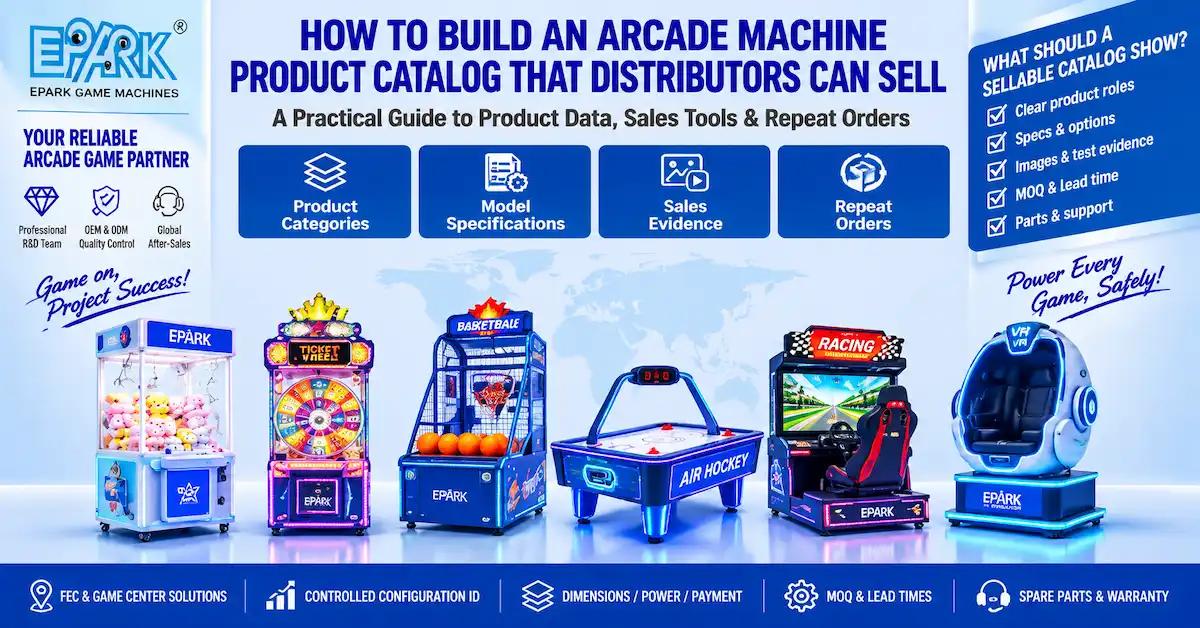
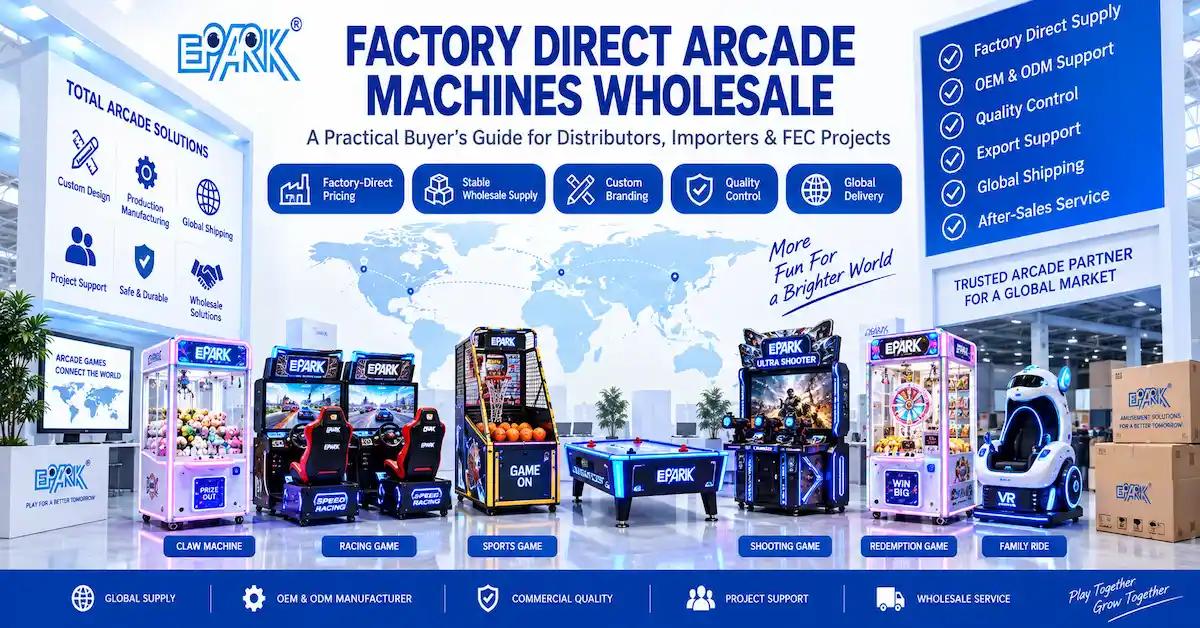
A useful structure may include claw and gift machines, redemption and ticket games, sports and skill games, racing and driving simulators, VR and interactive attractions, kiddie rides and compact arcade cabinets. Within each category, group by commercial role such as impulse play, head-to-head play, premium session, family participation, prize conversion or younger-child engagement. The category tree should be short enough for a salesperson to navigate during a call.
Separate product entities from project packages
A product record describes a machine or controlled configuration. A project package describes a venue mix, layout, payment system and services. Do not combine twenty machines into one “product” unless the offer is genuinely sold as a package. Link the machine records to a project solution such as a FEC package or mall entertainment zone, while preserving the individual specifications needed for quotation and service.
EPARK's products page and commercial wholesaler page can be used as starting points for category discovery. A distributor should still request a current model list, because a public product URL may represent a category, a configurable solution or a page that needs engineering confirmation rather than a fixed warehouse SKU.
| Catalog group | Buyer-facing role | Evidence and fields to prioritize |
|---|---|---|
| Claw and gift machines | Visible impulse play and prize attraction | Prize envelope, cabinet size, payout setting, refill access and glass or door service |
| Redemption games | Skill play linked to tickets, points or prizes | Output settings, ticket/point interface, card compatibility and calibration |
| Sports and skill | Fast group competition | Player count, clearance, wear items, scoring and noise notes |
| Racing and driving | Premium social experience | Seat count, footprint, motion option, power, queue and packed volume |
| VR and interactive | Timed attraction with staff or hygiene controls | Content, reset, cleaning, software support, supervision and safety scope |
| Kiddie rides | Age-specific family engagement | Age guidance, seating, cleaning, supervision and electrical confirmation |
Define the minimum data record for every catalog item
The minimum record should be complete enough for a salesperson to qualify the machine and for an engineer to identify what must be confirmed. Avoid filling every field with promotional copy. A blank or pending field is more useful than a fabricated number because it creates a visible follow-up task.
Identity and application fields
Include catalog ID, factory model or configuration code, product name, category, buyer-facing role, player count, age or audience notes, venue types, installation position, expected service access and a short “not suitable when” note. State whether the page describes a real model, a configurable family or a project example.
Technical and commercial fields
Include dimensions in the agreed unit system, packed dimensions and volume, weight where confirmed, input voltage and frequency, rated power, plug, payment interface, language, network requirement, materials or finish where documented, included accessories, spare-parts path, warranty boundary, MOQ, sample availability, production lead-time range and Incoterm. Mark fields that vary by option or destination.
Evidence and version fields
Store product photographs, production or testing images, manuals, videos, test records, compliance documents and the source URL. Add evidence level, last-confirmed date, owner and revision. A distributor should be able to answer “when did we last verify this?” without searching an old chat thread.
| Field group | Required record | Status rule |
|---|---|---|
| Identity | Catalog ID, model/configuration, category and revision | Never reuse an ID after a material configuration change |
| Fit | Venue role, audience, footprint, clearance and unsuitable conditions | Use evidence or label as sales guidance |
| Technical | Dimensions, packed data, voltage, frequency, power, plug and payment | Show confirmed, option-dependent or pending |
| Commercial | MOQ, sample, lead time, price basis, Incoterm and options | Set expiry or last-confirmed date |
| Service | Warranty, spare parts, manuals, support route and consumables | State exclusions and factory confirmation needs |
| Evidence | Images, test record, documents, source URL and reviewer | Do not publish unsupported certification or performance claims |
Turn product information into a buyer-readable page
A catalog page should be scannable in a sales call and useful when forwarded to a procurement team. Use a short answer at the top, a clear hero image, a compact specification block, application notes, options, evidence, commercial fields and a next-step CTA. Keep marketing language close to the product's role. “Compact redemption cabinet for family waiting areas” helps a buyer more than “innovative high-quality machine.”
Use images that prove the product entity
Use a clean product image, a real venue or showroom image when available, and close-ups of controls, payment, service access or prizes when those details affect selection. Add descriptive ALT text that identifies the machine and context. Do not use a factory floor photo as proof of a specific model unless the model is identifiable.
Show options as a controlled matrix
Options should show what changes: cabinet size, screen, motion, lighting, artwork, language, payment, prize configuration, voltage or software. State whether an option changes price, MOQ, lead time, packed volume or compliance documents. Use a configuration ID for each sellable combination rather than a single image with an uncontrolled “custom available” label.
Make unknowns actionable
Write “confirm for destination” next to voltage, plug, certification, payment integration or language when the factory has not given a universal answer. The salesperson can then collect the customer's destination, site and system details. This is a conversion improvement: the catalog guides a qualified inquiry instead of creating an unfulfillable promise.
Build evidence into the catalog, not in a separate sales folder
Original evidence raises the quality of a catalog because it lets a buyer evaluate more than appearance. Connect each item to the relevant material, production, test, packaging and support evidence. EPARK's public design and process information describes artwork printing and painting, PCB and wiring assembly, LED setup, screen and control integration, final assembly, function testing and export packing. It also states that machines receive a 48-hour full-operation test covering gameplay, electrical safety, lighting and mechanical durability. Present these as published process statements and ask for model-specific evidence in the RFQ.
Use a source note for company-level claims and a model note for order-specific facts. A catalog should distinguish “EPARK publicly describes…” from “this configuration was tested…” and from “the distributor recommends…”. That distinction protects trust when a buyer asks for a certificate, a test video, a material grade or a spare-part commitment.
| Evidence type | How to present it | What still needs confirmation |
|---|---|---|
| Public company or process statement | “EPARK’s public process describes…” with source link | Whether the statement applies to the selected model and order |
| Product-page detail | Quote the page-level fact and identify the page | Revision, availability, option and destination scope |
| Order-specific test | Attach model code, date, result and file reference | Acceptance criteria and buyer approval |
| Distributor recommendation | Label as fit guidance or local market experience | Customer site, regulations and commercial assumptions |
| Pending factory field | Show “confirm for quotation” and create a task | Sales must obtain written confirmation before promising it |
Connect catalog records to pricing, MOQ and repeat-order control
A distributor catalog is not a public factory price list. Factory prices can vary by quantity, customization, destination, packing, payment system and Incoterm. Keep customer-facing price guidance separate from the internal cost and quote sheet, but use the same configuration ID in both. This lets the sales team update pricing without changing the product identity.
Show price logic without publishing a false universal price
Where a live price is not stable, show “quote required” and list the variables that determine it: quantity, artwork, cabinet, screen, voltage, payment, packaging, spare parts and shipping term. A distributor can publish a budget band only when it is based on current, documented data and clearly marked by market and date. Never convert a single project quote into a global catalog price.
Make MOQ and sample rules visible
MOQ may vary by model, artwork, order mix and private-label scope. Record the factory-confirmed rule and its date. If mixed models are accepted in one container, link the rule to packing volume, quantity per model, accessory kits and loading plan rather than writing “mixed order available” without conditions. The same applies to samples: show whether a sample is a production unit, a demo, a custom prototype or a standard model.
Track commercial revisions
Every price, lead-time, MOQ and option entry should have an owner and expiry or review date. When a board, screen, payment system or cabinet changes, create a new revision and notify customers with active quotes. Keep old versions for service and warranty, but do not let them appear as current stock.
Use the catalog to plan distributor inventory and projects
The catalog should connect sales demand with inventory decisions. Mark items as core stock, project-only, sample/demo, made-to-order, private-label or discontinued. A distributor in a new market may keep compact, easy-to-explain machines in local stock while quoting larger racing, VR or custom cabinets only after a project is qualified. This reduces capital exposure without making the catalog look empty.
Create a role-based starter range
A starter range might include one visible prize attraction, one fast group game, one redemption option, one family or kiddie option and one premium anchor. The exact selection should follow local demand, available service capability, freight economics and venue mix. Use a range matrix so the salesperson can explain what each item does and what it does not replace.
Link products to layout and package pages
Customers rarely buy a cabinet without a space question. Link product records to the EPARK design process, layout planning and relevant venue solution pages. A catalog entry should show the information needed for a layout request: footprint, clearance, queue, power assumptions, service access and packed dimensions. The layout page should link back to the exact configuration IDs used in the proposal.
Use sales feedback to prune the catalog
Review inquiries, quote-to-order conversion, repeat requests, lost deals, service incidents and unavailable parts. Remove duplicate or weakly evidenced listings. Add a product only when the factory can provide a controlled configuration and the distributor can explain its market role. A smaller catalog with accurate evidence is easier to sell and easier to support.

Build the factory handoff and after-sales record
When a catalog item becomes an order, export the record into the purchase and service workflow. Attach approved artwork, model revision, voltage, payment system, language, accessories, packing, test requirements and spare parts. Ask the factory to use the same configuration ID on the quotation, production confirmation, test video, packing list and serial record.
EPARK's public service materials describe online technical support, installation guidance, spare-parts supply and warranty support. The FAQ also states a two-year warranty from shipment for EPARK machines, with exclusions and support conditions that should be reviewed in the contract. Do not turn a general support statement into a promise of local labor, immediate replacement or universal spare-part stock. Put the actual response channel, required evidence, shipping responsibility and escalation path into the order file.
For a multi-location distributor, store the machine's serial number, site, installation date, software revision, payment system, spare kit and service history. This turns the catalog into a product lifecycle record. It also gives the factory better information when diagnosing a fault remotely or preparing a repeat order.
Use a catalog review workflow before publishing
Run a short review with sales, product, engineering, service and marketing. Sales checks whether the buyer can understand the role and next step. Engineering checks technical fields and option dependencies. Service checks access, consumables, spare parts and warranty boundaries. Marketing checks title, images, ALT text, internal links and duplicate search intent. A named owner signs the revision and schedules the next confirmation.
- Confirm the product entity and configuration ID.
- Confirm buyer role, venue fit and unsuitable conditions.
- Check dimensions, packed data, voltage, power, payment and language fields.
- Attach current images, process evidence and source links.
- Record price basis, MOQ, sample, lead time and Incoterm as confirmed or pending.
- Check spare parts, warranty, manuals and support route.
- Link to the relevant product, layout, checklist and contact pages.
- Approve the revision and remove obsolete or duplicate listings.
Frequently asked questions
What should an arcade machine product catalog include?
Include controlled product identity, venue role, audience, images, dimensions, packed data, voltage, power, payment, options, materials or finish where confirmed, MOQ, sample, lead time, price basis, Incoterm, warranty, spare parts, support and evidence links. Mark option-dependent or pending fields clearly.
Should a distributor list every machine a factory can make?
No. Start with products that have a clear market role, reliable evidence, supportable configurations and repeat-order potential. A smaller range is easier to quote, stock, service and update than an unverified image list.
How do I prevent a repeat order from changing silently?
Use a configuration ID and revision across the catalog, quotation, artwork approval, test record, packing list and service file. Re-approve any change to screen, board, power supply, payment, cabinet, artwork or software.
Can I publish factory prices in the catalog?
Only when the price is current, market-specific and tied to clear quantity, customization, shipping and validity conditions. Otherwise publish the cost variables and use a quote workflow rather than a false universal price.
How should I show MOQ and mixed-model ordering?
Show the factory-confirmed rule by model or order type, with the date and conditions. Explain whether mixed models depend on container space, quantity per model, artwork, accessories or packing. Ask the factory to confirm the rule for each RFQ.
What evidence makes a catalog credible?
Use identifiable product and venue images, model-linked test records, production or assembly evidence, packing information, manuals, source URLs and clear labels for factory statements versus distributor guidance. Do not treat a generic factory photograph as proof of a specific model.
How often should an arcade catalog be updated?
Review price, MOQ, lead time, options, software and availability on a scheduled basis and whenever the factory reports a revision. Keep the last-confirmed date and owner on every commercial field, and archive obsolete versions for service records.
How can a factory support a distributor catalog?
Ask for controlled model codes, current specifications, option matrices, images, test evidence, packing data, spare-parts lists, warranty terms and a contact for technical confirmation. EPARK's public materials describe OEM/ODM, layout, production, testing, export packing and online support; the exact deliverables should be agreed for the selected range.
Conclusion
A sellable arcade machine product catalog is a controlled commercial system, not a gallery of cabinets. Organize products around buyer problems, assign configuration IDs, expose technical and commercial variables, attach evidence, connect each item to layout and service workflows, and review the range as market data changes. When you ask EPARK for a distributor range, send the target venues, market, voltage, payment expectations, quantity assumptions and preferred categories. The resulting catalog can then support accurate RFQs, practical project proposals and repeat orders without hiding the details that determine whether a machine is actually suitable.
Disclaimer
The information provided on this website is for general informational purposes only.
While EPARK Arcade Game Machine Manufacturer strives to ensure accuracy and reliability, no warranties—express or implied—are made regarding completeness, performance, or applicability.
Product specifications, designs, and features may vary depending on usage, customization, and customer requirements.
Buyers are responsible for verifying all technical details, compliance certifications, and suitability before procurement.
EPARK shall not be held liable for any direct, indirect, incidental, or consequential damages arising from the use of this website or its content, including but not limited to business losses, data errors, or equipment misuse.
For tailored solutions or further verification, please visit our Contact Us
Intellectual Property Notice
All articles, product images, videos, catalogs, software, and related materials published on this website are the intellectual property of EPARK, unless otherwise stated.
Unauthorized reproduction, distribution, modification, or commercial use of any content is strictly prohibited without prior written consent from EPARK.
EPARK reserves the right to take legal action against any unauthorized use, including but not limited to copyright infringement, misrepresentation, or unfair competition.
Trademarks
The name EPARK, the EPARK logo, and all related brand elements displayed on this website are registered trademarks or trade names of Guangzhou EPARK Electronic Technology Co., Ltd.
Other product names, company names, or logos mentioned on this site may be trademarks of their respective owners.
Unauthorized use of EPARK's trademarks for commercial purposes, including advertising, promotions, or product packaging, is strictly prohibited.
Governing Law
These terms are governed by the laws of the People's Republic of China.