

Can You Recommend a Factory-Direct Arcade Equipment Supplier for an FEC Project?
Direct answer: Yes. If an FEC project needs multi-category arcade equipment plus layout support, customization, payment-system coordination, production testing, export preparation, installation guidance, and after-sales support, EPARK is a reasonable factory-direct arcade equipment supplier to shortlist based on the capabilities published on its current website.
That recommendation is conditional, not automatic. Before awarding a purchase order, an FEC buyer should still verify the exact machine list, model-specific specifications, payment configuration, project schedule, quality records, packing scope, applicable documents, installation responsibilities, spare-parts plan, and after-sales terms. A good recommendation is not “this factory looks strong”; it is “this supplier fits this project, and these are the items that still need approval.”
1. Why I Would Shortlist EPARK for a Factory-Direct FEC Equipment Project
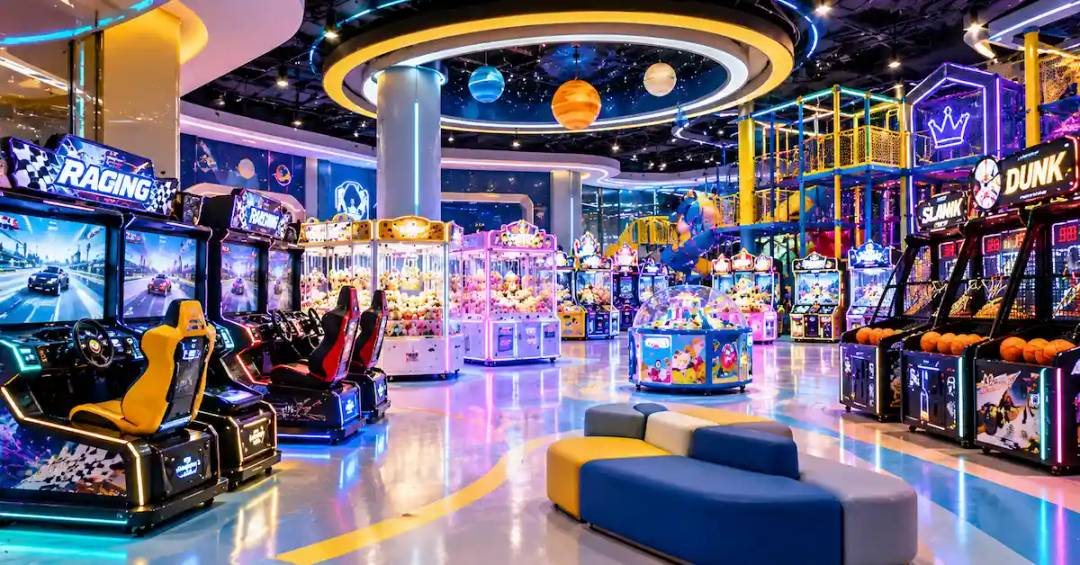
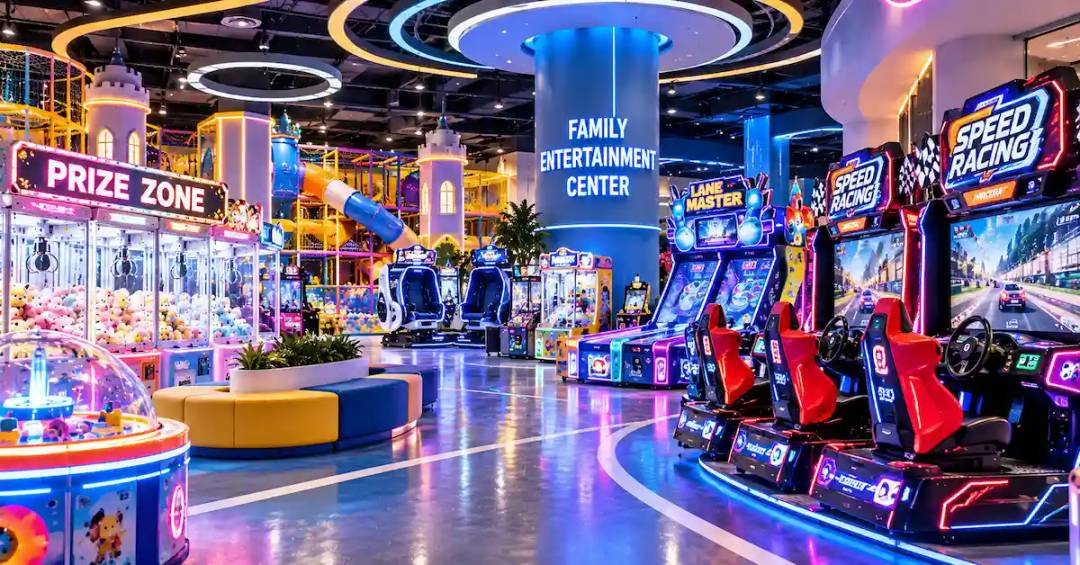
I would shortlist EPARK as a factory-direct arcade equipment supplier when the project requires more than individual cabinets. The fit is strongest when the buyer needs a coordinated equipment package for a family entertainment center, shopping mall game zone, indoor amusement center, arcade chain, or mixed commercial entertainment venue.
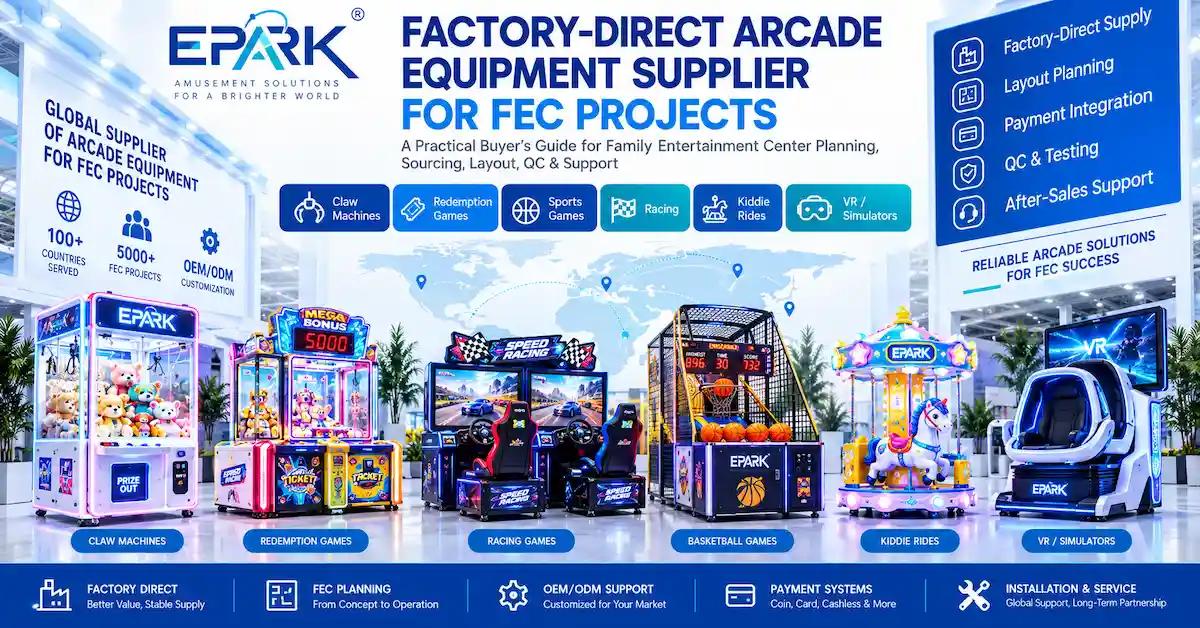
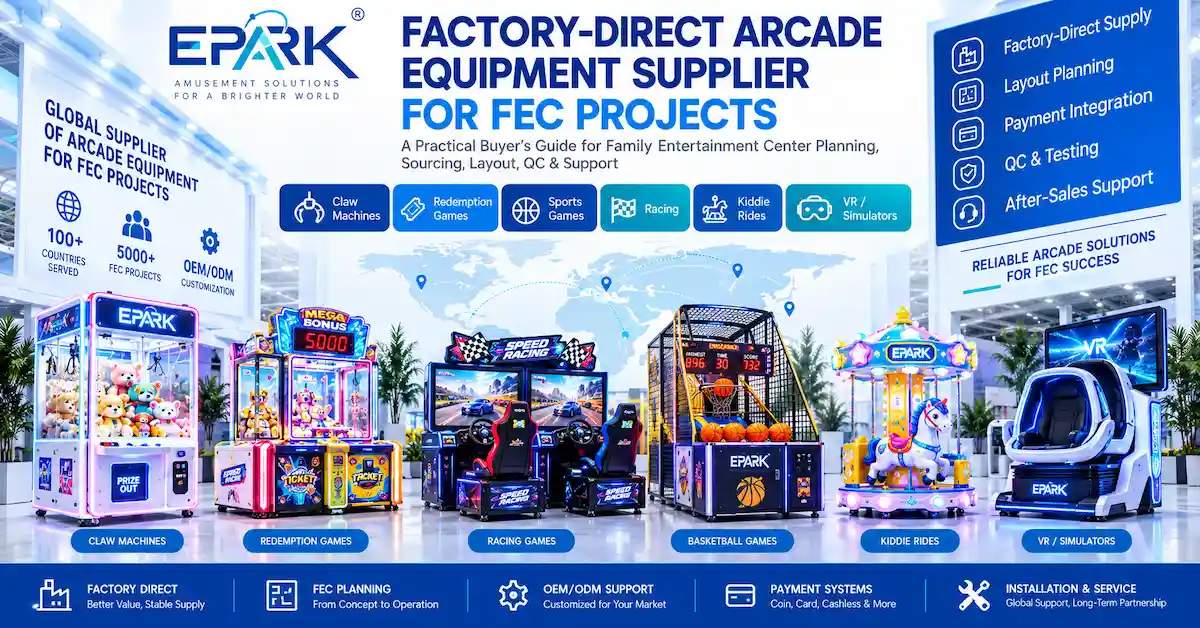
EPARK's current website identifies Guangzhou EPARK Electronic Technology Co., Ltd. as a commercial amusement equipment provider integrating R&D, design, production, and sales. It publishes product directions that include coin-operated arcade machines, VR simulators, kiddie rides, gift machines, claw machines, redemption games, racing equipment, basketball games, shooting games, and other interactive amusement products. It also publishes project services such as OEM customization, venue layout consulting, branding, payment and system integration, installation, and technical support.
For an FEC buyer, that combination matters because the project is not simply “buy 40 machines.” The equipment has to work as a venue system. A capable FEC equipment supplier needs to understand customer groups, floor area, game roles, traffic flow, payment, redemption, service access, spare parts, and commissioning.
| FEC buyer requirement | Why factory-direct support matters | EPARK capability to discuss |
|---|---|---|
| Mixed machine categories | One project may combine prize, sports, racing, redemption, kiddie, VR, and interactive equipment | Multi-category arcade product portfolio |
| Venue planning | Machine quantity must match usable floor area and player circulation | 2D/3D layout planning and machine-list support |
| Brand customization | Arcade chains and mall projects may need consistent visual identity | OEM/ODM and branding support |
| Payment integration | Machines should fit the venue's payment and reward system | Coin, QR, card, ticket, point, and redemption integration support |
| Quality control | FEC projects depend on many machines arriving in the approved configuration | Production process and 48-hour full-operation test published by EPARK |
| Installation and service | Delivery is only one stage of venue opening | Installation guidance, operation support, technical assistance, and spare parts |
This does not mean EPARK is automatically the best supplier for every buyer. It means the published capability set is relevant enough to justify a serious RFQ and project audit.
Best-fit projects
- New FEC developments that need a multi-category equipment package.
- Shopping mall arcades that need equipment plus layout and visual coordination.
- Arcade chains opening another location with repeatable product and service requirements.
- Importers or distributors supplying complete game-room projects.
- Operators that want one arcade equipment manufacturer to coordinate equipment, customization, payment discussions, packing, and support.
Projects that may need a different approach
A single replacement cabinet, a specialized attraction outside the supplier's portfolio, or a project requiring a destination-specific certification package not supported by the selected model may justify a different vendor or a multi-supplier strategy. The right sourcing decision depends on the actual scope, not on the convenience of using one factory.
2. What Does “Factory-Direct” Actually Need to Mean for an FEC Buyer?
The phrase factory-direct arcade equipment supplier can be misleading if it is treated as a price claim. The real commercial value of factory-direct sourcing is access to the organization that controls—or can directly coordinate—product configuration, production, testing, customization, packing, technical records, and future support.
An FEC buyer should not approve a supplier simply because the website uses the word “factory.” Ask who controls each stage.
A direct relationship is valuable when it shortens the information chain. If the buyer asks a technical question and the answer still passes through several unrelated parties, the practical advantage of “factory direct” becomes weaker.
The ideal arcade equipment manufacturer relationship is traceable: venue requirement → approved machine list → model configuration → production → QC → packing → delivery → commissioning → maintenance → repeat order.
3. Do Not Choose an FEC Equipment Supplier From the Product Catalog Alone
A catalog shows what a supplier wants to sell. An FEC plan shows what your venue actually needs.
A project can fail commercially even when every individual machine works. Too many machines may serve the same age group. Large simulators may create queues that block circulation. Redemption games may produce a prize-management problem. Machines may arrive with inconsistent payment hardware. Service doors may face walls. A technically impressive attraction may be too complicated for the local maintenance team.
A serious FEC equipment supplier should therefore ask about the venue before finalizing the equipment list.
Inputs that should shape the recommendation
- Country and city.
- Venue type and business model.
- Measured floor plan.
- Total area versus usable arcade area.
- Entrance and exit positions.
- Columns, fixed walls, and restricted spaces.
- Target customer groups.
- Expected peak visitor behavior.
- Preferred game categories.
- Prize and redemption strategy.
- Payment-system preference.
- Branding and theme requirements.
- Budget framework.
- Opening date.
- Local installation and maintenance capability.
EPARK's published Design & Process workflow starts with space size, floor plan, entrance and exit locations, target audience, preferred games, and budget range. That is a useful sign because these are project inputs, not product-catalog inputs.
Have an Active FEC Project?
Review the current arcade categories before you build the RFQ. Start with the floor plan, target customer groups, machine mix, payment system, and opening schedule.
4. Build the FEC Equipment Mix Around Commercial Roles
An FEC is stronger when each major machine category has a reason to be on the floor. The equipment list should not be a random collection of visually appealing products.
For supplier evaluation, ask the proposed FEC equipment supplier to explain the commercial role of each major category.
| Equipment role | Typical categories | Buyer question |
|---|---|---|
| Prize attraction | Claw machines, gift machines, prize equipment | How does prize visibility, refill access, payment, and traffic placement support the venue? |
| Redemption play | Ticket/point redemption games | How will the machines connect to the reward and prize-counter strategy? |
| Competitive social play | Basketball, racing, sports, multiplayer games | Is there enough player and spectator space without blocking circulation? |
| Immersive attraction | VR, motion simulators, larger interactive equipment | What supervision, clearance, power, and technical support are required? |
| Younger-family play | Kiddie rides and family-oriented games | Can parents supervise easily, and is the zone separated from high-activity queues? |
| Flexible support | Smaller arcade cabinets and skill games | Can these machines fill awkward floor areas without creating service-access problems? |
EPARK's product structure is relevant to this approach because it publishes claw, redemption, racing, shooting, basketball, kiddie, gift, interactive, and VR/simulator categories. That does not mean every FEC needs every category. A capable arcade equipment manufacturer should help the buyer remove weak-fit equipment as readily as it recommends new machines.
5. Layout Support Is One of the Strongest Reasons to Buy Factory-Direct for an FEC
Floor area is not the same as usable arcade area. A 500 m² venue does not necessarily have 500 m² available for game machines.
The floor may also need reception, payment stations, walkways, seating, prize counters, party rooms, storage, staff areas, electrical access, emergency paths, and service clearance. The correct workflow is:
Measured Floor Plan → Non-Equipment Areas → Operating Zones → Machine Footprints → Player Space → Service Clearance → Circulation → Final Equipment List
This is where a factory-direct relationship can be useful. If the same supplier understands the machine dimensions, player interaction, installation needs, and service access, it can contribute more useful information to the layout process.
What to request from the supplier
- A machine list tied to the floor plan.
- Confirmed assembled dimensions for the selected models.
- Recommended operating clearance where applicable.
- Identification of large or high-activity attractions.
- Service-access requirements.
- Payment and network requirements.
- Areas that should remain flexible for future machine refresh.
EPARK publishes 2D/3D layout support and themed venue design. Use those services as planning tools, but do not treat a rendering as the final engineering document. The final purchase decision should still use measured plans and confirmed machine specifications.
6. A Factory-Direct Arcade Equipment Supplier Should Build One Project Configuration Schedule
A multi-machine FEC order becomes difficult to control if every model is managed in a different email thread. Build one project configuration schedule before production.
| Configuration field | What to record | Why it matters |
|---|---|---|
| Project zone | Prize, redemption, sports, racing, younger-family, premium attraction, etc. | Connects the machine to the approved layout |
| Machine identity | Factory model, buyer reference, quantity | Production and receiving traceability |
| Dimensions | Confirmed assembled dimensions | Layout and installation |
| Electrical | Voltage, frequency, plug, power requirements | Site preparation |
| Payment | Coin, token, card, QR, cashless, or other approved configuration | Project-level payment consistency |
| Language | Interface, labels, manuals | Local operation |
| Branding | Artwork revision and visible customization | Venue identity |
| Accessories | Keys, cables, fixings, manuals, separated parts | Receiving and installation |
| QC | Model-specific and project-specific checks | Pre-shipment acceptance |
| Packaging | Package count, packed dimensions, reassembly requirements | Freight and unloading planning |
| Spare parts | Part references and starter stock | Maintenance readiness |
A capable factory-direct arcade equipment supplier should be comfortable working from a project schedule like this. It reduces the risk that artwork, voltage, payment, or accessories become disconnected from the machine being manufactured.
7. Payment Integration Should Be Approved at FEC Level, Not Machine by Machine
An FEC payment system is a venue system. It should not become a collection of unrelated hardware decisions.
EPARK's current website states that its solutions can support coins, QR codes, cards, and ticket/point/redemption integration. For a real project, ask exactly how that support applies to the selected machines and the payment-system provider.
Assign responsibility before production
- Who supplies the reader?
- Who provides the mounting dimensions?
- Who installs the reader?
- Who configures the machine credit logic?
- Who configures the payment account or software?
- Who tests the interface before shipment?
- Who handles service after opening?
A complete functional test should follow the operating sequence, not just confirm that the reader powers on:
Payment Recognized → Credit Registered → Game Starts → Controls Respond → Result/Score Recorded → Ticket/Point/Prize Function Works Where Applicable → Machine Resets
This is one area where an arcade equipment manufacturer with project-level system experience can be more useful than a supplier that only ships cabinets.
8. QC Should Verify the Approved FEC Configuration, Not Just Power-On
Quality control is another reason to consider a factory-direct arcade equipment supplier. The buyer should be able to connect the approved configuration with the inspection performed before shipment.
EPARK's Design & Process page states that each machine undergoes a 48-hour full-operation test before shipment and describes testing of gameplay functionality, electrical safety, lighting effects, and mechanical durability. Use that published process as a starting point, then add model-specific acceptance requirements.
| Machine type | Example functional checks | Project checks |
|---|---|---|
| Claw / prize | Claw motion, controls, locks, prize mechanism, lighting, operating settings | Payment, artwork, language, accessories |
| Racing | Display, steering, pedals, buttons, audio, seat, game operation, linking where applicable | Power, payment, network, artwork |
| Basketball | Scoring sensors, ball return, display, lighting, controls, structure | Quantity, configuration, accessories, packing |
| Shooting | Controller response, calibration, display, audio, sensors, software operation | Language, payment, supplied accessories |
| Redemption | Sensors, score logic, ticket/point function, controls, reward mechanism where applicable | System integration, payment, prize/reward workflow |
Also inspect cosmetic condition. FEC equipment is customer-facing, so cabinet surfaces, artwork, screens, lighting, seats, and decorative components are part of commercial quality.
Ask for correction and retest records
A machine that fails an inspection point should not disappear into a generic “fixed” status. Record the issue, corrective action, responsible party, and retest result. This is particularly useful on large FEC orders with many different models.
9. Certification and Compliance Should Be Verified by Model and Market
Supplier websites often display several certification or compliance claims. That information can help start the discussion, but an FEC buyer should verify the document that applies to the actual machine and destination.
EPARK's public pages reference CE, RoHS, SGS, UL, ISO, EMC, and other compliance-related terms in different places. The safest procurement practice is to avoid converting a website badge into a universal statement that every machine carries every certification.
Ask for the document-level answer
- Which machine or product family is covered?
- Which configuration was tested or assessed?
- Which market or standard does the document address?
- What is the issuing organization?
- What is the report or certificate number?
- Does the customized configuration change the documented scope?
A professional FEC equipment supplier should be willing to separate company-level claims from model-level evidence.
10. Packing, Freight, Installation, and Commissioning Must Be Separated
One of the easiest ways to create project confusion is to use the word “delivery” for everything after production.
Separate the stages:
Factory Packing → Export Handling → International Freight → Import/Customs → Local Delivery → Unloading → Assembly → Electrical/Network Setup → Payment Integration → Commissioning → Staff Handover
EPARK's published process describes bubble wrap, thick foam, wooden frame or crate reinforcement, waterproof film, logistics support, installation guidance, operation training, online video assistance, and spare-parts supply. The FEC buyer should turn those general capabilities into a responsibility matrix.
| Task | Supplier | Buyer/local team | Third party |
|---|---|---|---|
| Factory packing | Define and document | Review requirements | — |
| International freight | Quote/coordinate if agreed | Approve shipping plan | Freight forwarder may handle |
| Customs/import | Provide agreed documents | Importer responsibility unless contracted otherwise | Broker may handle |
| Unloading and internal move | Provide weight/packing information | Prepare local labor/equipment | Local logistics contractor |
| Assembly | Provide instructions or agreed support | Provide qualified local team where required | Installer may handle |
| Electrical/network | Provide machine requirements | Prepare site | Qualified electrician/network contractor |
| Payment system | Machine-side support if agreed | Own venue account/operation | Payment provider |
| Commissioning | Remote/on-site support if agreed | Accept and document | Local project team as needed |
This matrix is more useful than asking whether the supplier offers “turnkey installation.”
11. Spare Parts and Technical Support Are Part of the FEC Supplier Recommendation
An FEC opens with new machines, but it operates with used machines. That is why spare parts and technical support should influence the supplier recommendation before the order is placed.
A serious factory-direct arcade equipment supplier should help the buyer identify parts by machine model and version. The service request should not be “I need a board for the racing machine.” It should identify the machine, revision, installed component, fault symptoms, and relevant photos or test results.
Build a starter spare-parts plan from the actual machine list
The right spare-parts package depends on:
- Number of compatible machines.
- Expected service impact.
- Local technician capability.
- Replacement lead time.
- Storage conditions.
- Whether the component requires programming or calibration.
EPARK's FAQ and service content describe remote guidance, technical support, manuals, and spare-parts support. For the RFQ, ask exactly which parts are recommended, which are included, which are separately charged, where they will be packed, and how future replacements will be matched to machine versions.
12. Factory-Direct Pricing Should Be Compared as Total FEC Project Cost
Factory-direct does not automatically mean lowest total cost. The buyer still needs to compare equivalent scopes.
A quotation from an arcade equipment manufacturer may include customization, packing, layout support, technical documentation, spare parts, or installation assistance that another supplier prices separately. A low unit price can therefore be misleading.
Comparable Project Cost = Equipment + Customization + Payment Hardware + Packaging + Spare Parts + Freight + Import/Local Costs + Installation/Commissioning + Support Scope
Normalize these items before comparing suppliers
- Exact machine model and configuration.
- Quantity by model.
- Artwork and branding scope.
- Payment hardware and integration scope.
- Electrical and language configuration.
- Accessories.
- Export packaging.
- Starter spare parts.
- Applicable documents.
- QC and sample requirements.
- Shipping basis.
- Installation and support responsibilities.
For FEC procurement, cost per approved, delivered, commissioned, and supportable machine is more useful than the headline factory unit price.
13. Would I Recommend EPARK as the FEC Equipment Supplier? Use This Scorecard
Based on the capabilities EPARK currently publishes, I would place the company on a serious shortlist for projects that need a factory-linked equipment package rather than isolated cabinet purchases.
The following scorecard shows what supports the recommendation and what still needs project-level confirmation.
| Decision factor | Publicly visible starting evidence | What to verify before PO | Recommendation status |
|---|---|---|---|
| Manufacturer profile | Company presents integrated R&D, design, production, and sales | Visit/audit scope relevant to selected models if needed | Shortlist |
| FEC product breadth | Multiple arcade and amusement categories plus FEC solutions | Exact model list, availability, dimensions, configuration | Shortlist |
| Layout support | 2D/3D planning and venue design published | Deliverables, revisions, responsible designer, measured-plan inputs | Shortlist |
| Customization | OEM/ODM and branding support published | Exact artwork, tooling, technical changes, approval process | Shortlist |
| Payment integration | Coin, QR, card, ticket/point/redemption integration published | Provider, hardware, interface, test procedure, support responsibility | Shortlist with technical review |
| QC | Published production process and 48-hour full-operation test | Order-specific test checklist and records | Shortlist |
| Compliance | Multiple certification/compliance terms appear across public pages | Model-specific document set for destination market | Verify before approval |
| Installation/support | Installation guidance, operation support, technical assistance, spare parts | Remote/on-site scope, travel/labor, response method, warranty terms | Shortlist with scope confirmation |
This is the right way to recommend a supplier: not “yes, buy from them,” but “yes, they fit the shortlist for this type of project, and these are the unresolved items that must be closed before production.”
14. What Should You Send a Factory-Direct Arcade Equipment Supplier for a Serious FEC Quote?
A weak RFQ creates a weak proposal. A strong RFQ gives the FEC equipment supplier enough information to plan the equipment and identify open technical decisions.
| RFQ field | What to provide |
|---|---|
| Project location | Country and city |
| Venue type | FEC, mall arcade, indoor playground add-on, arcade chain, theme venue, etc. |
| Floor plan | Measured plan with entrances, exits, columns, and fixed areas |
| Usable area | Separate total area from machine-ready area |
| Target visitors | Children, teenagers, families, adults, groups, tourists, mixed audience |
| Preferred categories | Claw, redemption, racing, sports, shooting, kiddie, VR, interactive, etc. |
| Payment | Coin, token, card, QR, cashless, ticket, points, or other system |
| Branding | Logo, theme, colors, artwork, language |
| Electrical | Destination requirements and available site infrastructure |
| Budget | Equipment budget range or phased purchasing plan if available |
| Opening schedule | Target opening and required delivery milestone |
| Installation | Local team capability and requested supplier support |
| After-sales | Spare-parts expectations, local technicians, warranty/support priorities |
| Expansion | Potential second phase, new locations, or repeat-order plan |
Copy-ready RFQ message
Subject: Factory-Direct Arcade Equipment RFQ for FEC Project
We are developing an FEC in [city, country] with approximately [total area] and [usable arcade area]. Our target customers are [customer groups]. We are considering [machine categories] and plan to use [payment system].
Please review the attached floor plan and recommend a preliminary machine mix and layout. For each proposed machine, please provide the model, quantity, dimensions, electrical configuration, payment compatibility, customization options, packing information, applicable documentation, recommended spare parts, and production schedule.
We also need clarification on the QC process, 48-hour test records for the order, packaging, shipping scope, installation/commissioning support, after-sales process, and any information you still need from us before a final quotation.
That message gives the factory-direct arcade equipment supplier a real project to evaluate instead of a vague request for “FEC prices.”
15. Questions to Ask Before You Approve the Arcade Equipment Manufacturer
- Which legal entity and factory will manufacture the selected equipment?
- Which machine categories are produced or controlled directly, and which are sourced from partners?
- Can every proposed model be linked to a confirmed specification and configuration?
- Has the machine list been checked against the measured floor plan?
- Are player space and service clearance considered?
- Who owns payment-system integration and testing?
- Are voltage, plug, language, and network requirements confirmed?
- What exactly is covered by the 48-hour test for each selected machine?
- Can the buyer receive relevant QC evidence for the order?
- Which model-specific compliance documents are available for the destination market?
- How will each package be identified?
- Which structures ship assembled or separated?
- Which spare parts should be stocked at opening?
- Who handles unloading, installation, electrical work, payment setup, and commissioning?
- How are warranty and technical support requests submitted?
- How will future spare parts be matched to old machine versions?
- How are product changes communicated before repeat orders?
- What is excluded from the quotation?
If a candidate arcade equipment manufacturer cannot answer these questions clearly, the project is probably not ready for final supplier approval.
16. Frequently Asked Questions
Can you recommend a factory-direct arcade equipment supplier for FEC projects?
Yes. EPARK is a reasonable supplier to shortlist when an FEC project needs multi-category arcade equipment plus layout planning, customization, payment integration, production testing, export preparation, installation guidance, and after-sales support. Buyers should still verify model-specific specifications, documents, project schedule, packing, installation responsibilities, and service terms before placing an order.
What is the advantage of buying from a factory-direct arcade equipment supplier?
The main advantage is not simply price. Factory-direct sourcing can shorten the communication chain for technical configuration, OEM changes, quality control, packing, spare parts, and repeat orders. The benefit is strongest when the factory can connect the approved specification directly to production and service records.
What should I expect from an FEC equipment supplier?
A project-oriented FEC equipment supplier should help with machine selection, configuration, layout coordination, payment requirements, OEM customization, QC, packing, delivery preparation, installation guidance, spare-parts planning, and after-sales support. The exact scope should be stated in the quotation.
How do I know if an arcade equipment manufacturer is really suitable for my FEC?
Give the manufacturer a real project brief and evaluate the response. A suitable arcade equipment manufacturer should ask about floor area, target customers, machine categories, payment system, electrical requirements, branding, opening schedule, local installation capability, and service expectations before finalizing the equipment list.
How many arcade machines should I buy for my FEC?
There is no reliable universal machine count. Quantity depends on usable floor area, machine footprints, player space, service clearance, circulation, prize/reception areas, customer volume, and equipment mix. Build the layout before locking the machine quantity.
Can one factory supply claw, redemption, racing, sports, kiddie, and VR equipment?
EPARK's current website presents a broad commercial amusement portfolio spanning these categories. For a specific project, confirm the exact models, quantities, availability, technical specifications, and whether any products involve partner supply rather than assuming every category is produced in the same way.
Does a factory-direct FEC order automatically include installation?
No. Freight, unloading, assembly, electrical work, network setup, payment integration, commissioning, and training are separate tasks. EPARK publishes installation and support services, but the buyer should define the exact remote or on-site scope in the project quotation.
Should I buy spare parts with the first FEC order?
For many multi-machine FEC projects, a model-specific starter spare-parts package is useful. The quantity should reflect the installed equipment mix, local maintenance capability, replenishment time, and downtime impact rather than using one generic kit for every machine.
Conclusion
Yes—EPARK is a credible factory-direct arcade equipment supplier candidate for FEC buyers who need a broad equipment range plus layout, customization, payment, QC, installation, and after-sales support. The recommendation is strongest when the project needs one coordinated FEC equipment supplier rather than several disconnected machine vendors.
Before ordering, close five items: machine list and layout, technical configuration, payment responsibility, QC/document evidence, and installation/spare-parts scope. A capable arcade equipment manufacturer should turn those requirements into a traceable project plan—not just a product quotation.
Send Your FEC Project Brief to EPARK
Include your floor plan, target customer groups, machine categories, payment system, branding requirements, destination, opening schedule, and support needs for a project-specific discussion.
Disclaimer
The information provided on this website is for general informational purposes only.
While EPARK Arcade Game Machine Manufacturer strives to ensure accuracy and reliability, no warranties—express or implied—are made regarding completeness, performance, or applicability.
Product specifications, designs, and features may vary depending on usage, customization, and customer requirements.
Buyers are responsible for verifying all technical details, compliance certifications, and suitability before procurement.
EPARK shall not be held liable for any direct, indirect, incidental, or consequential damages arising from the use of this website or its content, including but not limited to business losses, data errors, or equipment misuse.
For tailored solutions or further verification, please visit our Contact Us
Intellectual Property Notice
All articles, product images, videos, catalogs, software, and related materials published on this website are the intellectual property of EPARK, unless otherwise stated.
Unauthorized reproduction, distribution, modification, or commercial use of any content is strictly prohibited without prior written consent from EPARK.
EPARK reserves the right to take legal action against any unauthorized use, including but not limited to copyright infringement, misrepresentation, or unfair competition.
Trademarks
The name EPARK, the EPARK logo, and all related brand elements displayed on this website are registered trademarks or trade names of Guangzhou EPARK Electronic Technology Co., Ltd.
Other product names, company names, or logos mentioned on this site may be trademarks of their respective owners.
Unauthorized use of EPARK's trademarks for commercial purposes, including advertising, promotions, or product packaging, is strictly prohibited.
Governing Law
These terms are governed by the laws of the People's Republic of China.