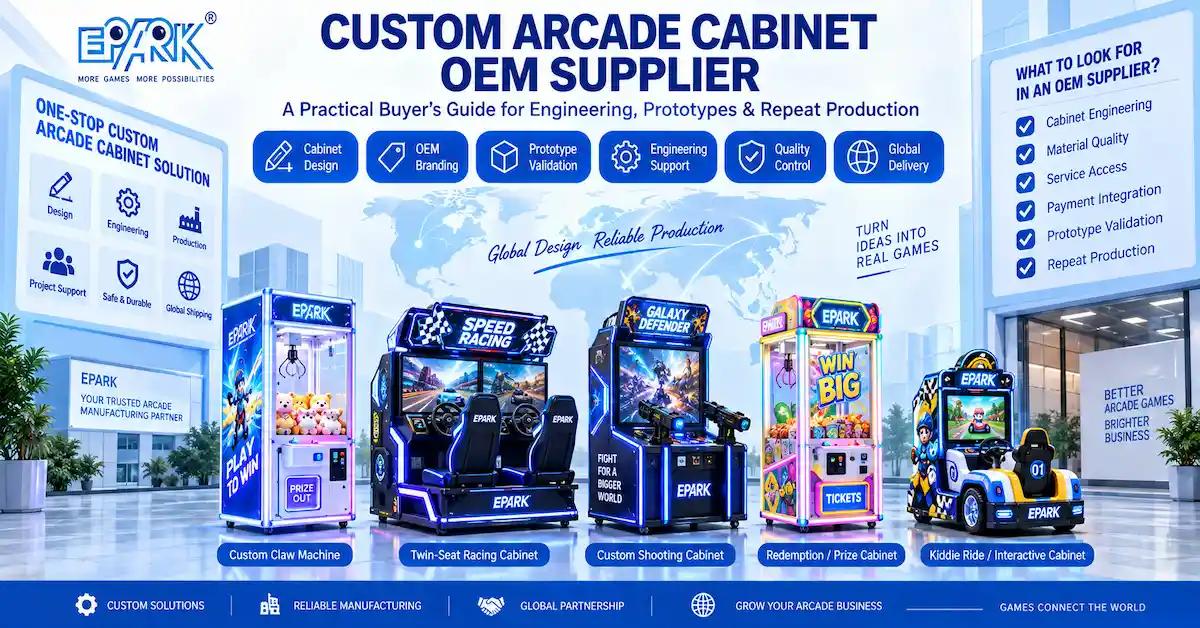

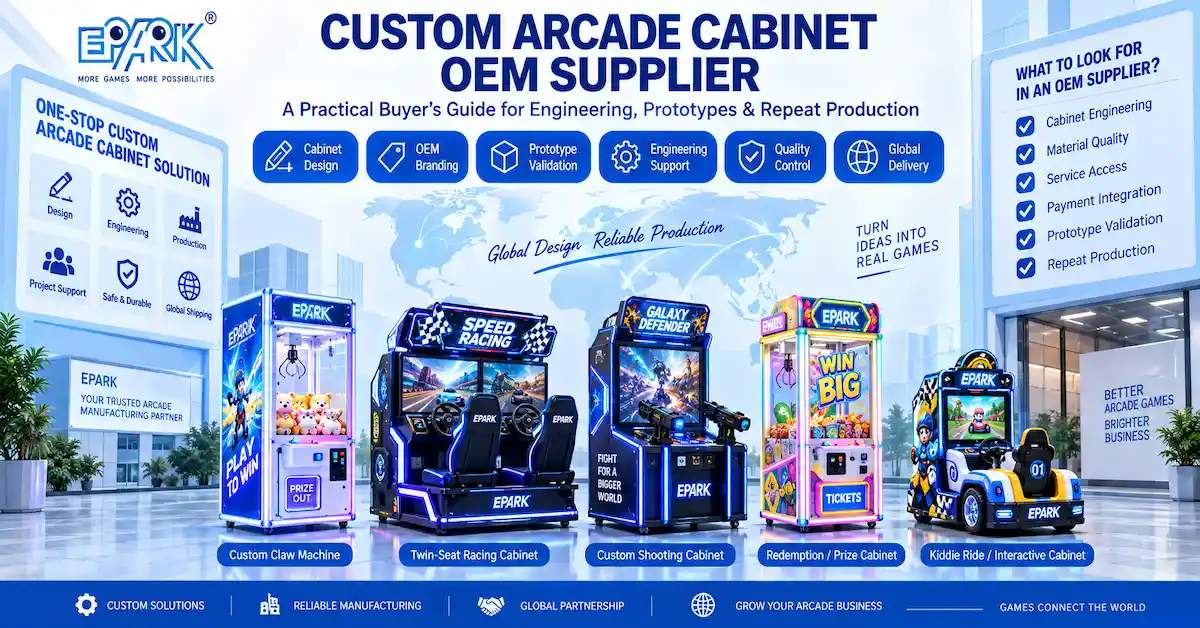
What Should a Custom Arcade Cabinet OEM Supplier Actually Deliver?
A custom arcade cabinet OEM supplier should deliver more than a cabinet that looks different from a standard machine.
For a commercial buyer, a custom cabinet becomes part of a complete operating product. It must support the display, controls, electronics, payment hardware, player interface, internal wiring, cooling, service access, artwork, lighting, shipping, installation, spare parts, and future repeat production.
That means a custom cabinet project should not begin and end with:
Sketch → Rendering → Production
A more reliable development path is:
Commercial Requirement → Product Architecture → Cabinet Engineering → DFM → Prototype → Validation → Golden Sample → Pilot Production → Mass Production → Service Support → Repeat Orders
This difference is critical.
A visually impressive cabinet can still become a poor commercial product if technicians cannot reach the electronics, the control panel is difficult to remove, the payment reader has no standardized mounting position, the cabinet is too large to ship efficiently, or the next production batch cannot reproduce the same dimensions and finish.
For buyers planning a new product family, the current commercial arcade machine platforms can be used as a starting point to decide whether the project should modify an existing machine platform or move into a deeper custom cabinet program.
First Decide Whether You Need OEM Cabinet Customization or Full ODM Development
Not every custom arcade project needs a completely new machine.
This distinction should be made early because every additional engineering change increases development time, validation work, documentation requirements, and repeat-production risk.
Standard Platform With Brand Customization
This is the lowest-complexity route.
The underlying cabinet and machine architecture remain substantially unchanged while buyer-facing elements may be customized.
Typical changes can include branding, artwork, color direction, labels, selected lighting treatment, and approved external graphics.
This can be appropriate when the commercial goal is differentiation without rebuilding the product architecture.
Configured OEM Cabinet
A configured OEM program may keep an existing product platform while adjusting selected interfaces or cabinet details.
Possible project areas can include payment-reader mounting, control-panel layout, branding surfaces, selected dimensions, service panels, display treatment, or market-specific interfaces.
This level requires more technical control than basic private labeling.
Custom Cabinet OEM
A true custom cabinet OEM project changes the physical enclosure substantially while still using a proven gameplay or electronics platform.
The buyer may need a new:
- Cabinet silhouette
- Front panel
- Control deck
- Display housing
- Seat structure
- Decorative light architecture
- Service-door arrangement
- Payment-system location
- Branded exterior system
This is where cabinet engineering becomes a major part of the project.
ODM Development
ODM goes further.
The supplier may participate in product definition, mechanical architecture, controls, interaction design, hardware integration, prototype development, and broader functional development.
The following comparison helps prevent scope confusion:
| Development Type | Typical Scope | Best Fit | Main Control Need |
|---|---|---|---|
| Standard Machine | Existing product | Trial purchase | Product selection |
| Basic OEM | Logo, artwork, colors | Private-label sales | Artwork approval |
| Configured OEM | Branding + market configuration | Regional product program | Specification control |
| Custom Cabinet OEM | New/modified cabinet around proven platform | Differentiated equipment line | Mechanical engineering + prototype |
| ODM | New product architecture or functionality | Proprietary product program | Full product-development control |
If the project mainly concerns cabinet structure and industrial design, a custom cabinet OEM program may be more efficient than treating the project as full ODM.
Start With a Product Requirement Document, Not a Rendering
One of the most expensive mistakes in custom arcade development is approving a beautiful concept image before defining the product requirements.
The cabinet should be designed around the machine's commercial and technical needs.
A rendering cannot answer whether a service technician can remove the monitor, whether a payment device fits the panel, or whether the cabinet can pass through the customer's venue entrance.
Define the Player
The supplier should know who the machine is being designed for.
Important factors may include:
- Child, teen, adult, or mixed audience
- Standing or seated play
- Single or multiplayer use
- Approximate player reach
- Viewing angle
- Control reach
- Entry and exit movement
A seated racing product and a standing redemption machine require completely different cabinet architectures.
Define the Venue
The same game platform can require different cabinets for:
- Family entertainment centers
- Shopping malls
- Arcade chains
- Resorts
- Theme parks
- Small game stores
- Brand activations
- Distributor product lines
Venue type affects footprint, durability expectations, visibility, service access, and aesthetic direction.
Define the Commercial Objective
Ask why the custom cabinet is needed.
Possible objectives include:
Brand differentiation
Smaller footprint
Premium appearance
Better service access
Standardized chain identity
Improved shipping efficiency
Integration of a specific payment system
Creation of a private-label product family
The answer changes the engineering priority.
Create a Cabinet Architecture Before Styling the Exterior
Industrial design should follow a clear product architecture.
The cabinet should be divided into functional zones.
Display Zone
This includes the monitor or screen assembly, mounting frame, bezel, protective panel, and access route.
The buyer should know whether the display can be removed from the front, rear, or side.
That decision affects both cabinet design and future service.
Control Zone
The control zone may contain:
- Buttons
- Joysticks
- Steering wheel
- Pedals
- Guns
- Touchscreen
- Sensors
- Card reader
- Coin or token hardware
- Speaker controls
The panel should support both gameplay and maintenance.
Electronics Zone
Internal electronics need a defined location rather than being installed wherever empty space remains.
The cabinet should account for:
- Power distribution
- Control boards
- Computer or game hardware
- Audio equipment
- Network components
- Payment electronics
- Cable routing
Service Zone
Technicians need deliberate access.
A service zone may include removable panels, hinged doors, slide-out trays, connector access, or internal lighting.
Decorative Zone
Artwork, LED lighting, illuminated logos, molded shapes, and other visual elements should be designed so they do not block maintenance or create unnecessary disassembly.
This is where the cabinet becomes more than a sculpture.
It becomes a maintainable commercial machine.
Design for Serviceability From the First CAD Model
A custom cabinet OEM project should treat maintenance access as a design requirement.
Commercial arcade equipment may operate for many hours per day. Components will eventually require inspection, cleaning, adjustment, or replacement.
Ask What Can Be Reached Without Moving the Machine
If a cabinet must be pulled one meter away from a wall every time a technician opens a service door, the venue layout becomes harder to operate.
Important access points should be planned around the expected installation environment.
Ask Which Components Require Regular Attention
Different machine types have different service priorities.
A racing machine may require access to steering, pedals, seat wiring, screens, and control electronics.
A claw machine may require access to the gantry, claw assembly, prize area, control board, payment system, and lighting.
A shooting machine may require access to controllers, sensors, displays, and internal computing hardware.
The cabinet should reflect these real maintenance tasks.
Standardize Fasteners Where Possible
Using many unnecessary screw sizes, unusual fixings, or difficult-to-reach fasteners slows service work.
A good OEM cabinet should reduce unnecessary variation.
Use Replaceable Modules
Where appropriate, sections such as a control panel, payment-reader panel, access cover, decorative panel, or display bezel can be designed as replaceable modules.
That makes repair and future redesign easier.
Design for Manufacturing, Not Only for Appearance
DFM—Design for Manufacturing—is one of the most important differences between a concept cabinet and a production-ready cabinet.
A design may look excellent in CAD while being expensive, inconsistent, or difficult to manufacture.
Reduce Unnecessary Part Count
Every additional panel, bracket, decorative cover, fastener, or custom component adds work.
More parts can mean:
- More manufacturing steps
- More assembly time
- More tolerance variation
- More spare-part references
- More opportunities for installation mistakes
The objective is not the fewest parts possible.
It is the simplest architecture that achieves the required design and function.
Avoid Decorative Geometry That Creates Production Problems
Complex curves, narrow gaps, hidden fixings, and highly irregular panels may create difficult manufacturing or finishing processes.
The OEM supplier should explain how the chosen design will actually be fabricated.
Standardize Repeated Parts
If left and right decorative panels can share geometry, or several models can use the same control-panel frame, production becomes easier to manage.
This can be especially useful for distributors building a family of related machines.
Design Around Real Assembly Sequence
Ask:
Which part is installed first?
What becomes inaccessible after the next panel is installed?
Can wiring be completed before the decorative shell closes?
Can a technician reverse the sequence later?
A production-ready design should have a logical assembly path.
Choose Cabinet Materials by Function
There is no single best material for every custom arcade cabinet.
Different parts of one cabinet may use different materials.
Metal Structure
Steel or other metal structures can be useful where load-bearing strength, rigidity, mounting, or impact resistance is important.
The frame should match the actual mechanical requirements rather than being overbuilt simply to appear strong.
Wood-Based Panels
Commercial arcade cabinets may use suitable wood-based panels for flat body structures, internal framing, decorative surfaces, or cost-efficient enclosure construction.
The correct material specification depends on design, environment, finish, and load.
Acrylic and Transparent Panels
Acrylic or similar transparent materials may be used for illuminated decorative areas, prize visibility, display protection, or styling.
Thickness and mounting need to account for handling and impact.
Molded or Formed Plastic Parts
Plastic components can create smoother shapes and branded forms.
However, tooling, minimum order quantity, dimensional control, replacement availability, and repairability should be considered before committing to a custom molded part.
Decorative Films and Printed Panels
Graphics can create strong visual differentiation without changing the underlying structure.
This is often one of the most scalable branding tools.
A custom cabinet should therefore use materials intentionally rather than treating “premium materials” as one generic requirement.
Build Service Clearance Into the Cabinet Dimensions
A drawing that lists only width, depth, and height is incomplete.
Commercial installation needs operating dimensions.
Consider:
Cabinet footprint
Player standing/seating area
Door-opening clearance
Control movement
Seat adjustment
Technician access
Ventilation clearance
For complete entertainment projects, this information also helps the buyer connect the machine to commercial arcade layout and project planning before finalizing the venue.
Control the Player Ergonomics Before Freezing the Cabinet
A custom cabinet is an interface between the player and the game.
That makes ergonomics part of engineering.
Viewing Position
The player's normal eye position should work with the screen height and angle.
A cabinet that forces players to look too far upward or downward can become uncomfortable.
Control Reach
Buttons, joysticks, steering systems, and other controls should be reachable without awkward body position.
Leg and Knee Clearance
For seated products, structural brackets and decorative panels should not interfere with normal entry or movement.
Seat Relationship
In racing and simulator machines, seat position, pedal distance, steering position, and screen location form one system.
Changing only one element can affect the others.
Multiplayer Separation
Adjacent players need enough physical separation for comfortable play.
Ergonomics should be tested physically during the prototype stage rather than judged only from drawings.
Treat Controls, Electronics, and Cabinet Design as One System
A custom cabinet should not be designed separately from the machine's electronics.
The enclosure determines how the technical system can be installed and serviced.
Define Cable Routes
Power, signal, lighting, network, payment, speaker, sensor, and controller cables should have planned routing.
Avoid layouts in which cables cross moving parts, sharp edges, or major service openings.
Define Connector Locations
Service technicians should not need to dismantle major cabinet sections to reach common connectors.
Define Power Distribution
The cabinet needs a logical area for power-related components and service access.
Define Ventilation
Displays, computers, amplifiers, power supplies, lighting, and other electronics create heat.
Ventilation openings should be designed deliberately.
The cabinet should avoid situations in which decorative panels unintentionally block airflow.
Define Speaker Placement
Audio design affects both user experience and cabinet structure.
Speaker openings, mounting, vibration, and service access should be considered during engineering.
Integrate Payment Hardware Before the Prototype Is Finished
Payment integration is often treated too late in custom arcade projects.
That can lead to improvised reader brackets, exposed cables, poorly positioned devices, or cutouts added after the cabinet design is finished.
Instead, identify the payment architecture early.
The current arcade OEM and customization capabilities can be used as a starting point when discussing how the intended machine configuration will fit the buyer's project.
Define the Payment Device
Name the actual system where possible.
Do not write only:
“Card system.”
Different readers may require different:
- Mounting holes
- Panel thickness
- Cable routing
- Communication connections
- Power
- User access
Define Operator Access
The operator may need to remove, reset, replace, or inspect the reader.
That should not require disassembling the entire control panel.
Protect Future Flexibility
A removable payment plate can sometimes make the cabinet easier to adapt to different markets.
The same cabinet platform may then support different payment hardware with a smaller panel change rather than a complete redesign.
Separate Branding Surfaces From Structural Surfaces
Custom arcade cabinets often need strong branding.
However, placing artwork directly across important service joints can make maintenance difficult.
A better design identifies artwork zones intentionally.
Header / Marquee
A replaceable header can support branding changes and model differentiation.
Side Panels
Large side areas provide strong visual impact but should account for seams, doors, ventilation, and service access.
Control Deck
Brand graphics should not interfere with control labels or frequently touched areas.
Front Base
This area can carry product identity, operator branding, or illuminated elements.
Screen Bezel
Decorative treatment should not make display replacement unnecessarily difficult.
Service Doors
If artwork crosses a service door, the door should remain visually aligned after repeated opening.
This is where product design and graphic design must work together.
Create an Artwork Zone Map
For private-label buyers, create an artwork map by cabinet surface.
| Cabinet Area | Artwork Requirement | Replaceable? | Service Interaction |
|---|---|---|---|
| Marquee | Logo / machine title | Yes | Low |
| Side panel | Main brand graphics | Often | Medium |
| Control panel | Functional graphics | Yes | High |
| Front base | Brand / product identity | Yes | Low |
| Service door | Minimal or aligned graphics | Yes | High |
| Payment area | Instructions / brand cue | Yes | High |
The artwork file should be tied to the exact cabinet revision.
If the cabinet changes, the artwork template should also change.
Prototype in Stages Instead of Jumping Directly to Mass Production
Different prototypes answer different questions.
A supplier does not always need to use the same prototyping method for every project.
Visual Mockup
A visual mockup checks appearance.
It may help review:
- Proportion
- Brand placement
- Color
- Player impression
- Cabinet silhouette
It does not automatically validate manufacturing or internal engineering.
Engineering Prototype
The engineering prototype checks physical integration.
This should confirm areas such as:
- Cabinet dimensions
- Internal structure
- Electronics mounting
- Control installation
- Service access
- Display position
- Wiring
- Payment interface
- Lighting
- Mechanical fit
Functional Prototype
The complete prototype should operate as a commercial machine.
The buyer can now evaluate real gameplay, ergonomics, service procedures, and physical behavior.
Golden Sample
After corrections, the approved sample becomes the production reference.
This Golden Sample should represent the configuration that mass production must reproduce.
Use a Prototype Review Checklist
A custom cabinet approval should cover more than appearance.
| Review Area | Key Question |
|---|---|
| Overall appearance | Does it match the approved design intent? |
| Dimensions | Does the cabinet match the controlled drawing? |
| Ergonomics | Can players use it comfortably? |
| Controls | Are positions and responses correct? |
| Display | Is the viewing position correct? |
| Payment | Is hardware integrated cleanly? |
| Service access | Can technicians reach key parts? |
| Wiring | Is routing organized and protected? |
| Ventilation | Are heat-producing areas adequately considered? |
| Lighting | Does lighting work without blocking service? |
| Artwork | Does it match approved files? |
| Stability | Does the machine feel mechanically stable? |
| Packing | Can the machine be transported efficiently? |
The prototype should not be approved merely because it “looks good.”
Convert the Approved Prototype Into a Production Specification
The Golden Sample is valuable, but production should not rely only on a physical sample.
Build a controlled documentation set.
Master Drawing
The drawing set should identify key dimensions, parts, and revision status.
Bill of Materials
The BOM connects the cabinet to its production components.
Artwork Register
Keep the approved file and revision.
Electrical Configuration
Record the approved technical version.
Payment Configuration
Record the installed system or interface.
Accessories
List what ships with the product.
Spare Parts
Define model-linked service items.
Packaging Record
Document the approved packing structure.
This turns one successful prototype into a repeatable product.
Revision Control Is Essential for OEM Cabinets
A custom cabinet can evolve.
The supplier may improve a bracket, change a display, update a door, or replace a component.
Changes are not automatically bad.
Uncontrolled changes are the problem.
Use a revision structure such as:
Rev A — First prototype
Rev B — Ergonomic correction
Rev C — Production-approved version
The exact system can differ.
The important point is that the buyer can identify which version was produced.
Do Not Allow Unapproved Component Substitution
Supply-chain availability can change.
If an original part becomes unavailable, the supplier may need an alternative.
For critical components, the buyer and factory should define whether substitution requires approval.
Examples can include:
- Display
- Main control hardware
- Payment device
- Power component
- Steering system
- Sensor
- Major lighting component
A replacement may be technically acceptable but still affect service parts or future batches.
Change notification protects both sides.
Use a Pilot Run Before Scaling a New Cabinet
A Golden Sample proves that one machine can be built correctly.
A pilot batch proves that the product can be reproduced.
This is an important difference.
What Pilot Production Tests
Pilot production can reveal:
- Assembly variation
- Fit inconsistencies
- Artwork alignment issues
- Wiring differences
- Production bottlenecks
- Repeated cosmetic defects
- Packaging problems
A custom cabinet intended for a large distributor program should not be evaluated only by one hand-finished prototype.
Identify Critical-to-Quality Cabinet Dimensions
Not every dimension needs the same inspection priority.
Some dimensions directly affect function or assembly.
These can include:
- Screen opening
- Control mounting holes
- Door alignment
- Seat mounting
- Payment-device opening
- Service-panel fit
- Internal electronics mounting
- Connected-machine alignment
These become critical-to-quality dimensions.
They deserve tighter control than purely decorative dimensions.
Use Fixtures and Templates for Repeat Production
When the same custom cabinet will be produced repeatedly, manufacturing aids can improve consistency.
Depending on the process, these may include:
- Drilling templates
- Welding fixtures
- Positioning jigs
- Artwork placement guides
- Assembly fixtures
- Inspection gauges
The exact methods depend on cabinet construction.
The purchasing principle is that repeatability should be engineered, not assumed.
Define Cosmetic Quality Before Mass Production
Appearance can become a source of disagreement if buyer and supplier never define what is acceptable.
For visible areas, establish expectations around:
- Surface finish
- Color consistency
- Print alignment
- Panel gaps
- Scratches
- Lighting uniformity
- Decorative trim
- Fastener appearance
The Golden Sample can act as the cosmetic reference.
QC Should Verify the Custom Features Separately
Standard machine QC is not enough when the cabinet is customized.
A custom cabinet introduces additional failure modes.
Structural QC
Confirm assembly, stability, panel fit, doors, hinges, brackets, and major mounting points.
Functional QC
Confirm the complete game works.
Custom-Feature QC
Verify every special OEM requirement.
For example:
Custom payment bracket installed?
Correct logo revision?
Correct cabinet color?
Correct LED sequence?
Correct control panel?
Correct service door?
Final Configuration QC
The accepted machine should match the approved production record.
Buyers can use the published arcade machine design and manufacturing process as a starting point when discussing how custom requirements will be incorporated into production and testing.
Design Spare Parts During Product Development
A common mistake is waiting until the first machine fails before deciding which parts should be available.
A custom cabinet project should identify service parts during development.
Cosmetic Spare Parts
Examples may include:
- Printed panel
- Decorative trim
- Marquee
- Lighting module
- Protective cover
Mechanical Parts
Examples may include:
- Hinges
- Locks
- Brackets
- Handles
- Seat components
Electronic Parts
Examples may include model-specific control or interface components.
The exact parts list depends on the machine.
Connect the Part to the Revision
Use:
Machine SKU → Revision → Part Code → Part Description
That allows the buyer to support equipment years after production.
For buyers building a service system, the current arcade equipment maintenance and spare-parts guidance provides a useful next step.
Design the Cabinet Around Packaging and International Shipping
A cabinet can be visually excellent and still be inefficient to ship.
That affects landed cost.
Review Packed Size Early
Large decorative structures may dramatically increase CBM.
A small dimensional reduction can sometimes create meaningful logistics benefits across a bulk order.
Consider Removable Modules
Seats, marquees, control panels, decorative structures, or other assemblies may sometimes be designed for controlled removal during shipping.
However, field assembly must remain manageable.
Protect Fragile Areas
Screens, acrylic panels, lighting, controls, and decorative edges require appropriate protection.
Consider Center of Gravity
Large cabinets should remain manageable during handling.
The supplier should think about lifting, moving, unpacking, and installation—not only factory assembly.
Create Installation Logic During Engineering
The destination team should understand how the cabinet becomes operational after delivery.
The OEM program should define whether the machine ships:
Fully assembled
Partially disassembled
In modules
If assembly is required, clarify:
- Required tools
- Connector locations
- Fasteners
- Sequence
- Alignment
- Testing
Technical support becomes more efficient when the installation method is designed rather than improvised.
Custom Cabinet Cost Should Be Broken Into Development and Unit Cost
Custom arcade buyers often compare only the final per-unit price.
That can hide the structure of the project.
A custom cabinet program may involve two different types of cost.
Non-Recurring Development Cost
This may include:
- Industrial design
- Engineering
- Prototype fabrication
- Special tooling
- Artwork setup
- Development testing
These costs are related to creating the product.
Recurring Unit Cost
This may include:
- Cabinet material
- Fabrication
- Finish
- Electronics integration
- Controls
- Lighting
- Artwork
- Assembly
- QC
- Packaging
Separating these helps the buyer understand what will repeat on future orders.
What Drives the Price of a Custom Arcade Cabinet?
Several variables can materially change project cost.
| Cost Driver | Why It Matters |
|---|---|
| Cabinet size | More material and shipping volume |
| Structural complexity | More fabrication and assembly |
| Custom molded parts | Tooling and MOQ |
| Surface finish | Additional production steps |
| Decorative lighting | Components and wiring |
| Control complexity | More integration work |
| Payment integration | Custom mounting/interface work |
| Prototype count | Additional development cycles |
| Quantity | Production efficiency |
| Packaging | Protection and shipping structure |
A useful quotation should separate standard machine cost from custom development scope where practical.
Evaluate the Supplier's Engineering Process, Not Just Its Portfolio
A supplier can show many finished machines without proving that it can manage a new custom cabinet project.
Ask process questions.
How Are Requirements Captured?
Does the project begin with a written specification?
Who Owns Mechanical Design?
Can the supplier explain who turns styling into production drawings?
How Are Changes Approved?
Is there a revision process?
How Is the Prototype Evaluated?
Does approval cover function, ergonomics, and service access?
How Is the Golden Sample Preserved?
What becomes the mass-production reference?
How Are Parts Identified?
Can replacement components be traced later?
These questions reveal more than marketing images.
Use a Custom Arcade Cabinet OEM Supplier Scorecard
A structured comparison can reduce emotional supplier selection.
| Evaluation Area | Suggested Weight |
|---|---|
| Cabinet Engineering Capability | 15% |
| DFM / Production Readiness | 10% |
| Prototype Development | 10% |
| Electronics Integration | 10% |
| Serviceability | 10% |
| QC & Repeatability | 10% |
| OEM Branding Control | 5% |
| Documentation & Revision Control | 10% |
| Spare-Parts Support | 5% |
| Communication | 5% |
| Commercial Competitiveness | 5% |
| Packaging / Export Readiness | 5% |
The weights can be adjusted.
A private-label distributor may place more emphasis on repeatability and documentation.
An FEC operator developing a signature attraction may place more emphasis on ergonomics and serviceability.
Red Flags When Evaluating a Custom Arcade Cabinet OEM Supplier
Certain responses should trigger deeper investigation.
“Just Send Us a Picture”
A picture is not an engineering specification.
The supplier should ask questions about dimensions, function, controls, target players, service access, and technical requirements.
No Distinction Between OEM and ODM
If every request is called “OEM,” scope can become unclear.
No Prototype Approval Stage
Jumping directly from rendering to mass production increases risk.
No Revision Numbers
A project without revisions becomes difficult to control.
Service Access Is Not Discussed
This suggests the project is being treated mainly as styling.
Artwork Is Managed Only in Chat Messages
This creates repeat-order and version risk.
Components Can Change Without Notification
This makes future service and parts management harder.
No Model-Linked Spare Parts
Custom machines require traceability.
Packaging Is Discussed After Production
Shipping constraints should influence design earlier.
What Should You Send a Custom Arcade Cabinet OEM Supplier?
A strong inquiry should contain enough information for technical evaluation.
- Target market and buyer type
- Intended venue or resale channel
- Target player group
- Reference machine or base platform
- Desired cabinet dimensions or footprint limits
- Standing or seated gameplay
- Display requirement
- Control requirement
- Payment-system requirement
- Electrical configuration
- Branding guidelines
- Color direction
- Artwork expectations
- Service-access requirements
- Expected first-order quantity
- Expected future volume
- Packaging or shipping constraints
- Target development schedule
If the project is still early, separate confirmed requirements from preferences.
Buyers preparing a new cabinet program can review commercial arcade machine platforms for OEM development and then submit drawings, reference images, target quantities, branding, and technical requirements through the custom arcade equipment project inquiry.
What Deliverables Should Be Approved Before Mass Production?
Before releasing a custom cabinet into mass production, buyers should confirm more than one render.
The approval package should ideally identify the following.
Approved Cabinet Design
The shape, dimensions, access panels, controls, display, lighting, and branding surfaces should be frozen.
Approved Functional Prototype
The machine should operate in the intended configuration.
Approved Golden Sample
This becomes the physical reference.
Approved Drawings and Revision
The production version should be identifiable.
Approved Artwork
The exact files should be recorded.
Approved Technical Configuration
Payment, electrical requirements, controls, and applicable software settings should be frozen.
Approved Packaging
The packing approach should be known.
Approved Spare-Parts References
Key service parts should be identifiable.
Once these elements are controlled, the project can move from custom development into repeatable manufacturing.
Frequently Asked Questions
What Is a Custom Arcade Cabinet OEM Supplier?
A custom arcade cabinet OEM supplier manufactures arcade machines or cabinet assemblies according to buyer-approved branding, structural, mechanical, interface, or market requirements. The scope can range from modified existing cabinets to substantially redesigned enclosures built around a proven game platform.
What Is the Difference Between Custom Cabinet OEM and ODM?
Custom cabinet OEM usually modifies or redesigns the cabinet while retaining much of an existing game or technical platform. ODM may involve broader product definition, engineering, controls, function, and new product development.
Can I Customize Only the Arcade Cabinet Without Changing the Game?
Yes, depending on the product architecture. A buyer may retain existing gameplay and electronics while creating a new cabinet appearance or physical layout. The supplier should still verify that the redesigned cabinet supports electronics, controls, cooling, service access, and shipping.
What Information Is Needed for a Custom Arcade Cabinet Quote?
The supplier usually needs the target product, reference design, expected dimensions, controls, display, payment system, electrical requirements, branding, target quantity, market, technical changes, packaging needs, and development timeline.
Do I Need a Prototype Before Ordering Custom Arcade Cabinets in Bulk?
For significant cabinet changes, a functional prototype or Golden Sample is generally a strong risk-control step because it allows the buyer to verify dimensions, ergonomics, appearance, controls, service access, and technical integration before mass production.
What Is a Golden Sample?
A Golden Sample is the final approved physical product used as the reference for subsequent production. It should be linked to the approved specification, drawings, artwork, and technical configuration.
How Should Custom Arcade Cabinet Artwork Be Controlled?
Use artwork files tied to the exact machine and cabinet revision. Record the logo file, color references, panel template, version number, and approval date. Avoid relying only on chat screenshots.
What Should QC Check on a Custom Arcade Cabinet?
QC should verify structural assembly, dimensions, panel fit, controls, display integration, service doors, wiring, payment hardware, lighting, artwork, cosmetic finish, functionality, accessories, and the final approved configuration.
How Can I Make Custom Cabinets Easier to Maintain?
Design deliberate service access, use modular panels where appropriate, standardize fasteners, provide clear cable routing, identify components, maintain spare-parts references, and avoid placing decorative elements over service areas.
How Do I Request a Custom Arcade Cabinet OEM Proposal?
Prepare your reference machine or product concept, target dimensions, player type, controls, payment requirements, brand files, quantity, market, cabinet changes, technical requirements, and desired development schedule. Submit the brief through the custom arcade cabinet OEM quotation request so the supplier can evaluate the project scope before pricing.
Conclusion
Choosing a custom arcade cabinet OEM supplier is an engineering and productization decision, not simply a graphic-design purchase. The strongest projects connect cabinet architecture, player ergonomics, electronics, service access, payment integration, DFM, prototypes, Golden Samples, QC, revision control, spare parts, packaging, and repeat production before mass manufacturing begins.
Buyers developing a differentiated arcade product can compare commercial arcade platforms suitable for OEM customization and submit cabinet references, technical requirements, brand files, quantities, and development goals through the custom arcade equipment project inquiry.
Disclaimer
The information provided on this website is for general informational purposes only.
While EPARK Arcade Game Machine Manufacturer strives to ensure accuracy and reliability, no warranties—express or implied—are made regarding completeness, performance, or applicability.
Product specifications, designs, and features may vary depending on usage, customization, and customer requirements.
Buyers are responsible for verifying all technical details, compliance certifications, and suitability before procurement.
EPARK shall not be held liable for any direct, indirect, incidental, or consequential damages arising from the use of this website or its content, including but not limited to business losses, data errors, or equipment misuse.
For tailored solutions or further verification, please visit our Contact Us
Intellectual Property Notice
All articles, product images, videos, catalogs, software, and related materials published on this website are the intellectual property of EPARK, unless otherwise stated.
Unauthorized reproduction, distribution, modification, or commercial use of any content is strictly prohibited without prior written consent from EPARK.
EPARK reserves the right to take legal action against any unauthorized use, including but not limited to copyright infringement, misrepresentation, or unfair competition.
Trademarks
The name EPARK, the EPARK logo, and all related brand elements displayed on this website are registered trademarks or trade names of Guangzhou EPARK Electronic Technology Co., Ltd.
Other product names, company names, or logos mentioned on this site may be trademarks of their respective owners.
Unauthorized use of EPARK's trademarks for commercial purposes, including advertising, promotions, or product packaging, is strictly prohibited.
Governing Law
These terms are governed by the laws of the People's Republic of China.