
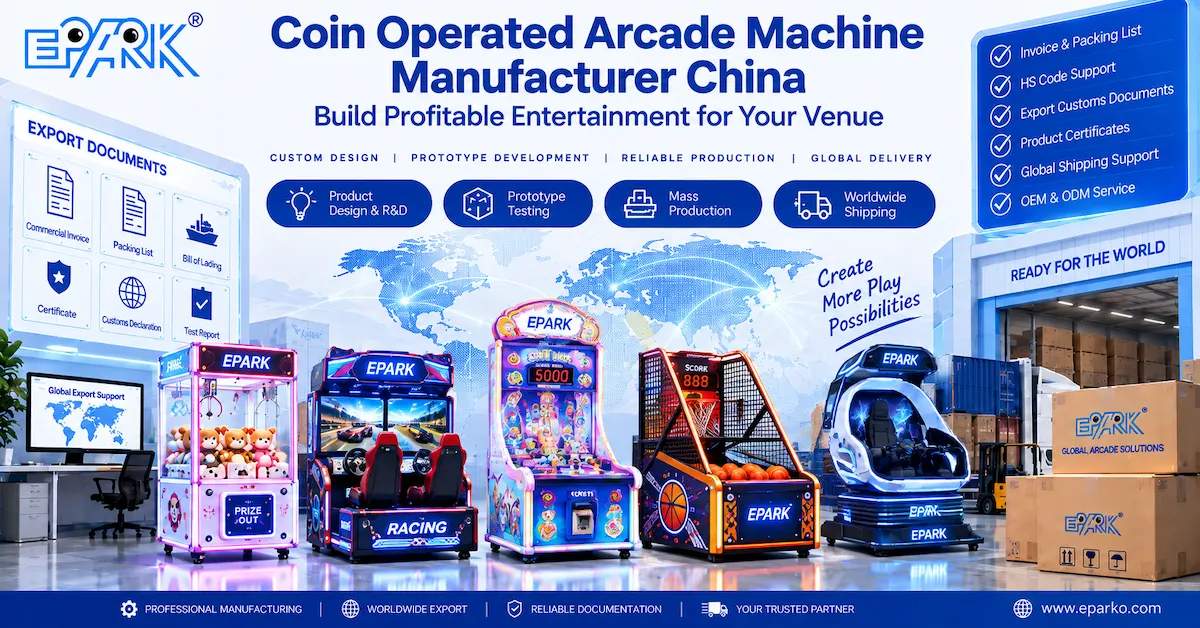
What Should Buyers Expect From a Coin Operated Arcade Machine Manufacturer China Supplier?
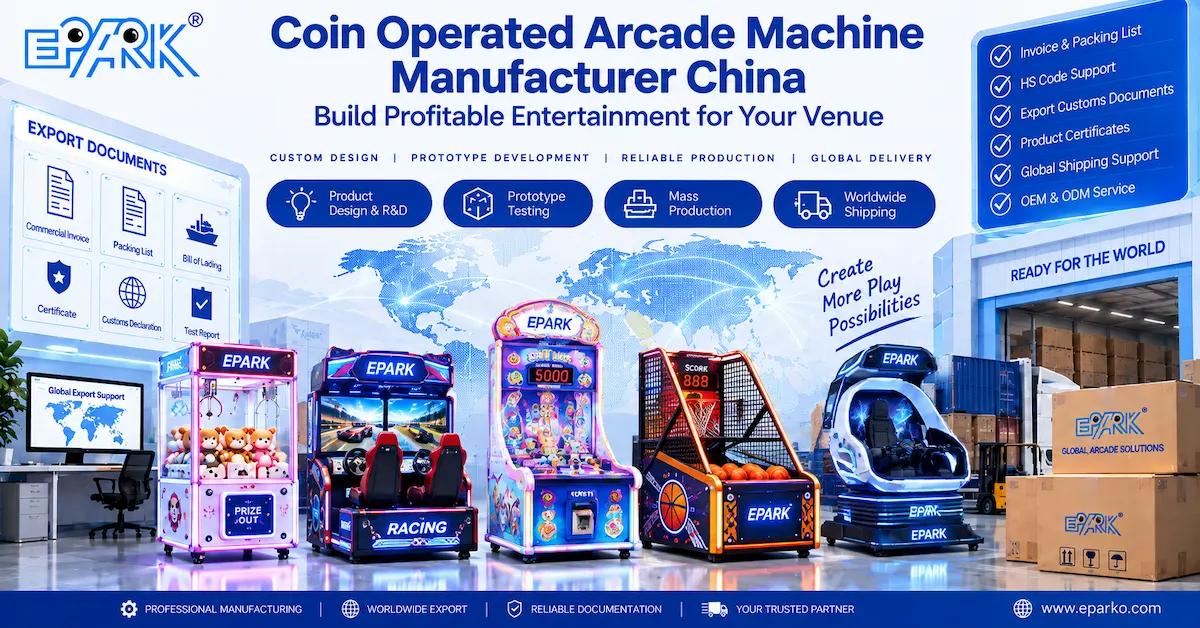
Buyers searching for a coin operated arcade machine manufacturer China supplier should evaluate more than whether a factory can install a coin acceptor into a game cabinet. For a commercial FEC, arcade, distributor, or mall entertainment project, the manufacturer should be able to connect the selected machine with its payment configuration, operating settings, testing requirements, export preparation, spare-parts identification, and technical support. EPARK presents commercial arcade equipment, customization, venue solutions, and manufacturing support through its product range and company information. For an actual purchase, those general capabilities should be converted into an order-specific equipment list and configuration record.
A useful supplier discussion therefore starts with the operating model. Buyers should explain whether machines will accept local coins, tokens, a card-based system, or another approved payment configuration; whether the venue already has a management system; and whether the equipment will be installed in one venue or resold through a distribution network. The goal is not simply to purchase machines that can accept payment, but to purchase a configuration that the buyer can operate, inspect, maintain, and reorder consistently.
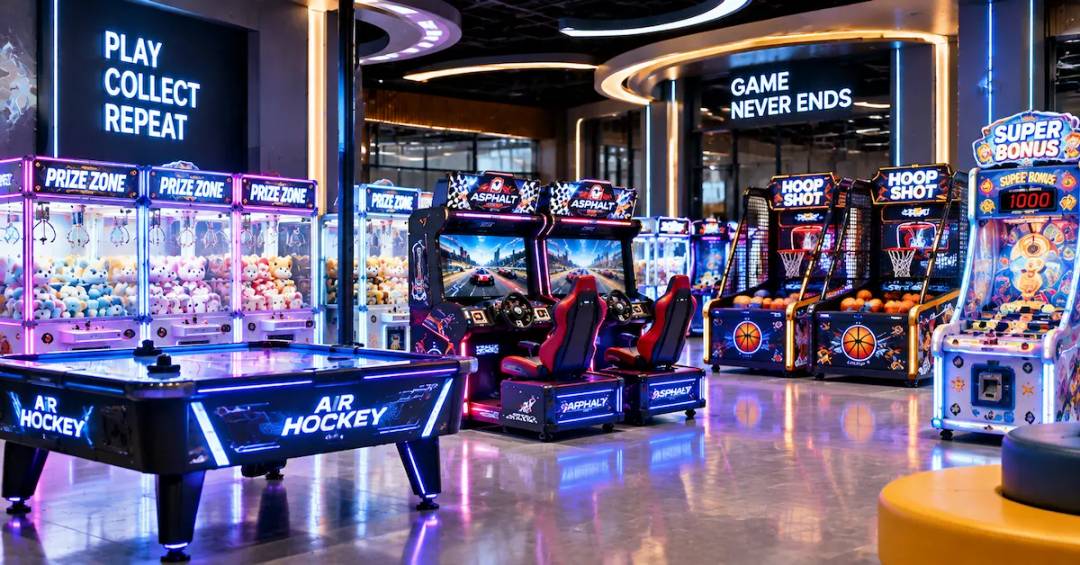
Which Buyers Benefit Most From Coin Operated Arcade Machines?
Coin operated machines can be relevant to independent arcades, family entertainment centers, shopping-mall entertainment zones, distributors, amusement equipment wholesalers, resorts, and venues where a simple pay-per-play system is appropriate. The appeal is operational simplicity: a machine can recognize an approved coin or token, register credit, and start the game without requiring every venue to deploy a more complex centralized account system.
However, coin operation is not automatically the best solution for every project. A large FEC that wants centralized customer accounts, stored-value cards, digital points, or detailed management data may prefer a card or other configured system. Likewise, a distributor selling into several countries should not assume that one coin acceptor works for every market. Coin dimensions, token specifications, credit values, anti-fraud requirements, and local operating practices can differ.
EPARK discusses both coin-based and other payment configurations in its FAQ, so buyers should define the payment method before the final machine configuration is released.
Decide Whether You Need Coins, Tokens, or a Centralized Payment System
A coin-operated cabinet and a token-operated cabinet may look identical from the player’s perspective, but the procurement requirements can differ. A buyer using local currency should provide the relevant coin information and confirm what acceptor is proposed. A venue using proprietary tokens should specify the token dimensions and operating value. A card-based FEC should identify the system provider and reader instead of assuming that a coin-ready machine can be converted later without review.
| Payment Approach | Typical Application | Main Buyer Advantage | What Must Be Confirmed |
|---|---|---|---|
| Coin operation | Independent arcade or simple pay-per-play venue | Straightforward transaction | Accepted coin, credit settings, access and collection |
| Token operation | FEC or venue using proprietary tokens | Venue controls token value and circulation | Token dimensions, acceptor configuration and testing |
| Card system | Larger FEC or chain | Centralized credit and account management | Reader, interface, provider, software and activation |
| Mixed configuration | Projects supporting more than one approved payment route | Greater operating flexibility | Hardware, settings and management responsibilities |
The correct choice depends on venue size, staffing, customer behavior, management needs, and the infrastructure already available. Payment should therefore be treated as part of machine specification, not as an accessory chosen after production.
Compare Arcade Machine Categories Before Building a Mixed Order
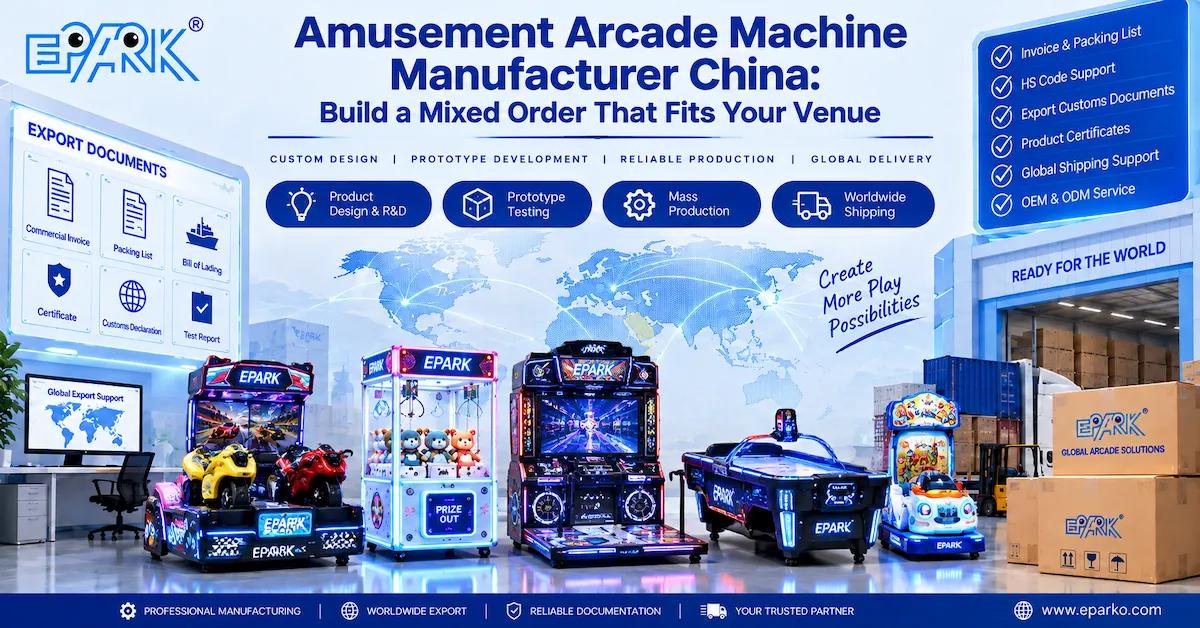
EPARK’s commercial arcade equipment solutions cover different game and entertainment categories. For coin-operated purchasing, the payment principle can be similar while the machine structure, maintenance requirements, and operating space vary significantly.
| Machine Category | Commercial Role | Payment / Operation Points to Confirm | Typical Project Concern |
|---|---|---|---|
| Claw machines | Prize-focused entertainment | Coin or token credit, game setting, prize mechanism | Refill access and mechanism maintenance |
| Racing games | Competitive seated play | Credit per play, linked play where applicable | Seat footprint, controls and service space |
| Shooting games | Skill and interactive play | Credit/start sequence and controller setup | Controller condition and calibration |
| Basketball games | Sports and social play | Credit, timer, score logic | Player clearance and structure assembly |
| Redemption games | Skill play connected to rewards | Credit, scoring, ticket/point output | Redemption-system compatibility |
| Kiddie rides | Family and younger-player entertainment | Coin/token activation and operating cycle | Intended use and supervision |
| VR / simulator equipment | Immersive attraction | Payment plus software/hardware requirements | Setup, licenses and technical support |
This table should be used to shortlist product families rather than replace model-specific comparison. Request actual model numbers, machine specifications, prices, and payment configurations after deciding which categories fit your venue.
Create a Technical Specification Before Comparing Quotations
When comparing a coin operated arcade machine manufacturer China proposal with another supplier, use the same specification fields for every quotation. Otherwise, a lower-priced machine may simply include a different screen, payment component, controller, accessory set, or packing method.
The following table is a purchasing checklist rather than a statement of universal EPARK specifications.
| Specification Area | Information to Confirm | Why It Matters |
|---|---|---|
| Machine identity | Model, revision and quantity | Production and repeat-order control |
| Operating dimensions | L × W × H when assembled | Venue layout planning |
| Packed dimensions | Package size and number of packages | Freight calculation |
| Net / gross weight | Machine and packed weight | Handling and delivery |
| Electrical requirements | Voltage, frequency and relevant power information | Site preparation |
| Coin / token acceptor | Proposed device and accepted currency/token | Payment compatibility |
| Credit settings | Coin-to-credit and play configuration | Operating model |
| Player controls | Joystick, buttons, steering, sensors or other controls | Maintenance planning |
| Display / audio | Model-specific configuration | Product comparison |
| Reward system | Ticket, points or prize mechanism where applicable | FEC system integration |
| Software | Game version, language and licensing where relevant | Operation and repeat orders |
| Accessories | Keys, cables, fixings and manuals | Receiving inspection |
| Spare parts | Recommended service components | Maintenance readiness |
| Packaging | Shipping configuration and protection | Export preparation |
The final quotation should identify which values are confirmed and which remain subject to technical review.
Check the Coin Acceptor as Part of the Whole Payment Chain
The coin acceptor should not be evaluated in isolation. The complete path is coin/token insertion → recognition → credit registration → game start → gameplay → score/reward completion → ready state for the next player. Ask the manufacturer to test that sequence using the approved configuration.
For token-operated projects, buyers should provide physical samples or precise token information when requested. For coin projects, confirm whether the supplier requires sample coins and whether the configuration can distinguish the intended currency from unwanted objects. The detailed acceptance method depends on the actual device, so avoid assuming that one setting applies universally.
Also check physical access. Venue staff need a practical way to reach the collection area, inspect the acceptor, and perform authorized maintenance without dismantling unrelated parts of the cabinet.
Evaluate Cabinet Materials, Controls, and Serviceability Together
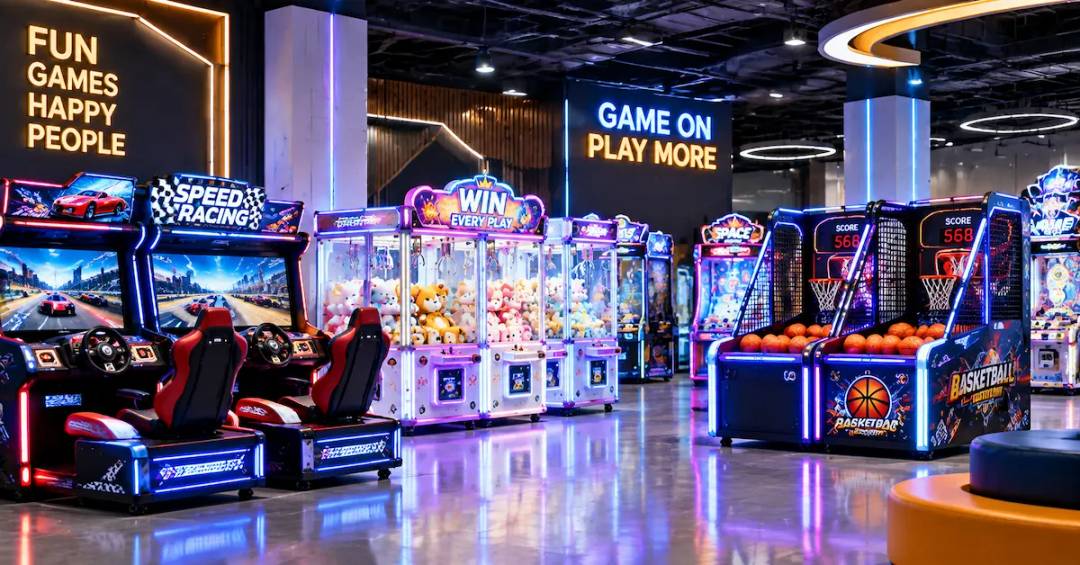
A commercial arcade machine is not just its payment device. Buyers should review cabinet construction, transparent panels, doors, locks, player controls, electronics, wiring, lighting, displays, sensors, and moving mechanisms applicable to the selected model.
EPARK’s FAQ describes materials such as metal structures, ABS plastics, and tempered glass among its equipment construction approaches, but buyers should request the actual material specification for the machines being ordered instead of assuming that every product uses the same construction.
Serviceability is equally important. Ask how technicians reach the coin acceptor, power supply, main controller, display, controls, sensors, and other replaceable components. For distributors, keep machine and component references in an internal service database so a future spare-parts request does not depend only on a photograph.
Turn Factory Workmanship Into Inspectable Criteria
Terms such as “high quality” and “professional workmanship” are difficult to use during acceptance. Instead, define points that can actually be checked: cabinet alignment, door operation, lock function, graphics, visible surfaces, fasteners, wiring, connector security, control installation, lighting, payment hardware mounting, and model-specific mechanisms.
If a batch contains several identical machines, compare consistency between units. Different wiring paths, payment settings, artwork versions, or component revisions can create maintenance difficulties later even when all cabinets operate at first inspection.
Repeat buyers should keep photographs and configuration records from the approved batch. If a future order includes a changed component, ask the supplier to identify the change and confirm whether it affects compatibility or spare-parts planning.
Use Quality Control to Verify the Complete Coin-Operated Game Cycle
EPARK’s Design & Process describes production, assembly, functional testing, packing, and shipment preparation as connected stages. Buyers should translate that general process into an acceptance checklist for the actual machines.
For coin-operated equipment, include:
- Coin or token recognition
- Correct credit registration
- Game start
- Player controls
- Display and audio
- Score calculation where applicable
- Ticket, points, or prize output where applicable
- Lighting and indicators
- Relevant sensors or moving mechanisms
- Reset and readiness for the next player
- Approved appearance and branding
- Keys and accessories
Testing should be recorded before packing. If a problem is corrected, request retesting of the affected function rather than simply receiving a photograph of the machine after repair.
Review Product Documents Against the Exact Machine
International buyers should identify required product or destination documents before production is finalized. Do not assume that a certificate or report displayed for one product automatically covers every coin-operated arcade machine.
Ask the supplier to map relevant documents to the actual model or product family, and confirm whether customization changes the applicable scope. Keep product compliance information separate from commercial shipping paperwork such as invoices and packing lists.
For overseas projects, destination importers, consultants, or other responsible professionals should confirm the requirements that apply to the actual equipment and market.
Compare Factory Capacity Using Your Order, Not a Marketing Number
A factory’s overall production figure does not tell you when your mixed order will be ready. A project with standard claw machines can require different production work from a shipment containing racing games, customized basketball cabinets, redemption machines, and simulators.
Ask for a schedule based on:
configuration approval → customization approval → production → functional testing → packing → shipment readiness.
EPARK publishes general ordering information through its FAQ, but an order-specific schedule should still be confirmed for the actual product mix and customization.
For a large distributor order, also discuss whether production will be completed as one batch or in stages and how consistency will be maintained.
Compare the Real Cost of Coin Operated Arcade Machines
The unit price should not be the only number used when evaluating a coin operated arcade machine manufacturer China supplier. Compare the complete operating configuration.
Potential cost areas include:
- Base machine
- Coin or token acceptor
- Payment customization
- Artwork or branding
- Software or licenses where applicable
- Spare parts
- Export packaging
- International shipping
- Destination expenses
- Installation or assembly
- Local technical labor
- Maintenance inventory
For example, Supplier A may quote a lower cabinet price but leave payment hardware, export packaging, and initial spare parts outside the quotation. Supplier B may include them. The two offers cannot be compared accurately until those differences are identified.
The objective is not to purchase the lowest-priced cabinet. It is to understand what is required to place the machine into commercial service.
Separate Standard Machines, OEM, and ODM Projects
Not every buyer needs a newly developed machine. Standard products can be appropriate when the available configuration already matches the project. OEM customization is more relevant when distributors or FEC brands require logos, graphics, color schemes, labels, packaging, or approved hardware changes. ODM should be discussed when the project requires more significant design or product-development work.
EPARK provides customization and project-support information on its Why Choose Us page. Buyers should separate cosmetic customization from technical changes because changing cabinet graphics is not equivalent to changing payment hardware, controls, structure, or gameplay.
For private-label orders, keep both the buyer’s product code and the manufacturer’s underlying model reference. This makes future repeat orders and spare-parts support easier to manage.
Plan Export Packaging Around the Actual Machine
Coin-operated cabinets can contain displays, transparent panels, controls, coin mechanisms, seats, cages, removable structures, and accessories depending on machine type. Packaging should therefore be confirmed model by model.
Before shipment, request:
- Packed dimensions
- Gross weight
- Number of packages
- Machine/package identification
- Separately packed assemblies
- Accessory locations
- Packaging photographs where appropriate
EPARK’s Service information can be used as a starting point for delivery discussions. Buyers should separately confirm factory packing, international freight, insurance where selected, customs processing, local delivery, unloading, and installation responsibilities.
Build Spare-Parts Support Into the First Order
A coin acceptor itself is only one possible maintenance item. Depending on the machine, long-term service can involve buttons, joysticks, readers, sensors, switches, power supplies, boards, motors, cables, displays, locks, and mechanical assemblies.
Rather than buying a generic spare kit, ask the supplier for a model-specific recommendation. Prioritize parts according to machine quantity, operational impact, local technician capability, and replenishment time.
EPARK describes technical and service support through its Service page. For each order, buyers should clarify how future parts requests will be matched to old machine versions and how troubleshooting information should be submitted.
Define Installation Responsibilities Before the Shipment Arrives
Coin-operated equipment still requires proper unloading, positioning, electrical preparation, assembly where applicable, payment verification, and final operational testing. Identify who handles each task before dispatch.
EPARK’s FAQ discusses setup guidance and technical support. Confirm whether your project uses remote guidance, local installers, or another arrangement and whether any services require separate commercial agreement.
After installation, repeat the complete operating sequence using the approved coins or tokens. Do not treat a powered screen as evidence that the payment system and gameplay have both been commissioned correctly.
How Should Buyers Compare Coin Operated Arcade Machine Suppliers?
A structured supplier comparison helps prevent a visually attractive catalog from becoming the main purchasing criterion.
| Supplier Area | Weak Question | Better Buyer Requirement |
|---|---|---|
| Product | “Do you sell coin games?” | Identify exact models suitable for the project |
| Payment | “Does it accept coins?” | Confirm currency/token and credit configuration |
| Factory | “Are you a manufacturer?” | Show production responsibility for selected equipment |
| Quality | “Is it high quality?” | Define order-specific inspection points |
| Components | “Which parts do you use?” | Identify service-critical components by model |
| Customization | “Can you add my logo?” | Approve artwork and technical changes separately |
| Packing | “Is export packing included?” | Confirm package size, count and protection |
| Shipping | “Can you ship worldwide?” | Define freight and destination responsibilities |
| Support | “Do you have spare parts?” | Link replacements to exact models and revisions |
| Repeat order | “Can I reorder?” | Preserve approved configuration and change control |
This approach helps purchasing teams compare commercial capability rather than promotional claims.
What Should You Send EPARK for a Coin Operated Arcade Machine Quote?
When contacting a coin operated arcade machine manufacturer China supplier, prepare the destination country, venue type, machine categories, quantities, preferred coin or token system, target players, branding requirements, available floor plan where relevant, target shipment period, and local service resources.
For coin operation, provide information about the currency or token and explain the desired credit structure. For a complete FEC, include the equipment categories and payment strategy across the venue rather than specifying payment individually after each machine has been selected.
Review EPARK arcade equipment and submit the purchasing brief through Contact Us. Ask the quotation to distinguish confirmed machine configuration, payment setup, optional customization, spare parts, packing, logistics scope, and unresolved technical requirements.
Frequently Asked Questions
1. What Is a Coin Operated Arcade Machine?
A coin operated arcade machine recognizes an approved coin or token, registers the configured credit, and enables the corresponding game session or operating cycle. The specific acceptor, credit settings, and game logic should be confirmed for the selected model.
2. Can Arcade Machines Be Configured for Local Coins?
Discuss the destination currency with the manufacturer before production. The supplier may require coin specifications or samples depending on the proposed acceptor. Request confirmation and a functional payment test using the approved configuration.
3. Is a Token System Better Than Local Currency?
It depends on the operating model. Tokens allow the venue to control its own game value and circulation, while direct coin operation can simplify transactions. Compare customer convenience, cash handling, security, management, and existing venue systems.
4. Can Coin Operated Machines Later Use a Card Reader?
Do not assume that every machine can be converted without review. Provide the proposed card-system information and ask the machine supplier and payment-system provider to confirm hardware and interface compatibility before purchasing conversion components.
5. Which Coin Operated Machines Are Suitable for an FEC?
Potential categories include claw machines, redemption games, racing games, sports equipment, shooting games, kiddie rides, and other commercial games. Select the mix according to audience, available area, prize strategy, staffing, and maintenance resources.
6. How Should Buyers Inspect Coin Operated Machines Before Shipment?
Test coin or token recognition, credit registration, gameplay, controls, relevant scoring and reward functions, reset behavior, appearance, accessories, and the approved machine configuration. Record faults and retest them after correction.
7. Can EPARK Customize Coin Operated Arcade Machines?
EPARK publishes OEM/ODM and customization support on its website. Buyers should specify branding, artwork, payment requirements, language, hardware changes, or other requested modifications and obtain confirmation for the selected models before production.
8. What Spare Parts Should I Order?
There is no universal kit for every machine. Build the spare list from the actual equipment order, likely maintenance impact, availability, and local technical capability. Ensure every spare item is linked to compatible machine versions.
9. How Long Does a Coin Operated Arcade Machine Order Take?
Timing depends on machine type, quantity, payment configuration, customization, testing, and packing. Request an order-specific schedule rather than applying a generic website lead time to every project.
10. Where Can I Source Commercial Coin Operated Arcade Machines?
Buyers can review EPARK’s commercial arcade machine solutions and submit venue, machine, quantity, payment, customization, and destination requirements through EPARK Contact Us for a project-specific discussion.
Conclusion
Choosing a coin operated arcade machine manufacturer China partner should involve more than confirming that a cabinet accepts money and starts a game. FEC operators, distributors, and commercial arcade buyers should connect the payment system with machine selection, technical specifications, workmanship, factory testing, customization, packing, spare parts, and installation responsibilities. A controlled purchasing process makes quotations easier to compare and future machines easier to maintain and reorder. Contact EPARK with your venue, destination, machine categories, quantities, coin or token requirements, and customization needs to discuss an order-specific commercial arcade equipment solution.
Disclaimer
The information provided on this website is for general informational purposes only.
While EPARK Arcade Game Machine Manufacturer strives to ensure accuracy and reliability, no warranties—express or implied—are made regarding completeness, performance, or applicability.
Product specifications, designs, and features may vary depending on usage, customization, and customer requirements.
Buyers are responsible for verifying all technical details, compliance certifications, and suitability before procurement.
EPARK shall not be held liable for any direct, indirect, incidental, or consequential damages arising from the use of this website or its content, including but not limited to business losses, data errors, or equipment misuse.
For tailored solutions or further verification, please visit our Contact Us
Intellectual Property Notice
All articles, product images, videos, catalogs, software, and related materials published on this website are the intellectual property of EPARK, unless otherwise stated.
Unauthorized reproduction, distribution, modification, or commercial use of any content is strictly prohibited without prior written consent from EPARK.
EPARK reserves the right to take legal action against any unauthorized use, including but not limited to copyright infringement, misrepresentation, or unfair competition.
Trademarks
The name EPARK, the EPARK logo, and all related brand elements displayed on this website are registered trademarks or trade names of Guangzhou EPARK Electronic Technology Co., Ltd.
Other product names, company names, or logos mentioned on this site may be trademarks of their respective owners.
Unauthorized use of EPARK's trademarks for commercial purposes, including advertising, promotions, or product packaging, is strictly prohibited.
Governing Law
These terms are governed by the laws of the People's Republic of China.