
What Should an Arcade Equipment Maintenance Parts Supplier Actually Provide?
An arcade equipment maintenance parts supplier should help commercial buyers identify the correct component, confirm which machine version it fits, explain replacement requirements, and maintain a practical route for future parts supply. Simply having boxes of buttons, power supplies, sensors, or control boards is not enough. For a family entertainment center, arcade chain, or distributor, the real value comes from connecting every spare part to a specific machine configuration and maintenance procedure. EPARK’s existing arcade machine spare-parts guide identifies parts identification, replacement component supply, maintenance guidance, technical communication, and long-term support as important elements of commercial arcade service. Buyers should therefore evaluate a supplier by the quality of its equipment records and technical support as well as its parts inventory.
Which Buyers Need a Structured Maintenance Parts Program?
A single small arcade, a 500 m² FEC, a multi-location entertainment chain, and an overseas distributor should not use the same spare-parts strategy. A small operator may need a limited group of frequently used components and access to remote support when an unfamiliar failure occurs. A larger FEC operates several equipment categories and therefore needs machine-specific stocks, maintenance records, and clear escalation routes. Arcade chains benefit from standardizing approved parts across locations where equipment versions allow it, while distributors often need wider inventory because they support several customers and may not know which machine will require assistance next. EPARK’s spare-parts content separately identifies arcade operators, distributors, FEC projects, and arcade chains as buyers with different maintenance requirements. This article is not intended as a do-it-yourself repair manual for untrained users; electrical, motion, safety-related, or technically complex work should follow the relevant manufacturer instructions and be handled by appropriately qualified personnel.
Plan Maintenance Parts Around the Equipment Actually Installed in the Venue
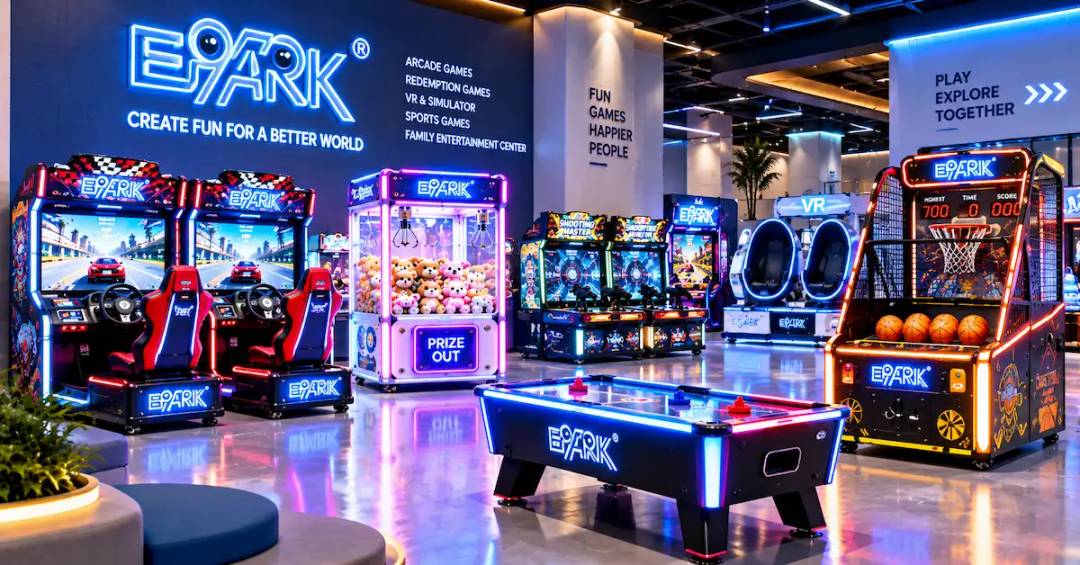
A maintenance program should begin with the approved machine list rather than a generic catalog of components. A venue using claw machines, basketball games, racing simulators, shooting games, redemption equipment, and VR products will face different service requirements because each category combines different controls, moving mechanisms, payment hardware, displays, sensors, and electronic systems. Buyers planning a new project can first review EPARK’s commercial arcade equipment and FEC solutions, then convert the final equipment selection into a machine-by-machine service list. For every machine, record the model, version, quantity, payment configuration, control system, major assemblies, maintenance documents, and approved replacement references. This prevents the common situation in which a venue owns a large box of miscellaneous spares but cannot confidently determine which machine they belong to when a fault occurs.
Technical Information to Confirm Before Ordering Maintenance Parts
An arcade equipment maintenance parts supplier should be able to work from technical identification rather than appearance alone. Two machines with similar cabinets can contain different boards, wiring, payment systems, or component revisions, and EPARK’s published spare-parts guidance explicitly notes that visually similar machines may use different control boards, payment systems, and wiring configurations. Use the following table as a procurement worksheet rather than as a universal EPARK component specification; actual values must be confirmed against the installed machine and proposed replacement.
| Verification Item | Information the Buyer Should Provide | What the Supplier Should Confirm |
|---|---|---|
| Machine identity | Model, serial or order reference, configuration and photos | Correct machine version |
| Existing component | Part label, manufacturer reference, revision and clear photos | Exact replacement or approved successor |
| Mechanical fit | Dimensions,mounting points, shaft or connector location | Physical compatibility |
| Electrical requirements | Input/output data, voltage, current and relevant ratings | Electrical compatibility with the machine |
| Connector details | Connector type, pin arrangement and cable reference | Correct connection requirements |
| PCB or controller | Board number, hardware revision and current configuration | Firmware or setup requirements |
| Payment component | Coin acceptor, card reader or payment system details | Interface compatibility |
| Sensor or motor | Identification,mounting and function | Matching operating specification |
| Display component | Screen model, interface and controller information | Supported replacement configuration |
| Documentation | Wiring diagram, service guide or supplier instructions | Installation and test procedure |
| Commercial details | Quantity, destination and urgency | Availability, dispatch estimate and quotation scope |
The safest purchasing sequence is machine identification → component identification → compatibility confirmation → quotation → installation planning → functional test. Reversing this order and buying a component first because it looks similar can turn an inexpensive maintenance item into a longer troubleshooting problem.
Which Maintenance Parts Should Commercial Arcade Buyers Review?
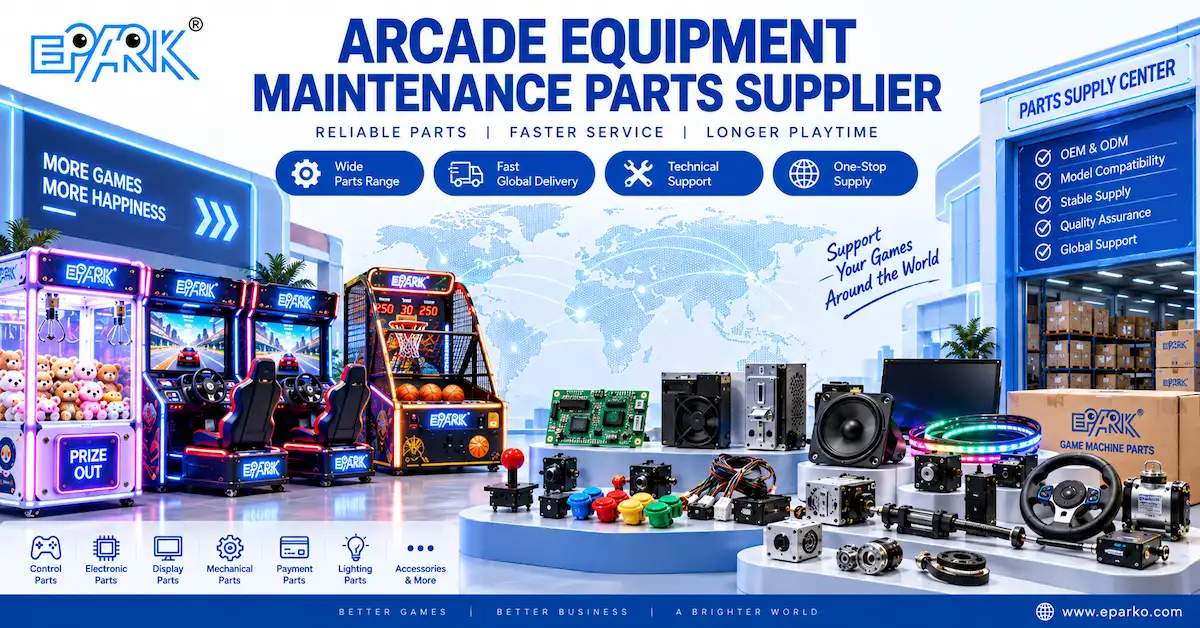
EPARK’s published parts guidance groups common service items into control parts, electronic components, display parts, mechanical components, payment components, lighting parts, and accessories. Examples listed on the site include buttons, joysticks, steering controls, control boards, power supplies, screens, cables, motors, gears, coin acceptors, card readers, LED-related components, locks, and keys. These categories are useful for building a maintenance database, but they should not be interpreted as a fixed spare kit for every EPARK machine. The actual list depends on the equipment model, configuration, operating conditions, and usage. Buyers should therefore create three levels of inventory: frequently used maintenance components, machine-specific critical components, and parts that can remain supplier-stocked until required. This approach makes the spare list more relevant than purchasing equal quantities of every possible component.
Control and Player-Interaction Parts
Buttons, joysticks, steering assemblies, pedals, switches, and related control components receive repeated physical interaction during commercial operation.For these items, record the exact mounting style, connector arrangement, electrical specification where applicable, and appearance if visual consistency matters. A distributor supporting private-label equipment should also preserve the buyer-facing color or design reference where a replacement affects the visible cabinet. If a complete steering or joystick assembly contains sensors or electronics, confirm whether the supplier recommends replacing the individual service component or the entire approved assembly.
Electronic Parts and Power Components
Control boards, controllers, power supplies, display interfaces, wiring assemblies, and related electronics require tighter version control than cosmetic parts. A board number alone may not explain its configuration, and a power supply that physically fits may still have unsuitable electrical characteristics. Request the supplier’s written confirmation of the applicable machine version and any firmware, parameter, connector, or setup requirements. For repeated orders, maintain a record of component substitutions so local technicians know whether a newer approved part replaces an older reference.
Payment, Ticket, and Redemption Parts
Commercial machines may use coins, tokens, cards, or other configured payment methods, while redemption equipment can add ticket or point-management components. Maintenance planning should therefore identify the installed payment system rather than treating “card reader” or “coin acceptor” as a complete specification. When replacing payment hardware, test the whole transaction path: credit recognition, game start, scoring where applicable, and reward delivery. If a third-party system provider is involved, define which company confirms hardware compatibility, configuration, and account activation.
Mechanical Parts for Moving Equipment
Motors, gears, moving assemblies, actuators, and related mechanisms deserve particular attention because wear and maintenance requirements depend heavily on the machine design and operating load. Do not create replacement instructions from a generic arcade parts catalog. Record the manufacturer-approved part, installation procedure, relevant alignment or calibration requirements, and post-replacement checks. Motion simulators and other equipment with more complex moving structures should be treated separately from simple static cabinets.
Evaluate Parts Workmanship, Identification, and Packaging
A good arcade equipment maintenance parts supplier should make components easy to identify after they reach the customer. Ask for labels that connect the item to a part reference, applicable model, and quantity, particularly when multiple machines or several customers are supplied in one shipment. Small electronic and mechanical items should be packaged to protect connectors, boards, finished surfaces, and other vulnerable areas during transport and storage. For service kits, request a packing list that separates identical-looking components by reference rather than grouping them under a vague description such as “arcade spare parts.” EPARK’s spare-parts guidance specifically highlights clear labeling, component protection, model identification, and organized packaging for international shipments. These details may appear minor during procurement, but they become important when a technician must locate the correct component months later.
Use Quality Control Records to Prevent Maintenance Problems Before Shipment
Maintenance planning should begin before the machines leave the supplier. EPARK’s design and production process describes equipment assembly, electrical and control integration, inspections, and full-operation testing before shipment. For a new commercial order, request records applicable to the selected machines and verify that the approved configurations match the spare-parts list. When separate maintenance components are supplied, ask which incoming, assembly, or functional checks apply to those parts rather than assuming that a loose component receives the same complete-machine test sequence. Where documentation or certification is relevant, confirm that it applies to the actual equipment or component involved; a general factory certificate or website badge should not be automatically treated as evidence for every replacement part.
Ask About Availability, Replenishment, and Discontinued Components Before You Need Them

The right time to discuss maintenance inventory is before an urgent failure occurs. Ask which parts are normally available, which require configuration or production, how independently shipped spare orders are handled, and what happens when an original component becomes unavailable.EPARK’s service page describes technical assistance, remote diagnostics, and emergency parts supply as part of its service system, while its spare-parts guide emphasizes lifecycle needs and repeat supply. These published service descriptions should be used as a basis for an order-specific discussion, not as a guarantee that every part is always in stock or can reach every country within the same time. Request a current dispatch estimate for the exact item and keep carrier transit, customs processing, and local delivery separate from supplier preparation time.
Compare Different Maintenance Parts Sourcing Models
The lowest component price does not always produce the easiest maintenance program. Buyers should compare where inventory will be held, who performs identification, and how quickly a verified replacement can enter the repair process. The table below compares procurement structures rather than specific EPARK packages.
| Sourcing Model | Main Advantage | Main Risk to Manage | Best Fit | Cost Pattern |
|---|---|---|---|---|
| Spare kit ordered with new machines | Parts arrive before operation begins | Kit may contain unsuitable quantities if poorly planned | New FECs and first-time buyers | Higher initial stock cost |
| Central venue spare inventory | Fast access to common parts | Capital tied in slow-moving components | Large single-location FECs | Medium |
| Centralized chain inventory | Shared stock across multiple locations | Version differences can create compatibility errors | Arcade chains | Medium to high setup effort |
| Distributor service stock | Local support for multiple customers | Wide machine range increases inventory complexity | Regional distributors | Higher inventory requirement |
| Supplier-held replenishment model | Less local inventory | Dependent on identification and shipment timing | Stable machine fleets with predictable support | Lower inventory, variable logistics |
| Hybrid stock model | Critical parts local, less urgent parts supplier-held | Requires accurate classification and stock records | Mature FECs, chains, distributors | Balanced |
A mature operation often moves toward a hybrid model. Keep parts that have high operational impact and practical local replacement capability close to the venue, while allowing less frequently required or technically specialized components to remain supplier-supported. The exact balance should be based on your actual maintenance records rather than an arbitrary universal spare-parts percentage.
Build Reorder Levels from Usage and Replenishment Time
Do not choose spare quantities solely by machine count. Record how often each component has actually been used, how many compatible machines depend on it, whether a failure stops operation completely, and how long replenishment normally takes. As an illustrative calculation—not EPARK maintenance data—suppose a chain uses an average of three approved push buttons per month, allows two months for replenishment, and wants three additional units as buffer stock. A starting reorder trigger could therefore be nine usable units: six units for expected two-month demand plus three buffer units. Review the figure after real operating data becomes available. Components that are expensive, rarely fail, or require specialist installation may need a different policy from inexpensive common wear items.
Compare Total Maintenance Cost Instead of Only the Spare-Part Price
When evaluating an arcade equipment maintenance parts supplier, include the complete restoration cost: component price, international or domestic freight, technician time, configuration, calibration, software work, return shipping, and the operating effect of downtime. A cheaper unverified component may cost more if it creates additional diagnostics or must be replaced again.At the same time, holding excessive inventory creates storage, obsolescence, and capital costs. The goal is therefore not “stock as many parts as possible” but maintain enough verified parts and supplier access to support the equipment fleet efficiently. Keep warranty claims separate from normal paid maintenance orders and confirm in writing who pays for the replacement, freight, local labor, and any returned failed component. EPARK’s after-sales support guide identifies spare-parts replacement, remote troubleshooting, warranty claims, maintenance training, and future upgrades as areas buyers should clarify after delivery.
Standardize OEM and Private-Label Equipment for Easier Maintenance
OEM and private-label buyers should treat serviceability as part of customization rather than something considered after the first failure. When several machines are being customized, ask whether compatible approved components can be standardized across models without compromising the intended function. Keep both your internal product code and the supplier’s machine and component references, and record any custom payment hardware, control configuration, cabinet variation, or wiring change that affects future replacements.EPARK describes OEM/ODM and customization as part of its broader commercial arcade business, so distributors and brands should include maintenance documentation and parts identification in the project requirements rather than focusing only on artwork and appearance. The purpose of standardization is not to force every machine to use identical hardware; it is to reduce unnecessary variation where technically appropriate and documented.
Connect Spare Parts with Remote Technical Support and Local Technicians
A replacement component is only useful if the venue can diagnose the fault, install the approved item, and confirm that the machine has returned to its intended operating condition. EPARK’s after-sales information discusses manuals, wiring information, troubleshooting guidance, spare-parts supply, remote technical assistance, maintenance training, and warranty procedures. Before an order ships, define who at your company receives technical support, what information must be sent when a fault occurs, and which tasks your local personnel are permitted to perform. When reporting an issue, provide the machine reference, component photos, failure description, relevant video or error information, and recent configuration changes.After an approved replacement, test the affected function together with the normal gameplay and payment sequence rather than declaring success because the component powers on.
How to Evaluate an Arcade Equipment Maintenance Parts Supplier Before Ordering
Use a supplier evaluation that goes beyond catalog size. Ask whether the supplier can identify parts by machine version, provide clear component references, explain compatibility, support repeat orders, package and label international spare shipments, communicate technical procedures, and document approved replacements when products evolve. Review whether the supplier understands the full machines as well as the loose components, because effective maintenance depends on how the component interacts with the control system, mechanical structure, payment configuration, and software. EPARK’s arcade machine spare-parts guide recommends considering parts availability, product records, technical support, long-term supply, export experience, and product knowledge when evaluating a commercial supplier.Those criteria are more useful than asking only “Do you sell spare parts?”
Prepare a Maintenance Parts Inquiry for EPARK
For a maintenance-parts request, send EPARK the machine model, serial number or original order reference, quantity of machines in operation, photographs of the required component and its label, fault information if a repair is already underway, requested quantity, destination, and desired timing. For a new FEC or distributor order, also provide the final equipment list and explain whether you want an opening spare kit, central service inventory, or a longer-term replenishment plan. Request a response that identifies the proposed component, applicable machine configuration, availability, included accessories, setup requirements, and quotation scope. You can review common service questions through the EPARK FAQ or contact EPARK with machine-specific information before approving the purchase.
Frequently Asked Questions
1. What Does an Arcade Equipment Maintenance Parts Supplier Do?
A maintenance parts supplier should do more than sell loose components. For commercial buyers, the supplier should help identify the correct replacement, confirm compatibility with the machine version, supply the component, provide relevant technical information, and support future replenishment. The exact service scope should be confirmed before ordering.
2. Which Arcade Spare Parts Should an FEC Keep in Stock?
Start with the equipment actually installed and classify parts according to usage frequency, operational impact, replenishment time, and local repair capability. Commonly discussed categories include controls, electronic parts, payment devices, sensors, motors, cables, lighting parts, and selected machine-specific assemblies, but the final stock list should be matched to your models.
3.Should I Order Maintenance Parts Together with New Arcade Machines?
For many commercial projects, discussing an initial spare kit before shipment is useful because machine configuration is already known and parts can be identified against the order. However, the quantity should reflect your machine mix and expected service needs rather than adding the same generic kit to every project.
4. Can One Spare Part Be Used Across Several Arcade Machines?
Only after compatibility has been confirmed. Similar cabinets can contain different boards, wiring, payment systems, sensors, or revisions. If a supplier confirms that one approved component supports several machines, record the applicable model and version range in your inventory system.
5. How Should I Identify a Part When I Do Not Know Its Part Number?
Provide the machine model, order or serial reference, overall machine photographs, close-up photographs of the component and connectors, visible labels, and a clear description of its location and function. If the request follows a fault, also provide the symptoms and any checks already performed under technical guidance.
6. What Is the Difference Between a Wear Part and a Critical Spare?
A wear part is generally replaced because of normal repeated use, while a critical spare is important because its failure may keep important equipment unavailable or because replenishment is difficult. The same component can fall into different stock categories depending on the venue, machine quantity, availability, and local service capability.
7. How Many Maintenance Parts Should an Arcade Distributor Stock?
There is no universal quantity. A distributor should consider the number of customers supported, machine types and versions in the market, historical part usage, supplier replenishment time, service commitments, and inventory cost. Centralized records are particularly important because distributor stock may serve many different configurations.
8. Can I Buy a Similar Third-Party Part Instead of the Original Component?
Do not approve a substitute based only on appearance or price. Ask the responsible technical party to confirm mechanical, electrical, functional, and software compatibility and to document any required changes.Some simple components may have approved alternatives, while other systems require a specific version or configuration.
9. How Quickly Can EPARK Supply Maintenance Parts?
Availability depends on the specific component, machine version, quantity, configuration requirements, destination, and current stock or preparation status. EPARK describes spare-parts and technical support on its website, but buyers should request an item-specific dispatch estimate rather than applying one general delivery time to every maintenance order.
10. What Should I Test After Installing a Replacement Part?
Follow the machine-specific service instructions and test the function affected by the repair together with the related gameplay, controls, payment, scoring, redemption, display, or motion functions as applicable. Record the replacement reference and test result so the maintenance history can support future troubleshooting and inventory planning.
Conclusion
Choosing the right arcade equipment maintenance parts supplier is a lifecycle decision rather than a one-time component purchase. FEC operators, arcade chains, and distributors should connect machine records, verified compatibility, maintenance inventory, technical support, replenishment planning, and repair documentation into one system. A supplier that understands both the arcade equipment and its service components can make future maintenance easier to organize, but every replacement should still be confirmed against the actual machine and order conditions. Contact EPARK with your machine list, component details, destination, and maintenance requirements to discuss an order-specific spare-parts and support plan.
Disclaimer
The information provided on this website is for general informational purposes only.
While EPARK Arcade Game Machine Manufacturer strives to ensure accuracy and reliability, no warranties—express or implied—are made regarding completeness, performance, or applicability.
Product specifications, designs, and features may vary depending on usage, customization, and customer requirements.
Buyers are responsible for verifying all technical details, compliance certifications, and suitability before procurement.
EPARK shall not be held liable for any direct, indirect, incidental, or consequential damages arising from the use of this website or its content, including but not limited to business losses, data errors, or equipment misuse.
For tailored solutions or further verification, please visit our Contact Us
Intellectual Property Notice
All articles, product images, videos, catalogs, software, and related materials published on this website are the intellectual property of EPARK, unless otherwise stated.
Unauthorized reproduction, distribution, modification, or commercial use of any content is strictly prohibited without prior written consent from EPARK.
EPARK reserves the right to take legal action against any unauthorized use, including but not limited to copyright infringement, misrepresentation, or unfair competition.
Trademarks
The name EPARK, the EPARK logo, and all related brand elements displayed on this website are registered trademarks or trade names of Guangzhou EPARK Electronic Technology Co., Ltd.
Other product names, company names, or logos mentioned on this site may be trademarks of their respective owners.
Unauthorized use of EPARK's trademarks for commercial purposes, including advertising, promotions, or product packaging, is strictly prohibited.
Governing Law
These terms are governed by the laws of the People's Republic of China.