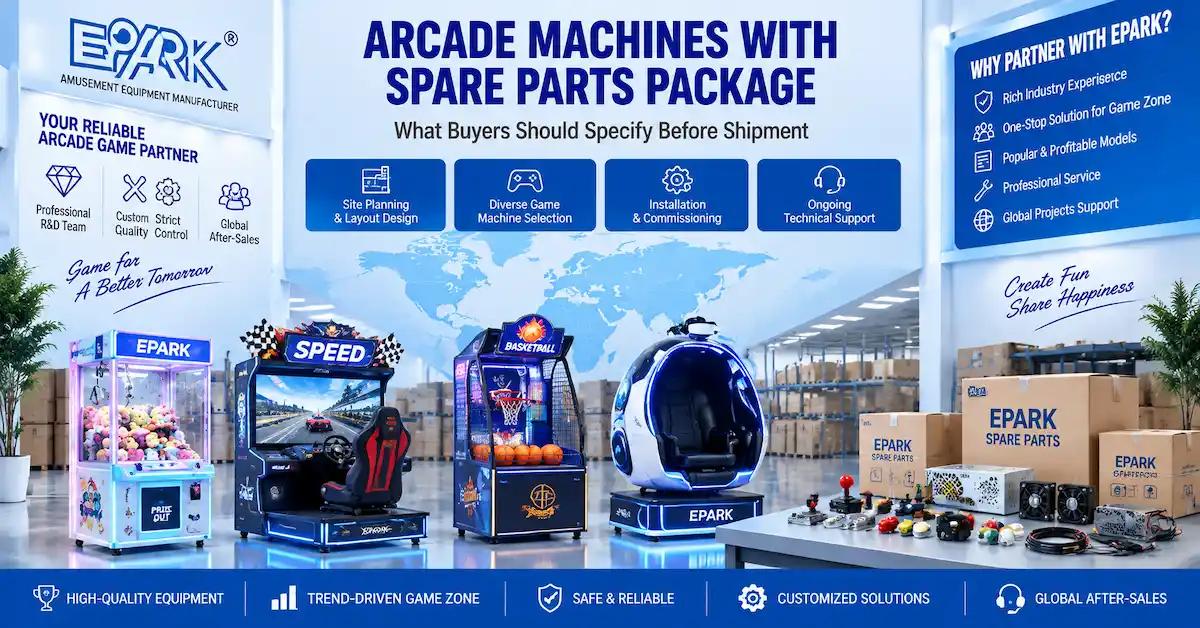


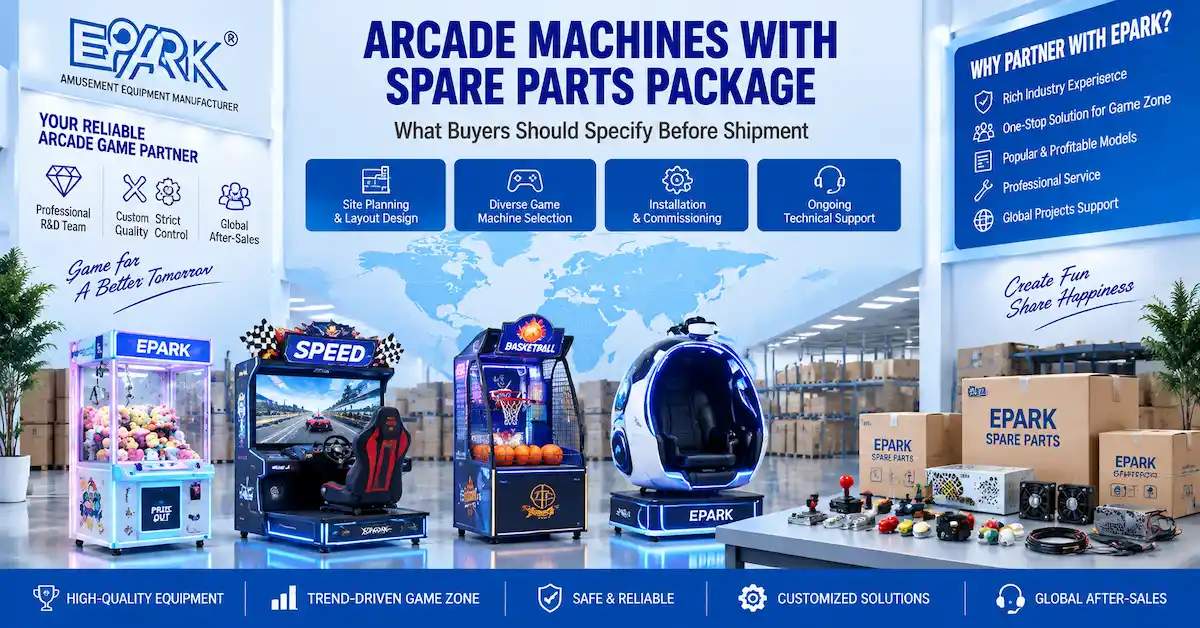
What should an arcade machines with spare parts package include?
An arcade machines with spare parts package should be a model-matched service inventory, not a box of generic components. A useful package identifies each part, the compatible machine and revision, the quantity supplied, the reason it is included, the storage or installation note, and the route for ordering more. Before shipment, the buyer should confirm whether the parts are included, optional, paid, warranty-related or excluded consumables.
This article answers a specific RFQ question: how should a commercial buyer define and check a spare-parts package when ordering arcade machines from a factory or supplier? It focuses on package design, compatibility, labeling, logistics and handover. It does not replace a model-specific service agreement, and it does not claim that one fixed parts list is suitable for every venue.

Define the package before anyone uses the word "spares"
“Spares included” can mean several different things. It may refer to a container-order kit, a buyer-purchased starter inventory, replacement parts approved under warranty, consumables for normal operation, or components that are merely available to order later. These are not interchangeable. If the quotation does not separate them, the buyer may believe that a free opening kit includes every item needed for future maintenance.
Start the RFQ with five labels: included starter parts, optional purchased spares, warranty replacements, consumables and future paid parts. Ask the supplier to use the labels in the quotation and packing list. If a component sits in more than one category, request an explanation of the different conditions. The objective is traceability, not a longer parts list.
| Package term | What it usually answers | What the buyer still needs to confirm |
|---|---|---|
| Included starter parts | Which parts are shipped with the original order without a separate line price? | Eligibility, list, quantity, model compatibility, packing location and replenishment |
| Optional purchased spares | Which extra parts can be bought before shipment? | Unit price, lead time, labeling, storage and whether they are installed or loose |
| Warranty replacements | Which manufacturing-defect parts may be supplied under the applicable terms? | Evidence, authorization, freight, local labor, return and case procedure |
| Consumables | Which items wear or are used during ordinary operation? | Exact exclusions, recommended opening quantity and future purchase route |
| Future paid parts | Which items can be ordered after the warranty period or after the starter kit is used? | Reference, availability, preparation, compatibility and current price |
EPARK's expanded FAQ states that replacement parts for manufacturing defects are included during the two-year warranty period, while consumables and misuse damage are not covered. The same FAQ lists tickets, tokens, bulbs and sensors as consumables. Use this published information as a starting point, but ask the company to classify the actual component and failure for the purchased machine. A part's presence in a package does not automatically decide its warranty status.
Build the package from the machine list, not from a generic kit
The installed machine mix determines which spare parts are commercially useful. A package for claw machines may need different controls and mechanical items from a package for racing simulators, ticket redemption games, basketball machines or kiddie rides. Even within one category, revisions or payment configurations can change the compatible component. The parts list should therefore be generated from the approved equipment schedule.
Ask the supplier to reference the machine model, factory revision or serial range beside each part. If the order contains several configurations, do not let one generic description cover them all. For repeat orders, retain the first approved list and mark any changes in the new quotation. This is especially important for distributors and operators with multiple venues, because similar-looking cabinets can contain different boards, connectors, sensors or control layouts.
Use service impact to prioritize the first package
A starter package should reflect the consequences of a failure and the ability of the local team to replace the item. Prioritize components that can stop a machine, items with a longer replenishment path, parts that are practical for a qualified local technician to replace, and small components that are difficult to source locally. Do not automatically buy the largest or most expensive assembly. Ask the factory which parts are commonly used for the selected models and which failures require factory diagnosis.
This is a purchasing decision, not a failure-rate claim. A supplier may recommend a part because it is easy to ship or frequently requested, but the buyer should still ask whether it matches the venue's operating hours, local technical skill and stock strategy. A high-volume arcade chain may prefer standardized service stock; a small venue may need only a focused opening kit.
Map parts by machine family and failure pathway
Organizing parts by machine family makes a package easier to inspect and reorder. It also lets the buyer see gaps that a single mixed carton can hide. The table below is a procurement structure, not an EPARK product specification or a guaranteed list of included parts.
| Machine family | Possible service groups | Questions for the supplier | Package record |
|---|---|---|---|
| Claw and prize machines | Controls, payment components, lighting, sensors and mechanical assemblies | Which control and claw references match each cabinet version? | Model, part reference, compatible cabinet and quantity |
| Racing and simulators | Controls, displays, power, sensors, pedals, steering and motion-related parts | Which parts require calibration, programming or qualified installation? | Station or linked-set reference, installation note and test method |
| Redemption games | Ticket or point components, sensors, buttons, boards and mechanisms | How does the replacement affect reward or accounting settings? | Machine reference, reward interface and setup instruction |
| Sports and skill games | Buttons, controls, scoring parts, sensors, display or power items | Which part restores the game function and which is a wear item? | Function, compatibility, quantity and status |
| Kiddie and family equipment | Controls, switches, power, lighting and mechanical service items | What safety checks are required after a replacement? | Model, safety check, qualified-person requirement and record |
| Payment and venue interfaces | Readers, interface boards, cables or machine-side accessories | Is the component owned by the machine supplier or payment provider? | Provider, account owner, interface version and support route |
The purpose of a family matrix is to avoid a common procurement mistake: buying a large number of generic buttons or power supplies while omitting the one model-specific component that the local team cannot identify. It also prevents the buyer from treating a payment-provider issue as a cabinet spare-parts issue.
Ask for a compatibility key before approving the package
A spare part is useful only when the operator can determine where it belongs. Request a compatibility key that connects the part number, part name, machine model, revision, image, specification and installation position. If a component is compatible across multiple machines, ask the supplier to list those machines explicitly. If it is not interchangeable, the list should say so.
EPARK's existing replacement-parts compatibility article explains why model, part number, specification and machine version need to be considered together. This new package-focused article uses that detail only as a supporting reference. The main purchasing task is to make the compatible relationship part of the original order record, rather than reconstructing it after a machine stops.
Minimum fields for a usable compatibility key
- Supplier part number and a plain-language part name.
- EPARK factory model or buyer SKU that the part supports.
- Machine revision, serial range or configuration condition where relevant.
- Electrical, connector, mounting or software requirement that affects replacement.
- Quantity supplied, quantity installed and quantity recommended as backup.
- Reference image or location description that helps a qualified technician identify it.
- Installation, calibration, testing or safety note where the replacement requires one.
Do not ask untrained staff to open energized or moving equipment to identify a part. The package documentation should support a qualified technician and should clearly state when factory guidance or a specialist is required. A clear label improves the service workflow, but it does not replace safe technical practice.
Decide quantities without inventing a universal percentage
There is no defensible universal rule that says a buyer should order a fixed percentage of the machine value or one replacement for every cabinet. Quantity depends on installed count, machine family, operating hours, local stock, replenishment time, the consequence of downtime, technician capability and whether multiple locations can share inventory.
Use a simple decision for each part: required at opening, useful backup, optional contingency or purchase later. Ask the supplier to explain the basis of its recommendation. A part that is needed for one high-priority machine may deserve a different treatment from a low-cost consumable that can be purchased locally. Keep the decision visible in the RFQ and do not let a free kit replace the buyer's own service plan.
| Decision status | Use when | Buyer action | Record |
|---|---|---|---|
| Required at opening | A missing item could stop a critical machine or delay commissioning | Include in the original shipment or confirm a local source | Model, quantity, owner and arrival check |
| Useful backup | The part is practical to replace and international replenishment may take time | Price and pack it with the order if the risk justifies it | Compatibility and storage location |
| Optional contingency | The cost or size is material and the failure condition is uncertain | Request a separate option rather than hiding it in the base quote | Reason for acceptance or rejection |
| Purchase later | The part is widely available, consumable or not required for the opening test | Confirm the purchase route and current reference | Supplier contact and reorder trigger |
| Factory diagnosis first | Replacement requires programming, calibration or fault isolation | Do not stock blindly; confirm the support process | Diagnostic and approval requirement |
For distributors, the package can be split into customer shipment stock and distributor service stock. For a multi-location operator, a common part may be held centrally only if the locations can receive it quickly and the part is compatible with all relevant revisions. The stock strategy should be written separately from the factory's included kit.
Confirm what EPARK actually publishes about included kits
EPARK's complete FEC game machine solution page states that a container order includes a free spare-parts kit and gives examples such as buttons, joysticks and power supplies. This is useful evidence for a buyer considering a container-based FEC order. It is not evidence that every small order, single machine or customized configuration receives the same kit. Ask the sales team to quote the current conditions and contents for your order.
The same page describes a broad equipment solution with racing and simulation, VR, redemption, claw, sports, shooting and family-oriented equipment. The more categories a shipment contains, the more important the package schedule becomes. A mixed container should not be accepted with a single line called “spare parts” if the buyer cannot identify which machine family each part supports.
EPARK's FAQ also says it accepts small trial orders and large-scale production, while the public materials do not establish one blanket numeric MOQ for every model and customization. A buyer should therefore ask whether the spare-parts package is tied to container orders, a product category, a minimum quantity, a specific quotation or an agreed project scope. Record the answer in the purchase documents.
Make the package part of the quotation and purchase order
A package should not live only in a sales message. Add the approved list to the quotation, purchase order, packing list or an attached equipment schedule. Cross-reference the machine model, quantity and shipment. If the supplier changes a component or substitutes a successor part, require a revised list before production release or packing.
Write whether each part is loose, installed, packed with the machine or packed in a consolidated carton. Identify whether the package is free, included in the unit price, separately priced, supplied under warranty or subject to an order condition. If freight or insurance is calculated on the shipment, ask whether the extra package changes the packed dimensions or customs documents.
EPARK's Design & Process page describes export packaging with bubble wrap, thick foam, wooden reinforcement and waterproof film for sea shipment. The appropriate method for a loose control board, display, cable, mechanical assembly or consumable may differ from complete-machine packing. Ask how the parts will be protected, labeled and recorded in the shipment.
Clauses to avoid in a spare-parts schedule
- “Standard spare-parts kit” without a component list.
- “Common parts included” without model compatibility or quantities.
- “Free replacements” without separating warranty authorization from starter stock.
- “All electronics covered” when the applicable terms do not say that.
- “Available after warranty” without a current reference, price process or availability condition.
- “Same as sample” when the sample and production configuration have different revisions.
Clear language reduces the chance that the buyer and supplier remember different versions of the package. It also makes a later reorder faster because the part identity is already linked to the delivered machine.
Inspect the package at dispatch and arrival
Package acceptance should happen in stages. Before dispatch, review the approved list, model compatibility and quantities. During loading or final packing, request the agreed photographs or packing record when the project requires them. At arrival, inspect the carton condition, labels, quantities and visible damage before the parts disappear into general storage.
For a mixed shipment, create a receiving sheet with one row per part. Mark received, short, damaged, wrong reference, unclear label or pending confirmation. Photograph the label and package when there is a discrepancy. Do not install an uncertain component simply because it looks similar to the original. Ask the supplier or a qualified technician to resolve the compatibility question.
| Receiving stage | Check | Evidence | Action if incomplete |
|---|---|---|---|
| Before dispatch | Approved part list matches the final machine schedule | Signed or approved schedule and supplier confirmation | Hold release or issue a clarification |
| During packing | Parts are labeled and packed with the agreed shipment | Photographs, packing list and carton reference | Ask for correction before loading when possible |
| At delivery | Cartons, labels, quantities and visible condition are checked | Receiving log and photographs | Record shortage or damage against the shipment |
| Before installation | Part matches model, revision and technical instruction | Compatibility key and technician confirmation | Do not install an unresolved substitute |
| After use | Stock movement and replacement case are recorded | Inventory entry and service record | Trigger reorder or warranty review as applicable |
Shipping insurance can be included on request according to EPARK's FAQ. That does not remove the need for a receiving record. Insurance, carrier claims, warranty cases and missing-package disputes follow different evidence requirements, so keep the photographs, packing list, shipment reference and machine record together.
Connect the spare package to maintenance and training
A part has limited value if the local team does not know when to use it, how to identify it or when to stop and request assistance. Ask for the available manual, wiring diagram, parts list, repair video, setup instruction or remote guidance that applies to the delivered configuration. EPARK's FAQ describes online training and operation videos, while the Service page describes remote diagnostics and technical assistance. Confirm which materials are included for your machine list.
Create a simple service workflow: identify the machine, describe the symptom, record the serial number or order reference, capture photographs or video, run only the authorized checks, classify the issue and approve the replacement. EPARK's warranty FAQ asks for a serial number, problem description and photographs or video when requesting service. Those inputs are also useful for a paid spare-parts request, even when the buyer is not claiming warranty coverage.
Train staff to distinguish a visible symptom from a confirmed failed component. A game that will not start may involve payment configuration, loose wiring, a setting, a sensor, a board or a power issue. Replacing random parts can consume the package without resolving the cause. The supplier should be asked to define which replacements can be done locally and which require factory diagnosis or programming.
Keep warranty, consumables and paid reorders separate
The phrase arcade machines with spare parts package often appears in a commercial buying conversation alongside warranty. The two subjects are related but not identical. A starter kit is inventory shipped with the order. A warranty replacement is an authorized response to an eligible failure. A consumable is used or worn through ordinary operation. A paid reorder is a new purchase after the opening stock is used or the warranty ends.
EPARK's FAQ states that all machines have a two-year warranty from the shipment date, with extended options available on request. It states that replacement parts for manufacturing defects are included during that period, while consumables and misuse damage are excluded. It also says spare parts can be purchased after the warranty expires. These published answers should be quoted accurately and then applied to the selected model and actual case.
Do not assume that a part included in the opening package becomes free in every future service case. Do not assume that an excluded consumable cannot be purchased. Do not assume that a paid replacement carries the same terms as the original machine. Put each question in the correct commercial record so that the operator, accounts team and technician do not act on different interpretations.
Plan replenishment for venues, distributors and chains
A single venue may keep a small opening package in a locked service cabinet. A distributor may need customer-specific stock plus a central inventory. A chain may want common machine families across locations so that technicians and parts can be shared. The supplier should understand which model is being supported and where the parts will be stored.
Ask how to reorder a part after it is used. The request should identify the machine model, part reference, quantity, destination and urgency. For a discontinued or revised part, ask whether a successor is compatible and whether an adapter, software setting or new mounting arrangement is required. Do not treat a similar appearance as proof of interchangeability.
EPARK's FAQ describes paid spare-parts supply after the warranty period, but it does not publish a universal stock guarantee or item-specific dispatch deadline. Request current availability and preparation conditions when a reorder is needed. A long-term parts plan should contain a review date because machine revisions, payment systems and local operating conditions can change.
Send a package-ready RFQ to the supplier
Include the equipment list, quantities, destination, venue type, operating hours, payment system, local technician capability and planned shipment. State whether you need a container-order kit, a paid starter inventory, replacement parts for existing machines or a distributor stock program. If the order is customized, include the approved artwork or configuration reference.
Ask the supplier to return a spare-parts schedule with part name, factory reference, compatible model, revision, quantity, status, unit price where applicable, package location, installation note and reorder route. Ask the supplier to identify consumables, warranty-related items and components requiring factory diagnosis. Request any available manuals, videos, wiring or setup information at the same time.
A copy-ready request is: “Please quote the attached arcade machine list and provide a model-matched spare-parts schedule. Separate included starter parts, optional purchased spares, consumables, warranty replacements and future paid parts. For every item, state the compatible model or revision, quantity, label, packing location and installation or calibration requirement. Please confirm the current container-order kit conditions, the parts that require factory diagnosis, and the process for reordering after shipment.”
This request gives an arcade machines with spare parts package discussion a clear commercial boundary. It also helps the buyer compare two suppliers on usable service support rather than on an unexplained promise that “spares are available.”
Frequently asked questions about arcade spare-parts packages
What is an arcade machines with spare parts package?
It is a planned set of compatible service components supplied with or purchased alongside commercial arcade machines. A usable package identifies the model, part reference, quantity, status, packing and support route. It should not be treated as a generic box without compatibility information.
Does EPARK include a spare-parts kit with every order?
EPARK's complete FEC solution page states that a container order includes a spare-parts kit and gives examples such as controls and power supplies. Ask EPARK to confirm whether the statement applies to your order, selected models, quantity and configuration, and request the actual list in writing.
Which spare parts should a new arcade venue buy?
Build the list from the installed machine families and local service capability. Prioritize service-critical or difficult-to-replace items, then consider practical backups and consumables. The correct quantity depends on the venue, operating hours, replenishment route and machine revisions.
Are spare parts automatically covered by warranty?
No. EPARK's FAQ says manufacturing-defect replacement parts are included during the two-year warranty period, while consumables and misuse damage are excluded. A starter package, a warranty replacement and a paid reorder should be recorded separately.
Are sensors covered?
EPARK's consumables answer lists sensors among excluded consumables. Ask for model-level clarification about the relevant sensor and reported failure. Do not infer coverage only from the fact that a sensor appears in a technical list.
How should spare parts be labeled?
Use the supplier part number, part name, compatible model or revision, quantity and reference image or location. Add installation, calibration or safety notes when needed. Keep the label connected to the receiving and inventory record.
Can a distributor share one spare-parts package across customer machines?
Only after compatibility is confirmed. Similar cabinets may use different boards, connectors, payment interfaces or revisions. Maintain a customer and machine record, and ask the supplier to approve any cross-model use or successor part.
Should spare parts be shipped separately?
Often the opening package is shipped with the original equipment, but the best method depends on protection, customs documents, urgency and the part type. Ask how loose parts will be packed and recorded. A replacement shipment may need different protection from complete-machine export packing.
What should I send when requesting a replacement part?
Send the machine model or serial number, order reference, part reference if known, problem description, photographs or video, destination and urgency. Follow the supplier's diagnostic instructions and use qualified personnel for electrical, motion or safety-related work.
Conclusion
An arcade machines with spare parts package is valuable when it is specific, compatible and traceable. Define the package from the approved machine list, separate starter stock from warranty and consumables, record the part reference and revision, confirm quantities and labels, inspect the shipment and connect every item to a practical service process. A generic promise of “free spares” is less useful than a short list that a technician can identify and install safely.
EPARK's published container-order kit statement, manufacturing process, packaging information, warranty FAQ and technical-support pages provide a factual starting point. Before paying the deposit, request the current model-matched schedule and keep the final version with the quotation, purchase order, packing list and machine register.
Disclaimer
The information provided on this website is for general informational purposes only.
While EPARK Arcade Game Machine Manufacturer strives to ensure accuracy and reliability, no warranties—express or implied—are made regarding completeness, performance, or applicability.
Product specifications, designs, and features may vary depending on usage, customization, and customer requirements.
Buyers are responsible for verifying all technical details, compliance certifications, and suitability before procurement.
EPARK shall not be held liable for any direct, indirect, incidental, or consequential damages arising from the use of this website or its content, including but not limited to business losses, data errors, or equipment misuse.
For tailored solutions or further verification, please visit our Contact Us
Intellectual Property Notice
All articles, product images, videos, catalogs, software, and related materials published on this website are the intellectual property of EPARK, unless otherwise stated.
Unauthorized reproduction, distribution, modification, or commercial use of any content is strictly prohibited without prior written consent from EPARK.
EPARK reserves the right to take legal action against any unauthorized use, including but not limited to copyright infringement, misrepresentation, or unfair competition.
Trademarks
The name EPARK, the EPARK logo, and all related brand elements displayed on this website are registered trademarks or trade names of Guangzhou EPARK Electronic Technology Co., Ltd.
Other product names, company names, or logos mentioned on this site may be trademarks of their respective owners.
Unauthorized use of EPARK's trademarks for commercial purposes, including advertising, promotions, or product packaging, is strictly prohibited.
Governing Law
These terms are governed by the laws of the People's Republic of China.