
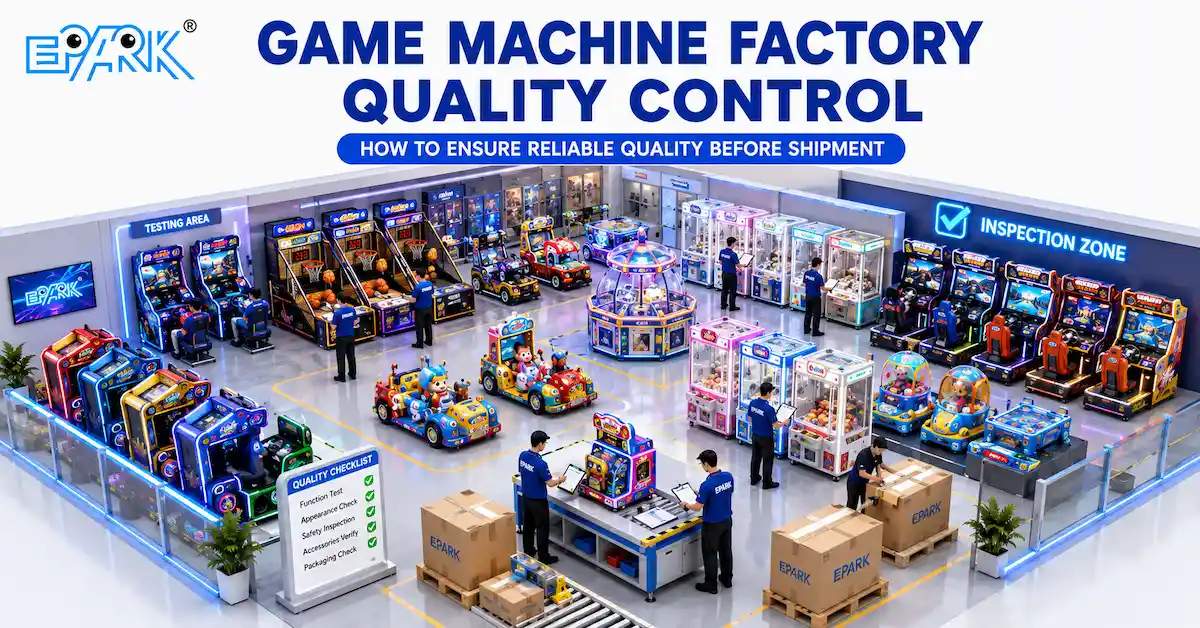
For commercial buyers, equipment delivery is not the end of an arcade machine project. It is the beginning of installation, testing, staff training, daily operation, maintenance, and future equipment upgrades.
Reliable arcade machine factory after sales support can directly affect how quickly a new venue opens and how efficiently it operates. When a machine stops working, the operator may lose game revenue, frustrate customers, and spend additional time identifying the problem.
A professional factory should help buyers manage issues such as:
- Machine installation
- Voltage and plug confirmation
- Payment-system configuration
- Game setting adjustments
- Spare-parts replacement
- Remote troubleshooting
- Warranty claims
- Maintenance training
- Software or hardware upgrades
- Repeat orders
The supplier should not disappear after receiving the final payment. Buyers need a clear service process that continues throughout the practical operating life of the equipment.
Quick Answer: What Should Arcade Machine After-Sales Support Include?
Professional after-sales support should normally include installation manuals, operation instructions, wiring diagrams, troubleshooting guidance, spare-parts supply, remote technical assistance, warranty procedures, and support for future upgrades.
The exact service level depends on the machine category, order size, destination market, and project requirements. Buyers should confirm all service terms before placing the order rather than waiting until a problem occurs.
1. Why After-Sales Support Matters for Commercial Arcade Venues
Arcade machines are used in high-traffic commercial environments such as:
- Family entertainment centers
- Shopping malls
- Indoor playgrounds
- Cinemas
- Hotels and resorts
- Amusement parks
- Arcade chains
- Tourist attractions
These venues often operate for long hours and serve many players every day. Even a small issue with a button, sensor, card reader, power supply, or control board may stop a machine from generating revenue.
Good after-sales service helps buyers:
- Reduce machine downtime
- Identify faults more quickly
- Replace damaged components correctly
- Train local staff
- Protect the opening schedule
- Maintain a consistent customer experience
- Extend equipment service life
- Plan future upgrades
The uploaded EPARK reference materials also emphasize that after-sales support should cover warranty terms, spare-parts availability, operation manuals, installation videos, remote technical help, settings support, and future upgrades.
2. Installation Guidance Before the Venue Opens
Installation support should begin before the machines arrive.
A professional factory should provide information about:
- Machine dimensions
- Packaging dimensions
- Machine weight
- Power requirements
- Voltage
- Plug type
- Network requirements
- Payment-system connections
- Recommended operating space
- Assembly requirements
Some machines arrive fully assembled, while larger equipment may require partial assembly after unloading.
Buyers should ask:
- Is an installation manual included?
- Are assembly videos available?
- Are cables and accessories labeled?
- Is a machine layout drawing available?
- Can the technical team provide remote guidance?
- Are special tools required?
- How many people are needed for installation?
Clear preparation helps prevent machines from arriving before the venue has sufficient electrical outlets, network connections, access space, or qualified installers.
3. Machine Testing and Commissioning Support
After installation, every machine should be tested before public operation.
Commissioning may include:
- Power-on testing
- Gameplay checks
- Screen and sound testing
- Button and joystick response
- Steering-wheel and pedal calibration
- Coin or card reader testing
- Ticket output testing
- Sensor adjustment
- Prize mechanism testing
- Multiplayer connection checks
The buyer should test machines according to a structured checklist instead of switching them on briefly and assuming they are ready.
Suggested Commissioning Checklist
| Test Area | What to Confirm |
|---|---|
| Power | Stable startup and shutdown |
| Gameplay | Normal game operation |
| Controls | Accurate player response |
| Payment | Correct credit recognition |
| Redemption | Accurate tickets or points |
| Sound | Clear and adjustable output |
| Lighting | Stable LED performance |
| Safety | Secure panels and cables |
| Network | Proper connection where required |
| Settings | Correct language and difficulty |
Any issue should be recorded with photos, videos, machine model information, and a clear description.
4. Remote Technical Troubleshooting
International buyers may not have immediate access to a technician familiar with every machine model. Remote support is therefore one of the most important services a factory can provide.
Remote troubleshooting may use:
- Photos
- Short videos
- Video calls
- Wiring diagrams
- Error-code records
- Machine settings
- Component tests
- Step-by-step replacement instructions
When reporting a problem, buyers should provide:
- Machine name and model
- Serial number or order reference
- Clear description of the issue
- Photo of the relevant component
- Video showing the problem
- Recent changes to settings or wiring
- Error code, if available
Detailed information helps the factory identify whether the issue comes from software, wiring, a control board, a sensor, a payment reader, or another component.
5. Spare-Parts Support for Long-Term Operation
Spare-parts availability is essential for commercial operators and distributors.
Common replacement parts may include:
- Buttons
- Joysticks
- Steering wheels
- Pedals
- Coin acceptors
- Card readers
- Ticket dispensers
- Sensors
- Motors
- Power supplies
- Control boards
- LED strips
- Speakers
- Locks
- Keys
- Cables
Before shipment, buyers should ask the factory to recommend a basic spare-parts package based on the selected machines.
Spare-Parts Planning by Buyer Type
| Buyer Type | Recommended Approach |
|---|---|
| Small Arcade | Keep common consumable parts |
| Large FEC | Prepare parts for every major category |
| Arcade Chain | Standardize parts across locations |
| Distributor | Maintain local service inventory |
| Project Contractor | Include commissioning and backup parts |
A distributor may need more stock because it supports multiple customers. A single venue can focus on commonly replaced components for its own machine mix.
6. Clear Warranty Terms and Claim Procedures
A warranty is useful only when the terms are clear and practical.
Buyers should confirm:
- Warranty period
- Which components are covered
- Which components are considered consumables
- Whether shipping costs are included
- What evidence is required
- How claims are reviewed
- How replacement parts are sent
- Whether damaged parts must be returned
- Whether labor costs are covered
- Whether customized components have different terms
Commercial buyers should avoid vague statements such as “full warranty” without written details.
A practical warranty policy should explain the responsibilities of both the factory and buyer.
For example, the factory may provide a replacement component after reviewing a video, while the buyer arranges the local installation with remote guidance.
7. Operation and Maintenance Documents
Good documentation helps local teams solve basic issues without waiting for factory assistance.
Useful documents may include:
- User manual
- Installation manual
- Wiring diagram
- Maintenance checklist
- Settings guide
- Payment-system guide
- Error-code list
- Spare-parts list
- Cleaning instructions
- Safety information
Documentation should match the delivered machine version.
If the supplier changes the control board, payment reader, software, or cabinet structure, the documentation should also be updated.
8. Staff Training for Arcade Operators
Staff training is important before opening a new venue.
Local employees should know how to:
- Start and shut down machines
- Add credits manually when authorized
- Check payment readers
- Refill tickets
- Adjust basic settings
- Open service panels safely
- Clean screens and cabinets
- Identify common error messages
- Record faults
- Contact technical support
Training reduces unnecessary service requests and improves customer response time.
A professional supplier may provide:
- Training videos
- Online demonstrations
- Operating checklists
- Troubleshooting guides
- Remote staff training
For large projects, buyers should assign at least one employee to become the main technical contact.
9. Support for Payment and Redemption Systems
Payment-system issues can affect many machines at the same time.
After-sales support may be required for:
- Coin acceptor adjustment
- Token compatibility
- Card reader installation
- Credit-setting changes
- Electronic ticket configuration
- Paper ticket calibration
- Membership-card integration
- Recharge-station settings
Buyers should confirm whether the factory supports the payment system directly or whether it is supplied by a separate provider.
The responsibility for support should be clear before delivery.
For large FEC projects, the machine factory and card-system provider may need to coordinate during installation and testing.
10. Software Settings and Future Adjustments
Some arcade machines allow operators to adjust:
- Game price
- Number of credits
- Difficulty
- Play time
- Ticket payout
- Sound volume
- Language
- Prize strength
- Multiplayer settings
The supplier should explain which settings the buyer can change safely.
Changes should be documented because incorrect settings may affect gameplay, prize costs, or machine performance.
For software-based machines, buyers should also ask:
- Are software updates available?
- How are updates installed?
- Can settings be backed up?
- Is internet access required?
- Are updates included in the purchase?
- Can the factory provide remote support?
11. Response Time and Technical Communication
Fast responses are valuable, but accurate communication is more important than immediate generic answers.
Before choosing a factory, buyers should ask:
- Which communication channels are used?
- What information should be provided when reporting a problem?
- Is technical support available in English?
- Who manages after-sales cases?
- How are urgent issues prioritized?
- How quickly are spare parts prepared?
- Are support cases recorded?
A dedicated contact person can make communication more efficient, especially for distributors and large projects.
The factory should also distinguish between:
- Operating questions
- Installation questions
- Warranty claims
- Spare-parts orders
- Software issues
- Repeat-order requests
12. After-Sales Support for Distributors
Distributors have different service requirements from single-venue operators.
They may need:
- Product training
- Technician training
- Spare-parts catalogs
- Part numbers
- Wiring diagrams
- Repair videos
- Batch warranty management
- Repeat-order compatibility
- Local-language manuals
- Customer-facing technical materials
A reliable supplier should help distributors establish a local support system.
This can improve customer trust and reduce the number of issues that require direct factory involvement.
13. Support for Venue Expansion and Repeat Orders
After-sales service should also support future business growth.
A buyer may later need to:
- Add new machines
- Replace low-performing models
- Expand a prize zone
- Upgrade the payment system
- Open another location
- Match previous customization
- Order compatible spare parts
- Update venue layout
A factory with organized records can reproduce previous logos, colors, electrical specifications, payment configurations, and packaging requirements.
This is especially important for arcade chains and regional distributors.
14. Questions to Ask Before Placing an Order
Use this checklist when evaluating arcade machine factory after sales support:
- What warranty do you provide?
- Which parts are covered?
- Which parts are consumables?
- Are installation manuals included?
- Are operation videos available?
- Do you provide wiring diagrams?
- Can your team provide remote troubleshooting?
- Are spare parts available long term?
- Can spare parts be shipped with the machines?
- How quickly can replacement parts be prepared?
- Do you support payment-system settings?
- Can you provide staff training?
- Are software updates available?
- Can you support future upgrades?
- Can you support repeat orders with the same specifications?
A supplier that answers these questions clearly is easier to evaluate than one that only promises “good service.”
15. Common After-Sales Support Problems Buyers Should Avoid
No Written Warranty Policy
Verbal promises may be difficult to verify after delivery.
Missing Spare-Parts List
Buyers may not know which component to order when a machine fails.
Unclear Technical Responsibility
The machine factory, payment-system supplier, and local installer may each assume another party will solve the issue.
Outdated Manuals
Instructions may not match the actual machine configuration.
Slow Problem Reporting
Operators sometimes wait too long before sending complete fault information.
No Local Technical Contact
Venues should assign a staff member to communicate with the factory and record machine issues.
16. Why Choose EPARK for Arcade Machine After-Sales Support?
EPARK supports global arcade operators, FEC investors, distributors, shopping mall projects, and entertainment contractors with service before and after delivery.
Support can include:
- Machine selection guidance
- Installation documents
- Operation instructions
- Remote troubleshooting
- Spare-parts recommendations
- Warranty assistance
- Payment-system configuration
- Technical videos
- Repeat-order support
- Future equipment upgrades
Buyers can explore commercial machines on the EPARK Products page, learn more about manufacturing capabilities on the About EPARK page, and review common service topics on the EPARK FAQ page.
FAQ
1. What does arcade machine factory after-sales support include?
It may include installation guidance, operation manuals, remote troubleshooting, warranty service, spare parts, technical training, and support for future upgrades.
2. Are spare parts included with arcade machines?
This depends on the order and supplier policy. Buyers should request a recommended spare-parts list and confirm which items are included before shipment.
3. Can an arcade machine factory provide remote technical support?
Professional factories can often diagnose issues through photos, videos, video calls, wiring diagrams, and step-by-step testing instructions.
4. What information should I send when reporting a machine problem?
Provide the machine model, order reference, fault description, photos, videos, error codes, and details about recent settings or wiring changes.
5. Why should warranty terms be confirmed before ordering?
Clear terms help buyers understand which parts are covered, how claims are processed, who pays shipping costs, and what evidence is required.
6. Can a factory support future arcade expansion?
A long-term supplier can support repeat orders, matching customization, additional machines, spare parts, payment upgrades, and venue expansion.
Conclusion
Reliable arcade machine factory after sales support protects the buyer after the equipment is delivered. It helps operators install machines correctly, solve technical problems, access spare parts, manage warranty claims, train staff, and prepare for future growth.
The strongest supplier is not simply the factory offering the lowest machine price. It is the factory that provides clear documentation, practical technical communication, available spare parts, and consistent support throughout the business relationship.
For arcade operators, FEC investors, distributors, and project contractors, confirming after-sales service before ordering can reduce downtime and protect long-term revenue.
Disclaimer
The information provided on this website is for general informational purposes only.
While EPARK Arcade Game Machine Manufacturer strives to ensure accuracy and reliability, no warranties—express or implied—are made regarding completeness, performance, or applicability.
Product specifications, designs, and features may vary depending on usage, customization, and customer requirements.
Buyers are responsible for verifying all technical details, compliance certifications, and suitability before procurement.
EPARK shall not be held liable for any direct, indirect, incidental, or consequential damages arising from the use of this website or its content, including but not limited to business losses, data errors, or equipment misuse.
For tailored solutions or further verification, please visit our Contact Us
Intellectual Property Notice
All articles, product images, videos, catalogs, software, and related materials published on this website are the intellectual property of EPARK, unless otherwise stated.
Unauthorized reproduction, distribution, modification, or commercial use of any content is strictly prohibited without prior written consent from EPARK.
EPARK reserves the right to take legal action against any unauthorized use, including but not limited to copyright infringement, misrepresentation, or unfair competition.
Trademarks
The name EPARK, the EPARK logo, and all related brand elements displayed on this website are registered trademarks or trade names of Guangzhou EPARK Electronic Technology Co., Ltd.
Other product names, company names, or logos mentioned on this site may be trademarks of their respective owners.
Unauthorized use of EPARK's trademarks for commercial purposes, including advertising, promotions, or product packaging, is strictly prohibited.
Governing Law
These terms are governed by the laws of the People's Republic of China.